
Minister for Lands and Natural Resources Emmanuel Armah Kofi Buah has announced Ghana’s readiness to collaborate with international partners to advance the safe, secure and peaceful use of nuclear energy for sustainable development.
He says such international cooperation aligns with the objectives of the Paris Climate Agreement, particularly the global pursuit of universal access to modern, reliable and low-carbon energy systems.
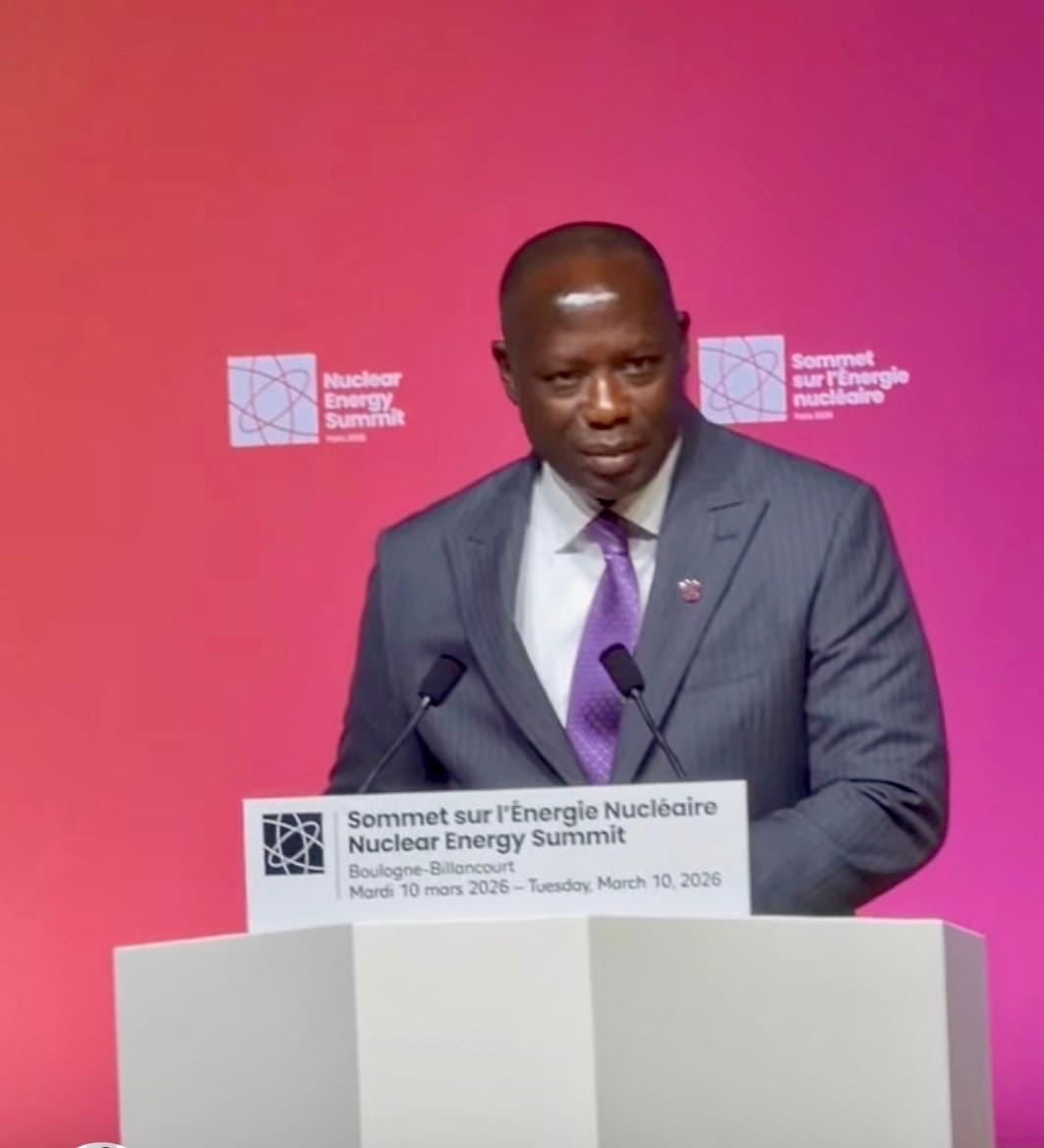
Speaking on behalf of President John Dramani Mahama at the Second Nuclear Energy Summit (NES2026) in Paris — a high-level gathering co-hosted by France and the International Atomic Energy Agency (IAEA) — Mr. Buah emphasised the importance of international support mechanisms to enable developing countries to participate meaningfully in the global nuclear ecosystem.
The summit convened heads of state, ministers, international financial institutions, industry leaders and nuclear technology experts to deliberate on the role of civil nuclear power in addressing global energy security, climate change mitigation and sustainable development objectives. The meeting also focused on strengthening international cooperation, financing frameworks for nuclear infrastructure, innovation in next-generation reactor technologies, and capacity development for countries seeking to introduce nuclear power into their energy mix.
Against a backdrop of rising electricity demand and accelerating decarbonisation commitments, nuclear energy is increasingly being recognised as a reliable source of low-carbon baseload power. Ghana is positioning itself among emerging economies exploring nuclear energy as a strategic pillar for long-term industrialisation and energy security.
Mr. Buah noted that while nuclear energy presents substantial opportunities for energy diversification and industrial growth, the pathway for countries seeking to establish nuclear programmes remains technically and financially demanding.
“While nuclear energy offers enormous opportunities, we must acknowledge the challenges new entrants face — including the high capital cost of nuclear infrastructure, the need for highly skilled human resources and the complexity of regulatory and safety frameworks,” he said.
Ghana’s interest in nuclear technology dates back to the early years of independence when Dr. Kwame Nkrumah envisioned the peaceful application of atomic energy as a catalyst for national development and scientific advancement. That vision culminated in the establishment of the Ghana Atomic Energy Commission (GAEC), which has since served as the institutional backbone for nuclear science, radiation technology and research activities in the country.
In recent decades, Ghana has advanced a structured nuclear power programme guided by the International Atomic Energy Agency’s Milestones Approach, a framework that outlines the institutional, legal, regulatory and technical infrastructure required before a country can deploy nuclear power plants.
According to the Minister, Ghana has successfully completed Phase One of its nuclear infrastructure development programme, which involves national decision-making, preliminary feasibility assessments and the establishment of foundational regulatory structures. Completion of this phase positions the country to transition toward the implementation stage, including site selection, technology evaluation, workforce training and financing arrangements for future nuclear power facilities.
The Minister indicated that Ghana intends to develop a highly specialised nuclear workforce capable of supporting reactor operations, regulatory oversight, nuclear safety management and fuel-cycle technologies. Such capacity development, he said, could position Ghana as a regional centre for nuclear science and technology within the West African sub-region, supporting research collaboration, industrial innovation and technology transfer.
Despite its long-term economic benefits, nuclear power development remains capital intensive, requiring multi-billion-dollar investments in reactor construction, grid integration, fuel supply chains and safety systems. Mr. Buah emphasised that developing countries would require coordinated international support to overcome these financial and technical barriers.
He called for strengthened cooperation in areas including technology transfer, regulatory capacity building, workforce development and sustainable financing frameworks.
“Supporting nuclear newcomers through technology partnerships and regulatory assistance will accelerate the global clean energy transition while unlocking opportunities for economic development, job creation and technological advancement,” he stated.
He further stressed the importance of innovative financing mechanisms — including public-private partnerships, build-own-operate models and multilateral financial facilities — to mobilise capital for nuclear projects while ensuring long-term sustainability.
By Eric Yaw Adjei