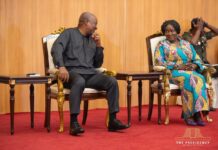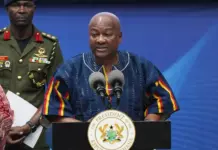


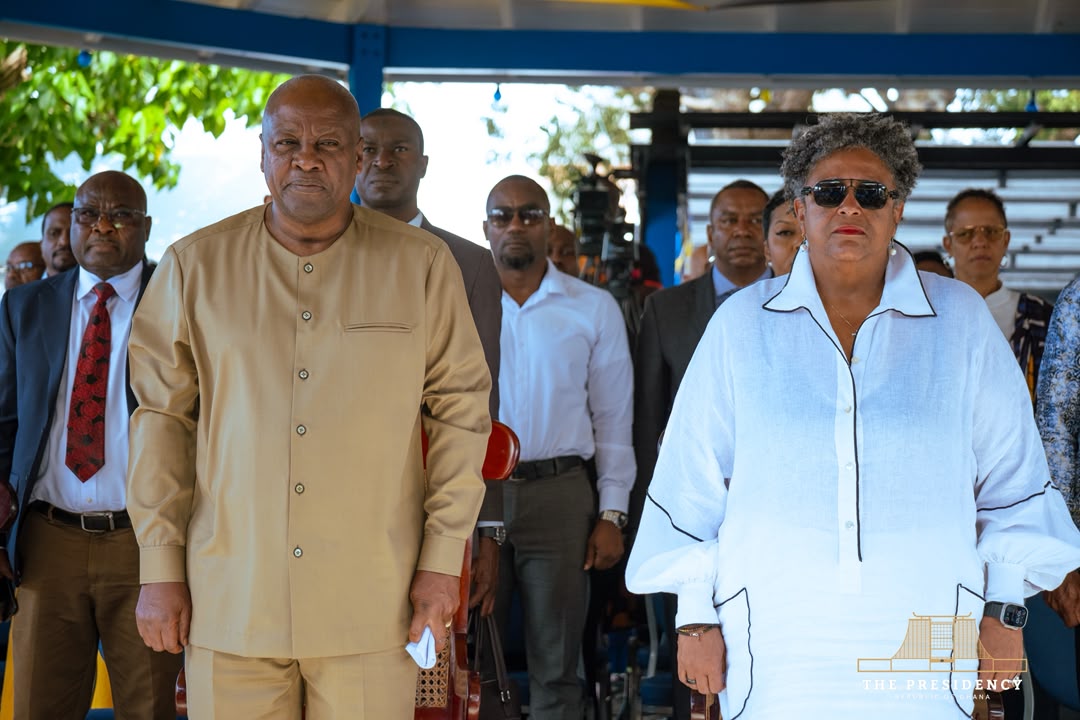

President John Dramani Mahama has called on Ghana and Barbados to embrace Sankofa and face the future together with shared ownership of their ancestry and heritage, as the two nations deepen ties across the Atlantic.
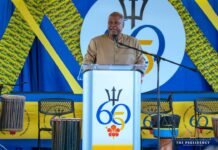
Addressing a Joint Sitting of the Parliament of Barbados on Friday, November 27, 2026, during his State Visit, Mahama said the Atlantic, once a barrier of separation, must now become a bridge to shared prosperity, restored identity, hope, and the renaissance of the global African dream.
“Let us face the future with shared ownership of our ancestry and heritage,” he said.
President Mahama, who became the second Ghanaian President to address the Barbadian Parliament, said Barbados will always remain an integral part of Africa’s family and a valued partner in the shared pursuit of prosperity, dignity, and progress.
He congratulated Barbados on its twin milestones — 60 years of independence and five years as a republic — and commended its effective governance, transformation from a mono-crop sugar economy to a diversified, knowledge-based, service-driven society, and its standing as a beacon of constitutional stability and the rule of law.
Drawing on Ghana’s Akan philosophy of Sankofa, symbolised by a mythical bird facing forward with its head turned backwards holding a precious egg in its beak, Mahama said: “Se wo were fi na wosankofa a yenkyi”, meaning it is not taboo to go back and fetch what you left behind.
“As you commemorate the twin milestones of Sixty and Five, let us embrace Sankofa together,” he said.
He said stripped names and identities will be restored, and uprooted roots and connections will be replanted.
“The African soul is resilient and endures. It lives in the cadence of the Barbadian dialect, echoing the rhythms of Twi, Ga, and Ewe,” Mahama said.
“It is present in your culinary heritage, where our kenkey and banku find kinship with your cou-cou, and our roasted plantain and yam nourish both our tables.”
He pointed to the susu savings system, the tuk band, reverence for elders, and the unquenchable thirst for freedom as further evidence of the shared heritage between Ghanaians and Barbadians.
Mahama paid tribute to ancestors whose bones rest beneath the sugarcane fields of Barbados and on the floor of the Atlantic Ocean, saying their endurance forms the foundation upon which the Parliament stands.
He said the spirit of courage, resistance, and determination that inspired King Cuffie, Bussa, and their compatriots must continue to guide both nations, and described the unveiling of King Cuffie’s statue and the solemnisation of the Newton burial grounds as a lasting tribute to victims of transatlantic enslavement.
Quoting Peter Tosh’s 1977 song “African” — “Don’t care where you come from. As long as you’re a black man, you’re an African” — Mahama said: “We are all Africans, and true brotherhood requires the moral courage to continue seeking justice for our ancestors.”
On reparatory justice, Mahama said he could not ignore the unfinished business in a Parliament representing a nation whose people built the wealth of others.
He noted that when slavery was abolished, the enslaved were not compensated, while enslavers received vast sums from imperial treasuries, with taxpayers repaying those debts into the twenty-first century.
He cited the adoption of United Nations General Assembly resolution A/RES/80/250, which he led, declaring the trafficking and chattel enslavement of Africans as the gravest crime against humanity, as an important milestone but only the beginning of a long journey.
“Let there be no misunderstanding: our pursuit is not about retribution nor revisiting old grievances, but about upholding human dignity, affirming historical truth, ensuring accountability, advancing reconciliation and healing, and asserting the rightful place of the African race in the world,” he said.
Mahama also called for solidarity within the African family, referencing the tragic death of Javitz Frimpong in the United States.
“We cannot demand dignity from the world while denying it to one another,” he said. “Every African life matters, and every individual deserves dignity and respect.”
Turning to practical cooperation, Mahama said Ghana-Barbados relations have entered a transformative era, moving from words to concrete action.
He disclosed that since 2022, over 380 Ghanaian nurses have served in Bridgetown at the Queen Elizabeth Hospital and clinics, and that historic charter flights had reduced travel between Accra and Bridgetown from 23 hours to just seven.
Ghana, he said, is finalising bilateral air services agreements with Caribbean partners and reviving its national air carrier to establish permanent direct air links and port-to-port maritime corridors across the Atlantic.
He added that Ghana has welcomed hundreds of members of the African family, including Barbadians, as full citizens, and his administration is streamlining legislation and visa-waiver frameworks so Barbadians and Caribbean citizens can travel, invest, settle, and claim ancestral citizenship in Ghana without unnecessary bureaucratic hurdles.
Mahama pledged that as Ghana prepares to assume the Chairmanship of the African Union in 2027, making the Sixth Region — the African Diaspora — operational and integrating Africa and the Caribbean as a cohesive economic and diplomatic bloc will be a central priority.
He proposed linking the African Continental Free Trade Area (AfCFTA) and CARICOM as one economic space, advancing Green and Blue Economies, empowering youth through creative and digital economies, and deepening academic and youth exchanges, including semester exchanges between the University of the West Indies at Cave Hill, University of Ghana, KNUST, and University of Cape Coast.
He affirmed Ghana’s support for the Bridgetown Initiative championed by Prime Minister Mia Amor Mottley, and said it complements his Accra Reset Initiative’s focus on sovereignty, equitable partnerships, and institutional reform.
On Ghana’s economy, Mahama said the country has emerged from severe debt distress to macroeconomic stability and is transitioning to resilience and structural prosperity through a four-year programme called the New Economy, with US$10 billion of its own resources to be deployed from next year toward eight strategic pillars.
He commended Mottley for expressing the hopes and frustrations of the Global South with clarity and courage, demonstrating that small nations can hold significant moral authority.
Closing with the words of Barbados’ National Anthem — “We write our names on history’s page with expectations great, Strict guardians of our heritage, Firm craftsmen of our fate” — Mahama said: “May Barbados continue to distinguish itself in history. May the Republic of Ghana and Barbados move forward together in lasting brotherhood.”