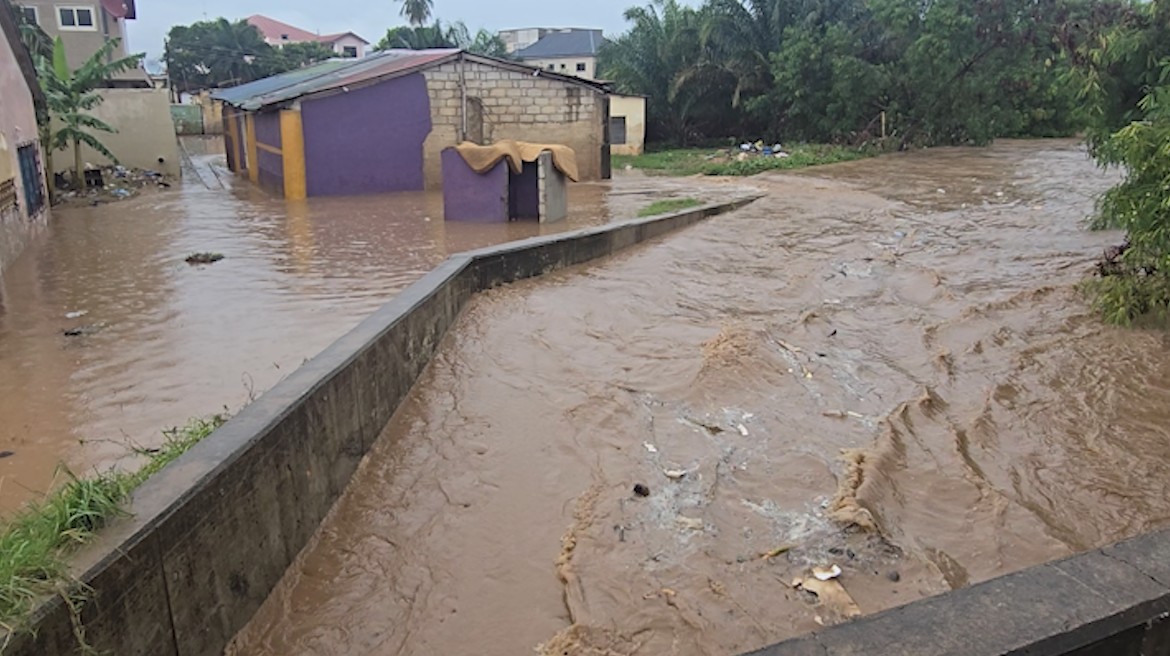

The Mindset Transformation Initiative (MTI) expresses its deep concern over the devastating effects of the heavy rains that swept across parts of Ghana last night, resulting in flooding, destruction of property, disruption of economic activities, and avoidable hardship for many citizens.
As a nation, we have become accustomed to a disturbing cycle.
The rains come, communities flood, public outrage follows, authorities make commitments, and once the waters recede, the urgency disappears until the next disaster strikes.
Today, we ask a simple but important question: Na Who Cause Am?
This question is not intended to assign blame to any single institution or group. Rather, it is a call for honest national introspection.
For many years, flooding has remained one of Ghana’s most predictable disasters. Yet, despite the knowledge, expertise, and experience available to us, we continue to repeat the same mistakes.
The reality is that flooding is not solely a government problem. It is not solely an environmental problem. It is not solely an engineering problem.
It is a collective responsibility challenge.
We cannot continue to build illegally in waterways and flood-prone areas and expect different outcomes.
We cannot continue to approve developments without strict adherence to planning regulations and expect different outcomes.
We cannot continue to dump refuse into drains, streams, and lagoons and expect different outcomes.
We cannot continue to encroach on wetlands, obstruct natural watercourses, ignore environmental impact considerations, and neglect drainage maintenance while expecting our communities to remain safe during heavy rains.
We cannot continue to politicize enforcement actions when lives and livelihoods are at stake.
The flooding challenge confronting Ghana demands a holistic, multi-sectoral response involving government, Metropolitan, Municipal and District Assemblies, traditional authorities, environmental agencies, developers, businesses, civil society organizations, faith-based institutions, the media, and citizens.
The Mindset Transformation Initiative believes that while infrastructure investment remains important, sustainable change will only occur when there is a corresponding transformation in attitudes, behaviours, and civic responsibility.
The nation does not suffer from a lack of laws. The nation suffers from inconsistent enforcement and a growing culture of indifference towards the consequences of our actions.
We must cultivate a national mindset that prioritizes compliance over convenience, collective responsibility over individual gain, and long-term sustainability over short-term interests.
As citizens, we must appreciate that environmental discipline is not the responsibility of government alone.
Every piece of refuse thrown into a gutter, every illegal structure erected in a waterway, every unauthorized development approved contrary to regulations contributes to the problem.
The time has come for a national commitment to responsible citizenship.
If the rains stop tomorrow and we return to business as usual, then we should not be surprised when the next downpour produces the same tragic consequences.
The question before us is not whether flooding will occur again.
The real question is whether we are prepared to change the behaviours and practices that make these disasters inevitable.
The Mindset Transformation Initiative therefore calls for:
- Strict enforcement of planning and building regulations across the country.
- Immediate protection and restoration of wetlands, waterways, and drainage reservations.
- Stronger accountability mechanisms for all institutions involved in development approvals.
- Enhanced public education on environmental responsibility and civic duty.
- A coordinated national strategy involving all stakeholders to address flooding from both infrastructure and behavioural perspectives.
- Sustained public engagement beyond periods of disaster and crisis.
Ghana deserves better.
The lives, homes, businesses, and futures of our people are too important to be subjected to the same preventable disasters year after year.
As we sympathize with all affected families and communities, we urge every Ghanaian to reflect honestly on their role in building a safer, cleaner, and more resilient nation.
Once again, we ask:
Na Who Cause Am?
The answer may be uncomfortable, but it is the first step toward lasting solutions.