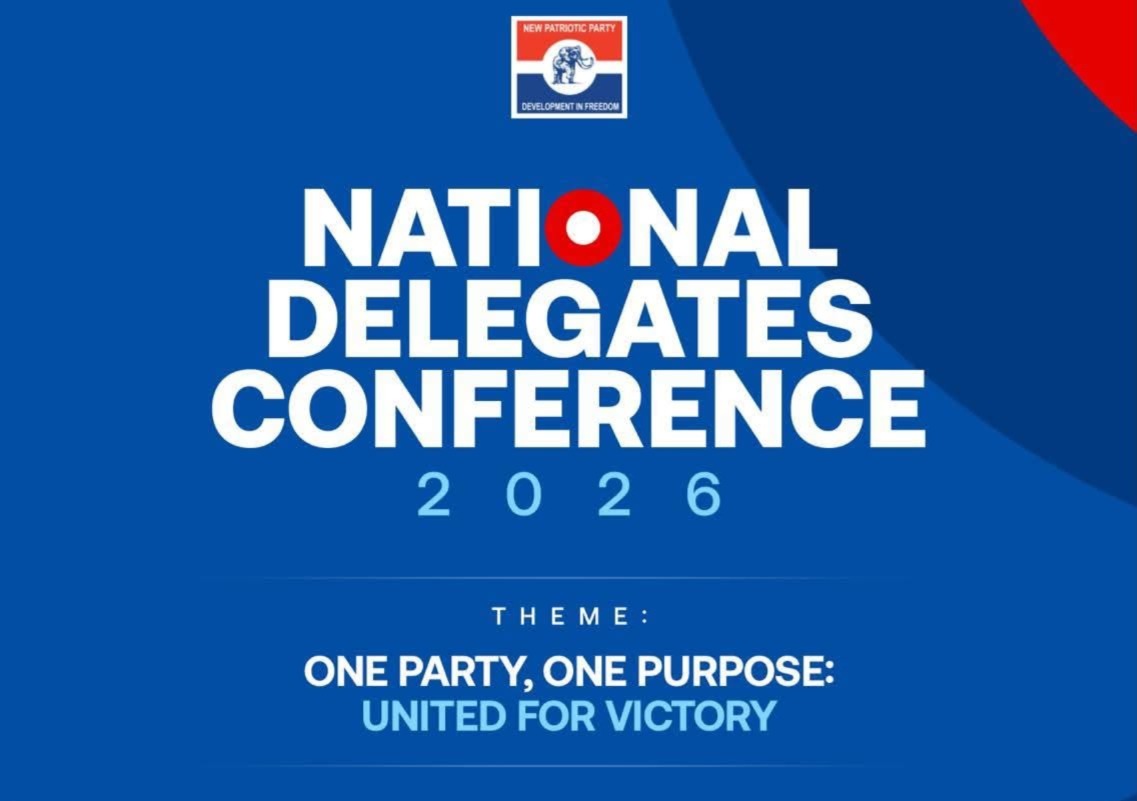

When more than 7,000 New Patriotic Party delegates gather at the Baba Yara Sports Stadium in Kumasi on October 3, 2026, they will be choosing officers for nine national positions.
But the significance of the election goes beyond the names on the ballot.
The contest comes at the end of a political rebuilding process that began after the NPP lost the December 2024 general election. Since that defeat, the party has reviewed what went wrong, changed parts of its constitution, elected a presidential candidate for 2028, reorganised its structures across the country and replaced the leadership of its most important electoral region.
That makes the Kumasi conference one of the most consequential internal events for the party since it returned to opposition.
The party says 7,163 delegates are expected to participate. Ashanti has the largest regional delegation with 1,122 delegates, followed by Greater Accra with 773 and Eastern Region with 732. Savannah has 184 delegates, while Western North has 223.
Forty five aspirants are contesting nine national positions and voting will take place across 31 polling stations.
The 7,163 delegates, however, do not all vote in every contest. The Youth Organiser race has an electorate of 2,745 delegates, the Women’s Organiser contest has 1,275, while 858 delegates are eligible to vote in the NASARA Organiser election.
The national officers election is therefore made up of different electoral colleges operating within one conference.
To understand why this election matters, the story has to return to December 2024.
The NPP lost power after eight years in government, but one of the clearest warning signs came from Ashanti Region, the party’s traditional electoral stronghold.
In the 2020 presidential election, the NPP secured 1,795,824 votes in Ashanti. By 2024, that had fallen to 1,366,800, representing a reduction of roughly 429,000 votes.
Over the same period, the NDC increased its Ashanti presidential vote from 653,149 to 697,076.
The NPP still won the region comfortably, but its share fell to about 64 percent while the NDC reached nearly 33 percent, its strongest percentage performance in Ashanti since the Rawlings era.
Turnout also fell sharply. About 82.9 percent of registered voters participated in Ashanti in 2020. In 2024, turnout was about 64.8 percent.
Those numbers exposed a major challenge for the NPP. The party’s electoral strength has traditionally depended not merely on winning Ashanti, but on producing very large margins and high turnout in the region. In 2024, that electoral cushion reduced significantly.
The party responded to the national defeat by establishing an 11 member Election Review Committee chaired by former Speaker of Parliament Rev. Prof. Mike Oquaye. The committee was asked to examine the causes of the defeat and consult party stakeholders.
Its report was submitted to the National Executive Committee in April 2025. The party subsequently established another committee to examine recommendations that required changes to the NPP constitution.
That review process eventually fed into the July 19, 2025 National Delegates Conference, where delegates considered more than 50 proposed constitutional changes and approved 54 reforms.
The amendments touched internal elections, grassroots participation, governance, executive structures, campaign organisation and the relationship between the party leadership and its presidential candidate.
Delegates did not accept everything. Among the proposals rejected was an attempt to change how polling station and electoral area elections were supervised, as well as a proposal connected to the definition of the youth age category.
The reforms therefore represented extensive institutional change, but also demonstrated that delegates were prepared to reject proposals they considered unsuitable.
The party then moved to settle another major question: who would lead it into the 2028 presidential election.
On January 31, 2026, former Vice President Dr Mahamudu Bawumia won the NPP presidential primary with 110,643 votes, representing 56.48 percent of valid votes. A total of 195,901 valid votes were cast.
His victory meant that, unusually, the NPP entered the national officers election with its presidential candidate already known.
The officers elected in Kumasi will therefore not spend the next few years waiting to know who the party’s presidential candidate will be. They will operate alongside a flagbearer who already has a direct mandate from nearly 200,000 party voters.
That makes the debate over who formally leads the NPP particularly important.
At the July 2025 reform conference, delegates approved a provision recognising the National Chairman as leader of the party. They also approved an arrangement in which the National Executive Committee and the presidential candidate would work together to develop the campaign structure, while the National Chairman would chair a Campaign Advisory Committee.
The party is revisiting that arrangement in Kumasi.
Among the constitutional proposals before delegates is a change that would make the flagbearer, rather than the National Chairman, the leader of the party.
That means the conference could determine not only who becomes National Chairman, but also the amount of formal political authority attached to that office.
If delegates retain the current arrangement, the newly elected chairman would have a separate constitutional leadership mandate while Dr Bawumia holds the presidential mandate.
If delegates transfer formal leadership to the flagbearer, the political centre of authority would move more clearly towards Bawumia, leaving the chairman with a more organisational role.
The chairmanship election is therefore taking place at the same time the party is debating the powers of the office itself.
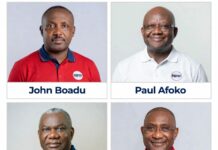
Four candidates are contesting the chairmanship and each brings a different history within the NPP.
John Boadu is attempting a return to the highest levels of national party leadership after losing the General Secretary position in 2022. In that election, Justin Kodua Frimpong defeated him by 2,857 votes to 2,524.
Boadu therefore enters the 2026 contest with extensive knowledge of the NPP’s national secretariat and organisational machinery, but also with the experience of having previously lost an internal election as an incumbent.
Paul Afoko’s candidacy brings back another important chapter in NPP history. He was elected National Chairman in 2014 but was suspended in October 2015 after the National Executive Committee endorsed a disciplinary recommendation against him.
Afoko challenged the process, while the party argued that the suspension had followed its internal constitutional procedures. An Accra High Court later rejected his challenge.
More than a decade later, Afoko is again asking NPP delegates to return him to the same office.
Sammy Crabbe was also involved in the internal crisis of that period. As Second Vice Chairman, he was suspended after challenging aspects of the process surrounding Afoko’s removal. He has since argued that his position at the time was based on defending the party’s constitution.
The presence of Afoko and Crabbe on the 2026 ballot means delegates are, in part, revisiting figures connected to one of the most difficult internal periods in the NPP’s recent history.
Boakye Agyarko enters the contest from a different background. The former Energy Minister is a long standing party figure but has not previously occupied the National Chairman or General Secretary position.
Delegates are therefore choosing among candidates who represent different forms of experience within the party: former secretariat leadership, former chairmanship, former vice chairmanship and former government executive experience.
The polling data provide one indication of how delegates were thinking in the final days before voting.
The final Global InfoAnalytics poll, conducted between September 24 and September 28, sampled 3,263 delegates across all 16 regions.
It placed John Boadu on 48 percent, Boakye Agyarko on 38 percent, Paul Afoko on 12 percent and Sammy Crabbe on 2 percent.
The movement within the polling series is also significant. Earlier in September, a large proportion of delegates remained undecided or unwilling to disclose their preference. As the campaign progressed, that undecided vote reduced significantly.
Another survey conducted by Professor Smart Sarpong and Feedback Africa also placed John Boadu ahead, although it produced a different margin between the candidates.
The two surveys therefore point in a similar direction on the order of support but differ substantially on the size of the gap. They are best treated as measurements of delegate sentiment rather than substitutes for the actual ballot.
The General Secretary contest presents another historical test.
Justin Kodua Frimpong entered the national secretariat in 2022 after defeating the incumbent John Boadu. Four years later, Kodua is now the incumbent defending that same office.
Global InfoAnalytics’ final poll placed him well ahead of his challengers, with Sylvester Tetteh, Eugene Antwi and Charles Dwamena trailing.
Yet the 2022 result itself offers a warning against treating incumbency or polling as a guarantee. John Boadu entered that election as the sitting General Secretary and still lost.
The final judgement therefore rests with delegates.
The decision to hold the conference in Kumasi adds another layer of historical significance.
The NPP previously held a national officers election at the Baba Yara Sports Stadium in 2010 after losing the 2008 general election and moving into opposition. Jake Obetsebi Lamptey won the National Chairman contest, while Kwadwo Owusu Afriyie became General Secretary.
Sixteen years later, the party has again returned to Kumasi for a national officers election after losing power and returning to opposition.
There is no constitutional rule requiring the NPP to go to Ashanti after electoral defeat, but the pattern is striking. In both 2010 and 2026, the party has taken its national officers election to its strongest region while attempting to rebuild from opposition.
The Ashanti NPP hosting the 2026 conference, however, is operating under very different circumstances.
For years, Bernard Antwi Boasiako, popularly known as Chairman Wontumi, was one of the most dominant political personalities within the regional party structure.
That changed dramatically in July 2026 when an Accra High Court convicted him in an illegal mining related case and sentenced him to 20 years in prison. The NPP announced that it would appeal the judgement.
His departure from active regional leadership created a major political transition inside the party’s strongest region.
Less than a month later, Odeneho Kwaku Appiah, popularly known as COKA, was elected Ashanti Regional Chairman.
COKA secured 658 of 928 valid votes, while Henry Kwabena Kokofu received 269. Delegates from 45 constituencies participated in that election.
The national conference therefore becomes the first major national NPP event hosted in Ashanti under the post Wontumi leadership.
For COKA, the significance goes beyond logistics.
The conference provides an early test of whether the regional structure can maintain cohesion following an abrupt leadership transition and whether the new chairman can rally an organisation long associated with the personality and political network of Wontumi.
A peaceful and orderly conference would not by itself prove that all internal differences have disappeared. It would, however, give the new regional leadership an opportunity to demonstrate organisational control at a time when the party is attempting to rebuild nationally.
This is where the idea of “Kumasi unity” takes on wider meaning. If the party can manage intense national contests in its strongest region without prolonged internal conflict, it strengthens the image of an organisation trying to move beyond the divisions that followed its 2024 defeat.
Ashanti’s delegate strength also matters, although the region cannot determine the national outcome alone.
Its 1,122 delegates represent about 15.7 percent of the full conference electorate. Greater Accra and Eastern together account for another 1,505 delegates.
A candidate may perform strongly in Ashanti and still require substantial support elsewhere to win a national position.
The chairmanship contest is therefore not simply an Ashanti election taking place in Kumasi. It is a national coalition building exercise being held on Ashanti soil.
The possible outcomes of Saturday’s election matter because they could shape the character of the NPP leadership going into 2028.
If incumbents and figures closely connected to the existing party machinery retain the major positions, the result would suggest continuity. The officials who supervised much of the period following the 2024 defeat would remain central to implementing reforms and coordinating the party’s preparations for 2028.
Such an outcome could provide institutional stability and preserve organisational knowledge. It could also raise questions among members who believe the scale of the 2024 defeat requires a more visible change in leadership.
If delegates instead remove several established officeholders and elect challengers, the result would represent a stronger organisational reset.
New executives would take control of important areas such as mobilisation, communications, administration and fundraising. They would, however, have to establish working relationships quickly with a flagbearer who has already been elected and with regional executives who are themselves relatively new.
In that situation, coordination would become one of the party’s immediate challenges.
The most consequential outcome may still come from the constitutional amendments.
If the National Chairman remains the formal leader of the party, the NPP could operate with two powerful sources of legitimacy: a chairman elected by national delegates and a flagbearer elected through the January presidential primary.
That arrangement would require close cooperation between the two centres.
If the constitution instead makes the flagbearer party leader, authority would be more clearly concentrated around Dr Bawumia, while the National Chairman would focus largely on organisation and party administration.
The Kumasi conference is therefore deciding both personnel and institutional power.
The outcome will also be measured against what happened in Ashanti in 2024.
A bitter post election dispute would raise fresh questions about unity in the region the NPP most needs to remobilise. A relatively smooth conclusion would allow the party to shift its attention from internal elections to rebuilding voter confidence.
But internal unity will not automatically solve the party’s electoral problem.
The NPP still has to understand why its Ashanti presidential vote declined by roughly 429,000 between 2020 and 2024 and why turnout in the region fell from about 82.9 percent to 64.8 percent.
Those are challenges that cannot be solved simply by electing new executives.
The 2026 conference is also different from the last National Delegates Conference in 2022.
That election involved 6,730 delegates, 47 aspirants and 20 polling centres at the Accra Sports Stadium.
At the time, the NPP was in government and preparing for its attempt to “break the eight.”
In 2026, the circumstances are almost the reverse. The party is in opposition. It has already selected a presidential candidate. It has completed an election review. It has changed sections of its constitution, reorganised its structures nationwide and replaced the leadership of its strongest region.
The national officers being elected in Kumasi are therefore not being chosen to defend an incumbent government. They are being chosen to rebuild an opposition party and prepare it for a possible return to power.
That changes the responsibility attached to the positions.
Saturday will produce winners, but the most important questions will emerge after the votes are counted.
The new chairman will have to operate within whatever leadership arrangement delegates approve. The national secretariat will have to work effectively with Dr Bawumia’s political organisation. Losing candidates and their supporters will have to be reintegrated into the party.
In Ashanti, COKA will face the additional task of maintaining regional cohesion after the Wontumi era while trying to rebuild voter enthusiasm in the party’s traditional stronghold.
Ultimately, the success of the NPP’s post 2024 reforms will not be measured by how many constitutional amendments were passed or how smoothly Saturday’s election was conducted.
It will be measured by whether the party can translate those institutional changes into stronger organisation, higher turnout, renewed support in its traditional strongholds and a coherent national campaign by 2028.
The baseline is already clear. The NPP’s presidential vote in Ashanti fell to about 1.37 million in 2024, roughly 429,000 below its 2020 figure. Turnout fell sharply and the NDC increased its share to almost 33 percent.
Kumasi is therefore not simply where the NPP is choosing a National Chairman, General Secretary, Organiser, Treasurer and other national officers.
It is where a party that lost power in 2024 is deciding who will manage its national machinery, how political authority will be shared and whether the reforms of the past two years can be converted into a serious organisational recovery ahead of 2028.
That is what makes this National Officers Election much bigger than the ballot.
By Wisdom Sarfo