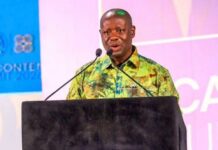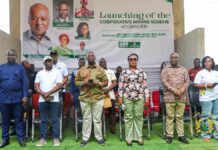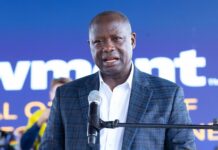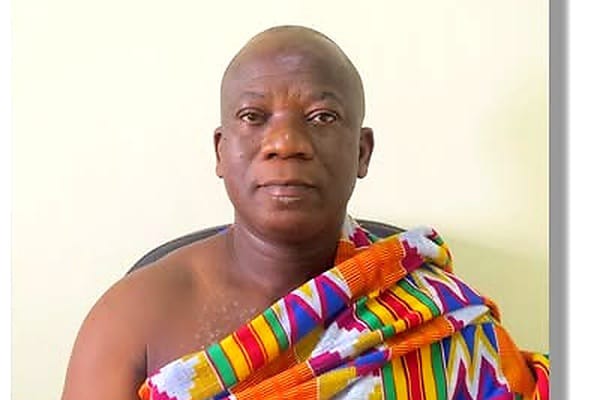

The Omanhene of the Eastern Nzema Traditional Area and President of the Eastern Nzema Traditional Council, Awulae Amihere Kpanyinli III, has accused the Member of Parliament for Ellembelle and Minister for Lands and Natural Resources, Emmanuel Armah-Kofi Buah, of meddling in a chieftaincy dispute in the area.
According to him, the MP has not displayed loyalty towards the legitimate and gazetted Omanhene.
Awulae Amihere Kpanyinli III, amplified the accusation in a statement titled: “When Political Power Crosses the Traditional Line: The Omanhene Says Enough.”
In the statement, the Omanhene decried Mr Buah’s dealings with a claimant to the stool.
“It has increasingly become a question of whether political power is being brought to bear on a traditional institution whose legitimacy ought to be determined by customary law, the Constitution and the appropriate chieftaincy institutions, not by politicians or the influence of state officials,” he said.
Awulae Amihere noted that while government must work with chiefs on development, land, mining and security, there is a serious concern about whether the Minister has crossed the line between legitimate engagement and political interference in a disputed chieftaincy matter.
“The concern is much narrower and much more serious: Has the Minister crossed the line between legitimate governmental engagement and political involvement in a disputed question of traditional legitimacy? The public deserves an answer,” he stated.
Paramountcy Predates Politics
The Omanhene stressed that the Eastern Nzema Traditional Area predates modern partisan politics and is not a creation of Parliament.
“The office of a Paramount Chief is not created by a Member of Parliament, a District Chief Executive, a Regional Minister or a Cabinet Minister. Political constituencies are electoral arrangements. Traditional institutions have their own history and constitutional protection,” he said.
He argued that Buah’s position as MP or as Minister for Lands and Natural Resources does not confer on him the power to determine who is Omanhene.
The Kundum Banner Incident
One incident cited is the appearance of the Minister on a public banner during the 2025 Kundum festival alongside a rival claimant described by the Council as a self-styled Omanhene.
“Ordinarily, a politician appearing on a banner might seem insignificant, but context matters. Where there is an unresolved dispute over legitimacy, the appearance of a senior Cabinet Minister alongside one claimant can reasonably be interpreted as political endorsement,” the Omanhene said.
He disclosed that lawyers acting for him had already written to the Minister and cautioned him, especially when his photograph was featured as Special Guest of Honour for the 2025 Kundum.
“The warning was therefore not absent. The Minister had been placed on notice, yet the conduct continued,” he added.
According to him, Kundum is an important cultural institution among the Nzema people associated with harvest and thanksgiving and should not be turned into a political instrument for conferring legitimacy.
*Introduction to NDC Chairman*
The Council also questioned the alleged introduction of the rival claimant as Omanhene to the National Chairman of the NDC, Johnson Asiedu Nketiah, during a thank-you tour, instead of the gazetted Omanhene.
“Presenting a disputed claimant to a national political figure as though the matter were settled creates a powerful public impression that the State has already chosen a side,” Awulae Amihere said.
He asked whether the National Chairman was informed that the claim was disputed, whether the gazetted Omanhene was consulted, and who authorised the presentation.
“Political interference does not always take the form of a formal letter. Sometimes it happens through photographs, banners, who is invited to an official meeting, or who is excluded,” he said.
Source: PR team of Awulae Amihere Kpanyinli III