
Member of Parliament for Sekondi in the Western Region Lawyer Blay Armah Nyameke has recounted how a teary encounter with a parent buoyed him to increase the threshold of his “Free Exercise Books Scheme” from 5 to 20 books per child.
Visibly downcast, Lawyer Blay Armah Nyameke explained that he met a parent whose two wards had been home for six weeks because of her inability to buy exercise books for them.
“I was shaken to the bone, considering the fact that about fourteen weeks make a term. So, having spent six weeks at home meant they had spent half of the term home because of basic school materials like exercise books. That cannot happen, not with me as the MP for Sekondi.”
The MP’s encounter is a sobering reminder of a silent crisis in the country’s basic education system. Something as simple as an exercise book, a modest commodity in many homes, can determine whether a child goes to school or stays home.
He stated that the psychological effect of the absence of basic learning materials is telling and leads to frustration for both parents and students, adding that teachers and school administrators also suffer.
“When parents are unable to buy, for example, books, they become frustrated and often vent it on their wards. The children, on the other hand, are also not able to have the free mind to learn because of the knowledge that their items for school are not complete. Teaching is also disrupted because some of the kids abstain from school. So many things go wrong.”
Across the country, parents are known to stretch old books into new terms, while children scribble in leftover pages of tattered copies from previous years. The Ghana Education Service confirms this is common, as poverty continues to dictate the rhythm of many classrooms. In such a context, distributing free books is not simply benevolence but a timely interruption of generational barriers to education.
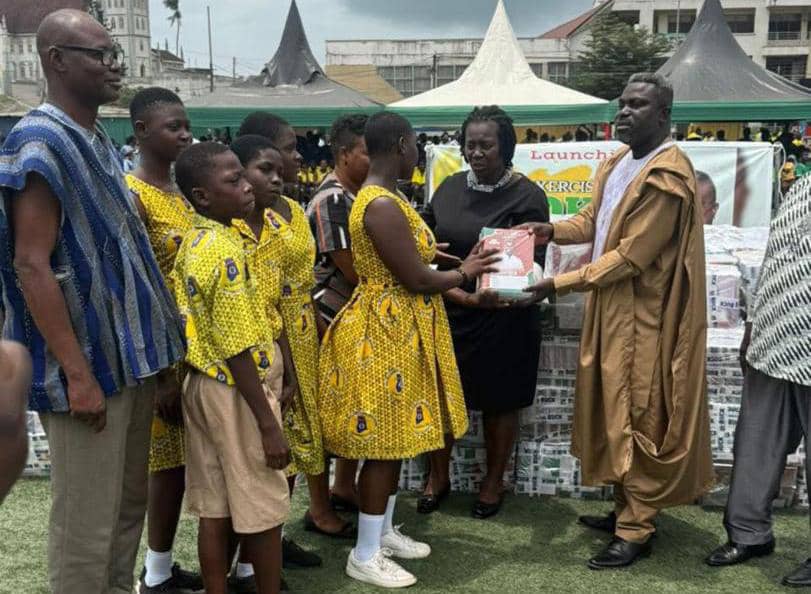
At a ceremony to officially hand over 300,000 exercise books to heads of basic schools in Sekondi for onward distribution to about 15,000 students, Lawyer Armah Nyameke said the benefits of quality education guaranteed with accessibility and affordability are unmatched and “this is what I strive for.”
“Undoubtedly, I am a politician. But I can say in all sincerity that this initiative, though borne out of politics, is a deeper expression of my genuine commitment to ensuring that no child in Sekondi misses school because the parents cannot afford to buy books. There are naysayers, but for many parents this gesture could be one that will save their kids from becoming social misfits.”
His words touch on a deeper political reality. Sekondi has had its share of MPs, each with promises and legacies. Yet few have left a mark as tangible as placing exercise books directly into the hands of children. In the political annals of Sekondi, the “Free Exercise Books Scheme” is already being spoken of as monumental, a gesture that goes beyond rhetoric to influence daily life.
It signals a shift in political imagination: that beyond infrastructure and campaign slogans, small, consistent interventions can change the trajectory of families, classrooms, and futures. For those who will come after him, this gesture sets a benchmark difficult to ignore.
He revealed that the initiative is part of his grand scheme, a set of measures designed to nurture a generation of engineers, medical practitioners, lawyers, and other professionals who, in the next decade, should propel Sekondi to greater heights.
The relief among parents is immediate. No longer must a mother or father choose between food for the household and books for their children. Teachers in Sekondi say the impact is equally transformative. With books now guaranteed, lessons can flow uninterrupted. Christina Andoh-Ackon, Western Regional Head of Supervision for the Ghana Education Service, corroborated:
“Several instances abound where kids will have to use old books for two weeks and over before they get new ones. Therefore, for the MP to provide all the exercise books each student will need is a big relief. I will encourage him to encourage his colleagues in hard-to-reach communities to emulate him because we need help in those areas.”
From one parent, guardian, and teacher to another, the message is clear: this is not mere charity; it is empowerment. For many, it is the bridge keeping children in school and dreams alive.
In Sekondi today, exercise books are not just paper and ink. They are tickets back to the classroom, to confidence, and perhaps, to futures rewritten.
By Eric Yaw Adjei