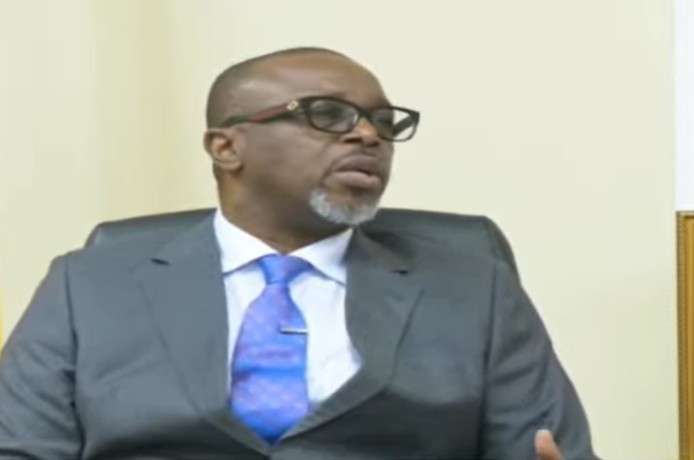

The Chief Executive Officer of Financial Intelligence Centre (FIC), Kwadwo Twum-Boafo has said a number of the transactions involved in the National Service Ghost names scandal should have been flagged by the banks.
The National Service Ghost names scandal primarily concerns the National Service Authority (NSA) where investigations uncovered a scheme that added more than 81,800 ghost names to the payroll between 2018 and 2024.
The estimated financial loss to the state ranges from GH¢548 million in confirmed cases to potentially GH¢2.2 billion following a comprehensive forensic audit.
Persons being prosecuted in the case include; former Deputy Executive Director, Gifty Oware-Mensah who is accused of using 9,934 ghost identities to secure a GH¢31 million loan for her private company, with the state charged interest on the non-existent services.
Also, Former Executive Director Osei Assibey Antwi is accused of authorizing payments for over 60,000 ghost names and having GH¢8.256 million deposited into an e-zwich account registered in his own name.
Speaking in an interview on TV3’s Hot Issues, Sunday, November 9, 2025, Mr. Boafo asserted that the alleged corrupt acts could not have happened if President Mahama was ruling the country at time.
He cited a similar case at the NSA under President Mahama’s first tenure where a huge sum of money was blocked from being transferred into a personal account after suspicion of money laundering.
“It should be (flagged). And I dare say that maybe if the NDC government was in power, it wouldn’t have happened. Because if you recall, during President Mahama’s first time in office, something like that was flagged at the National Service but it was nowhere near the scale of what has happened there,” he stated.
He explained that for a bank to block any transaction on suspicion of money laundering, the regularity with which the transaction is done and the quantum involved are the two factors to be considered.
He elaborated further by giving a scenario for which a bank can prevent a transaction based on suspicion of money laundering.
“An example; Keminni has a bank account with bank of TV3 and everyday she gets inflows of GHC10 million and as soon as the money hits her account, all the GHC10 million or GHC9.5 million is dissipated within a day. And she does this repeatedly that in the space of about let’s say six or seven months, Kemini has inflows of about GHC600m and she has dissipated all the funds.
“That’s very suspicious and in fact, it tells a story. Because you are money laundering, that is what it is,” he added.