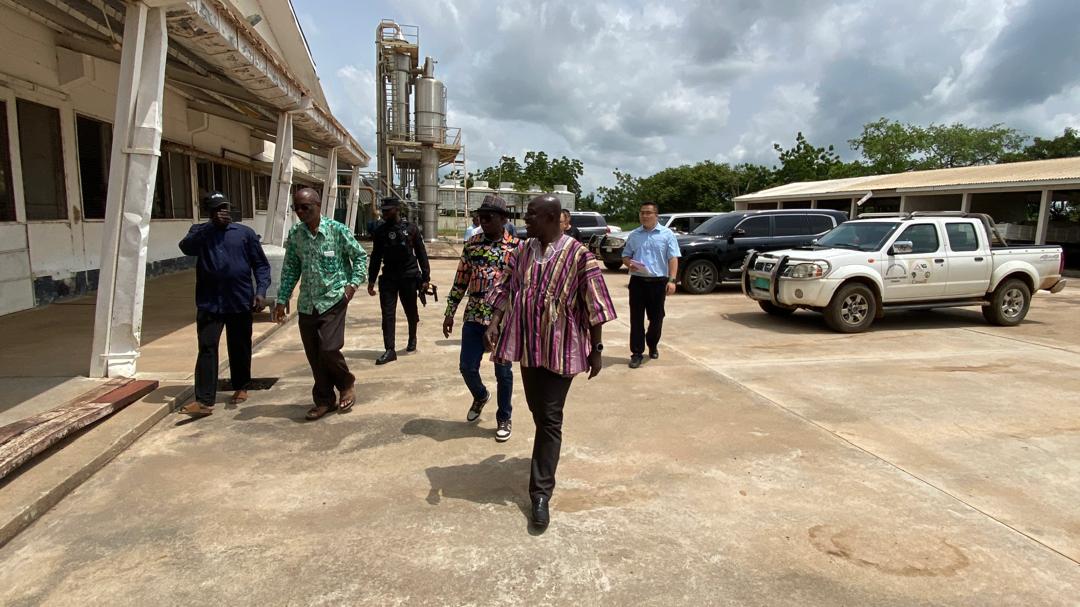

The Upper East Regional Minister, Donatus Akamugri Atanga, has led a delegation from Chinese investment firm Hanway International Investment Ltd. to the abandoned Pwalugu Tomato Factory as part of efforts to attract investment for the revival of the facility.
The visit, led by Hanway’s Chief Executive Officer, Cui Yongzhi, is aimed at assessing the factory’s potential and exploring the possibility of partnering with government to restore its operations after years of inactivity.
The Northern Star Tomato Factory, which last operated in 2012, has remained dormant, leaving parts of the facility exposed to theft and deterioration.
The factory has a capacity to process 500 metric tons of tomato into paste with a direct workforce of closer to 600 and indirect job of about 2500 including the farmers who serves as the immediate suppliers.
A visit to the factory revealed how deplorable the factory is with overgrown weeds and shrubs taken over the entire facility giving way for thieves to steal properties in the factory.
Some of the roofs of the factory have been ripped off, wood supporting the roofs and pillars rotten.
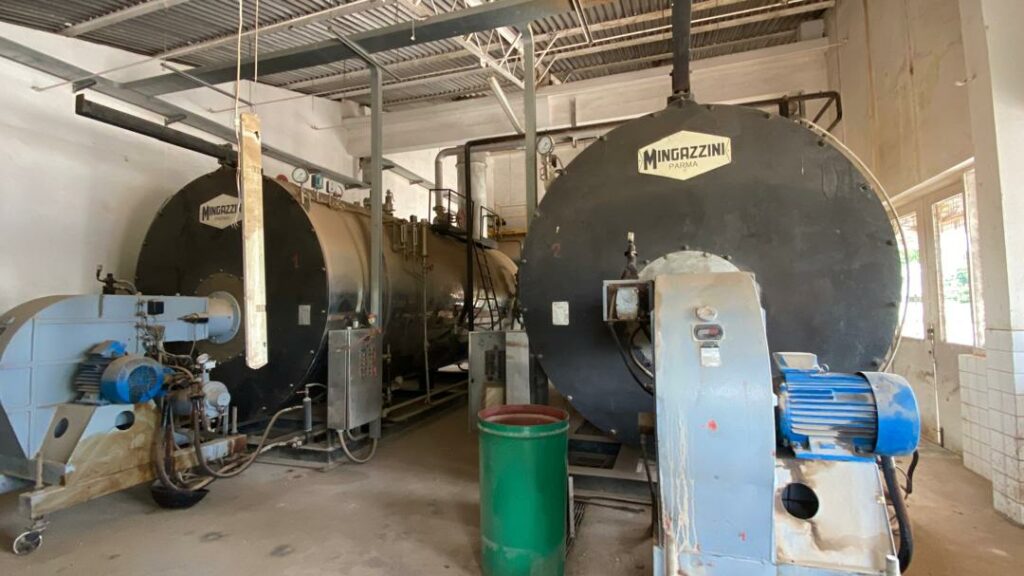
Interestingly, the machines and equipment for processing tomato are in good condition and can restart with little repairs and testing due to its factory-made durability.
Donatus Akamugri Atanga disclosed that many potential investors have developed interest in revamping the defunct factories in the region with the installation of a solar plant to support industrialization.
The minister led a delegation from the company, headed by its Chief Executive Officer, Cui Yongzhi, on a tour of the factory and nearby agricultural lands along the White Volta to see what the factory can offer.
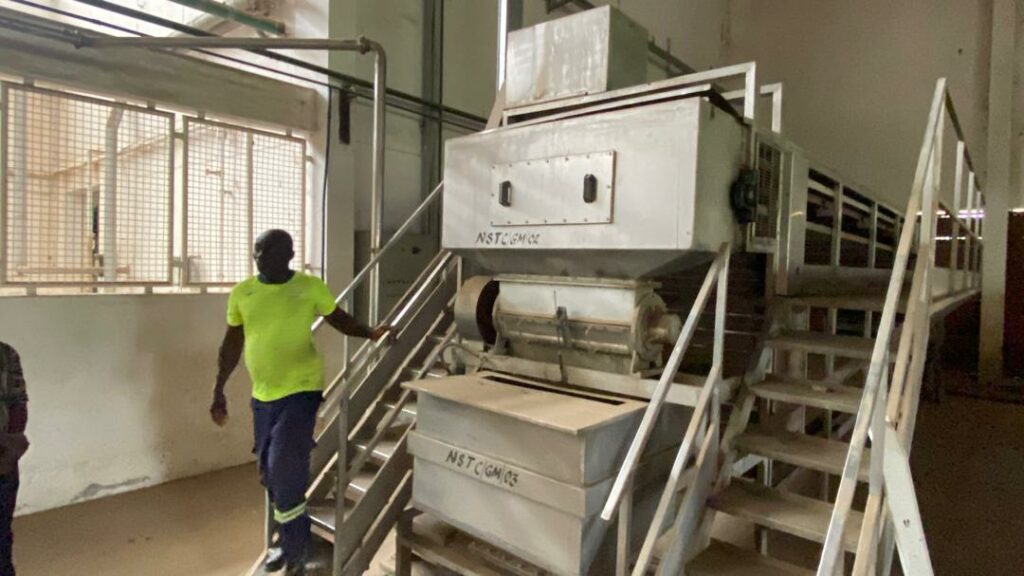
The discussions centred largely on what would be required to restore the factory’s production chain, including the establishment of a canning facility at Pwalugu.
Explaining the existing production arrangement to the investors, Donatus Akamugri said when the factory was previously operating, tomato paste was placed in drums and transported to Tema in the Greater Accra Region for canning.
He said the government would like the canning stage to be carried out at Pwalugu if the factory is revived.
The Minister said bringing canning to Pwalugu would remove the need to transport the processed tomato product to Tema before it could be packaged for the market.
“So, we want to now establish the canning here. So that when we come here, you can it. And we need to supply to the market and export,” he said.
Beyond tomatoes
Akamugri said any revival of the factory should also consider expanding the range of agricultural products that could be processed there.
“Not necessarily tomato paste alone. You can do onions. You can do pepper. You can do garden eggs. You can do beans. You can do dawa-dawa jam, so that it will be all year round,” he told the investors.
He said the government was also interested in improving productivity at the farm level, both in terms of output and quality.
“The government wants to improve on the first step. That is improving the quantities, and the quality of production. So that one acre can produce more,” he said.
The proposal would link any rehabilitation of the factory to increased agricultural production in the surrounding area.
Akamugri subsequently took the Hanway delegation to the White Volta, showing them agricultural lands on both sides of the river that could potentially be used for tomato production.
The availability of sufficient raw materials is important to any possible restart of the factory, given that a processing plant would require a consistent supply of tomatoes and other crops.
Shelf life and regional markets
The Minister also pointed to the problem of storing tomato paste in drums for extended periods.
“When the farmers produce, they’ll get market. Because when you can them from here, they won’t get spoiled,” he said.
He explained that the existing practice of putting paste into drums and adding salt to prevent fungal growth could still result in spoilage if the product remains in storage for too long.
“But if you get to this point and you can them, they can last. They can last, and you can supply, you can export,” he said.
The Minister also highlighted Pwalugu’s proximity to neighbouring countries.
“You know here, we are near Burkina Faso. We are near Togo. We are near Mali. So you can even export them to those parts,” he said.
He said a revived factory could therefore potentially serve markets beyond Ghana, particularly in the northern sub-region.
He also proposed government-backed institutional demand as part of the potential market for the factory’s output.
He said the government could direct schools and hospitals where food is provided under government programmes to source processed tomato products from the factory.
“The government will take a position to let you supply all the schools, all hospitals, where government is feeding. And this is going to be import substitution factory,” he said.
The Minister said Ghana’s dependence on imported tomato products presented an opportunity for local processors.
Under the government’s proposed import-substitution approach, he said, imported competing products could face higher taxes while investors in local production could receive incentives.
Akamugri also raised the possibility of tax relief on equipment required for the proposed rehabilitation.
“So, when you want to import your equipment, the equipment that you are going to bring here, and then produce this one, they will give you tax waiver,” he told the investors.
He added that he would engage the government on the issue once the company identified the machinery and equipment it would require.
“So, the machines, all that you are going to bring here, let us know. We are bringing them to reform the public tomato factory in Upper East,” he said.
“I will tell the government to waive the taxes on them so that you can have an easy way,” he added.
By Tanko Mohammed Rabiu