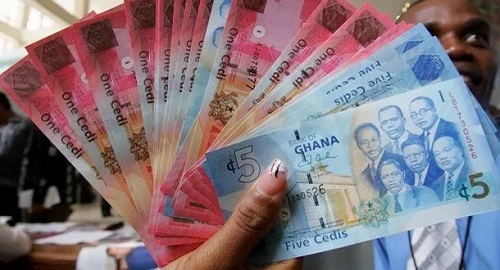

Gershon Kudjo Agbledzorwu , Head, Financial Markets Department, Bank of Ghana, has said that the central bank expects the stability of the Cedi to continue.
He said this after he indicated that the stability in the exchange rate seen in 2025 was a correction of what happened to the local currency in the past.
Speaking on the Key Points on TV3 Saturday May 2 in relation to the 9.1 Billion cedis loss regarding the domestic gold purchase programme, he said “what we saw in 2025, which is about 41 per cent appreciation, is a kind of correction that we observed.
“Many of our fund parties have also confirmed that the IMF is of the view that this is what we called a new reversion. We also see that think tanks also come out with studies to show that our currency is not overvalued at all. So, what happened may be described as a correction. So, going forward, we expect the currency to be stable, and once our currency is stable, we don’t expect the sharp appreciation we have seen, and therefore the issues from the significant revaluation loss that we saw may not be there.”
For his part, Paul Bleboo, head of Gold Management at the Bank of Ghana, justified the loss incurred as a result of the Domestic Gold Purchase Programme.
He says that economic stability comes at a cost. He highlighted that the net cost of the Domestic Gold Purchase Programme was GHS9.1 billion.
“The total gross loss of the programme is 21 billion. This programme is a quasi-fiscal activity.
“The net cost to the bank, the cost that the bank is carrying, is the 9.1billion Cedis. We all saw what happened in 2025 and we are all witnesses to the economic stability we are enjoying, the currency stability. Definitely, there is a cost to it,” he also said on the Key Points on TV3 Saturday May 2.
Bleboo further explained the purchase of the Domestic Gold Purchase Programme.
He recalled that the effect of the Covid and Russia Ukraine war had a negative impact on the economy especially the Cedi.
But the management of the central bank at that though it prudent to leverage on Ghana’s gold to address the volatility.
Speaking on the Key Points on TV3 Saturday May 2, he said “the progamme was launched to address the effect of these macroeconomic volatility starting from 2021.
“We had to think outside the box so we realised that gold is a reserve asset. So, what can we do with gold? What we can do is to leverage on these two things, use the local cedi to buy the gold, export the gold, refine it and add to our reserve.”
His comments come at a time the Bank of Ghana lost GH¢9.05 billion from its Domestic Gold Purchase Programme in 2025, its 2025 Financial Report has revealed.
This is compared to a loss of GH¢5.66 billion in 2024. The loss included Net Loss on Gold for Reserves and Net Loss on Gold for Oil.
Under the Gold for Reserves Programme, the report pointed out that doré gold was acquired for foreign exchange generation purposes and was disposed of within the shortest possible time following purchase.
Additionally, the gold was not held for price appreciation or trading gains.
The report also stated that the financial outcome of the programme reflected prevailing market prices at the point of sale, based on sale proceeds net of directly attributable costs to sell, relative to the acquisition cost of gold disposed of, together with interest earned on gold deposits.
During the year, 2,914,305 fine ounces of doré gold were purchased (2024: 1,092,492 fine ounces) and 2,895,426 fine ounces were sold (2024: 1,076,125 fine ounces).
The closing doré gold holdings as of 31st December 2025 amounted to 9,283 fine ounces (2024: 7,311 fine ounces).
The report said the net result recognised for the year reflected the realised difference between net sale proceeds and the carrying amount of doré gold sold.
Interest income earned on gold deposits during the year amounted to GH¢0.047 billion.
For the gold for oil programme, the revenue from the sale of gold, net of costs to sell and cost of gold sold, amounted to a net loss of GH¢0.544 billion (2024: GH¢0.667 billion).
However, the oil trading activities generated a net gain of GH¢0.341 billion (2024: net loss of GH¢1.155 billion).
The report pointed out that the overall result of the programme reflected gold trading margins, oil trading margins and related operational costs incurred in the course of meeting foreign exchange and energy supply objectives. The programme was discontinued in March 2025.