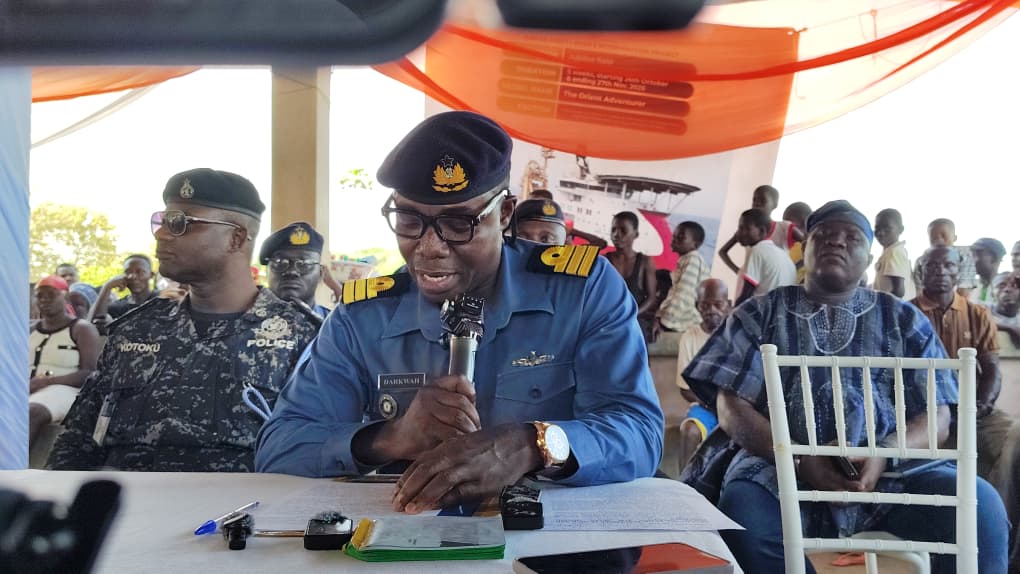

The Commanding Officer of the Western Naval Command, Commander Charles Darkwah, has urged the government to invest in strengthening Ghana’s maritime surveillance system to enable the country to respond more efficiently to emergencies at sea.
Commander Darkwah made the call while outlining the challenges the Navy faced during the search and rescue operation for the seven crew members of the Second Chance canoe, which had drifted into Beninese territorial waters.
Although the operation was successful, he said it exposed gaps that could cost lives in future emergencies.
“Despite the successful rescue mission, there were some challenges, including difficulty in communication, lack of distress signal transponders on the canoe, and inadequate night vision capabilities,” he said.
He explained that the absence of a distress transponder on the canoe made it harder to locate the vessel, while poor communication and limited night-vision capabilities slowed the search effort.
According to Commander Darkwah, the incident underscores the need for stronger collaboration among maritime stakeholders at all levels. He called for sustained investment in maritime surveillance, reliable communication systems and improved naval operational capabilities.
He specifically highlighted the need to acquire suitable ships, high-speed interceptor boats and high-endurance maritime drones. These assets, he said, would strengthen the Ghana Navy’s capacity for effective maritime monitoring, early detection of distress signals, coordination and rapid response.
“Such investments are essential to safeguarding lives at sea, improving maritime domain awareness, and reducing the occurrence of similar incidents in the future.
“The Ghana Navy would want to assure the government that once our strategic and quick-fix assets are procured, the area surveillance, wide area patrol coverage, and response challenges would drastically improve our ability to timely and effectively mitigate future maritime security challenges,” he added.
His appeal comes as fishing communities along the coast continue to depend on canoes for their livelihoods, often venturing far offshore with little or no safety equipment.
‘We wept throughout’- Seven Ngyiresia fishermen recount 12 days of terror at sea