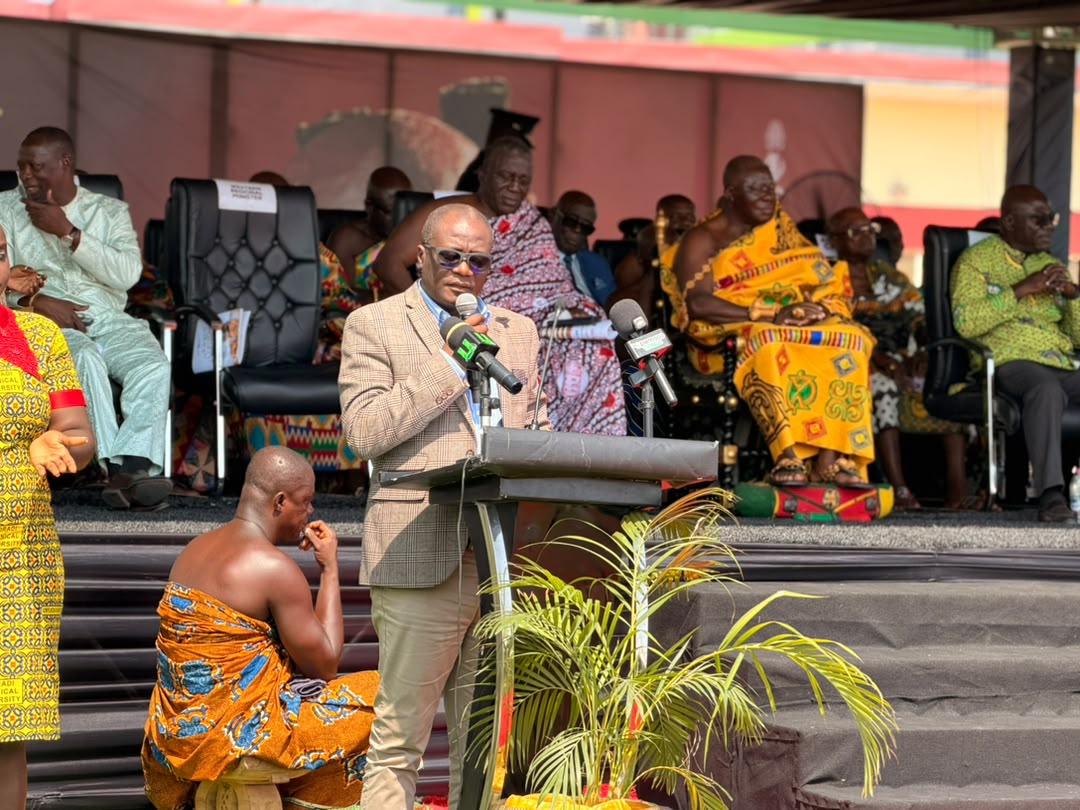

The Western Regional Minister, Joseph Nelson, has called for stronger collaboration between educational institutions and industry to transform the creative arts and applied technologies into viable businesses capable of creating jobs and stimulating economic growth.
He said the knowledge and skills acquired by students in tertiary institutions must translate into tangible economic opportunities through product development, commercialisation, intellectual property protection, access to finance and market expansion.
Mr Nelson made the call at the Takoradi Technical University’s (TTU) Faculty of Applied Arts and Technology Open Day, held in honour of the Asantehene, Otumfuo Osei Tutu II, in Sekondi.
The event, held under the theme, “Celebrating Innovation and Excellence: A Tribute to the Legacy of Otumfuo Osei Tutu II,” brought together traditional authorities, government officials, academia, industry players and members of the creative arts community to celebrate the Asantehene’s contribution to national development.
Welcoming Otumfuo Osei Tutu II to the Western Region, Mr Nelson described his presence as a demonstration of his enduring commitment to education and the development of young people.
He commended the Asantehene for his contributions to education through the Otumfuo Education Fund, as well as his interventions in peacebuilding, cultural preservation and environmental protection.
According to the Regional Minister, the Asantehene’s legacy extends beyond Asanteman and continues to make significant contributions to Ghana’s national development.
Mr Nelson observed that the creative arts and applied technologies were important components of a modern economy, with sectors such as fashion, textiles, graphic design, ceramics and sculpture offering significant opportunities for entrepreneurship, employment creation and wealth generation.
He said the Western Region, with its industrial, commercial, cultural and tourism potential, had enormous opportunities for creative professionals to develop innovative products and services using local resources.
However, he stressed that educational institutions must deliberately connect their training programmes to the needs of industry to ensure graduates can translate their competencies into productive ventures.
The Minister said the Western Regional Coordinating Council remained committed to strengthening partnerships between academia and industry while creating an enabling environment for young people to turn their ideas into sustainable businesses.
He disclosed that the Regional Coordinating Council’s Investment and Business Centre was available to facilitate business and investment opportunities emerging from the creativity and entrepreneurial initiatives of young people.
He consequently urged industry players, investors and business leaders to use the exhibition as an opportunity to identify promising talents, establish partnerships, provide mentorship and create pathways for internships, financing, production and market access.
Addressing students and young creatives, Mr Nelson encouraged them to go beyond developing original ideas to understanding market demands, protecting their intellectual property and building sustainable businesses around their talents.
He also challenged TTU to deepen its engagement with industry and development partners to ensure that its training, research and innovation respond to emerging economic needs.
The Regional Minister further used the occasion to promote the Western Region’s tourism and investment potential, highlighting its beaches, historic forts and castles, forest reserves, cultural attractions and hospitable communities.
He commended the Vice-Chancellor of TTU, Reverend Professor John Frank Eshun, the University Council, management of the Faculty of Applied Arts and Technology, lecturers, students and the organising committee for sustaining a platform that brings together education, traditional leadership, government and industry.
Mr Nelson expressed hope that the celebration would strengthen the relationship between education, culture, innovation and enterprise, while inspiring the next generation to contribute meaningfully to national development.
By Ebenezer Atiemo