


The waters off Cape Three Points, at the southernmost tip of the Western Region of Ghana, do not look like a battleground over money.
Canoes bob near mangrove-lined coves; women wait at the shore to smoke the day’s catch; the reef beneath the surface still shelters enough fish to draw scientists from across West Africa.
But beneath that calm sits an uncomfortable question that has trailed marine conservation efforts everywhere they have been tried, from Belize to the Philippines to the waters just offshore here: who, exactly, is going to pay for it?
Ghana’s answer to that question is still being written. On 7 October 2025, Cabinet approved the country’s first Marine Protected Area (MPA), covering 703.86 square kilometres of the Greater Cape Three Points Area, a landmark moment after years of scientific assessment, community consultation, and political negotiation.
Cabinet approval set the process in motion; the formal Gazette declaration that gives the MPA its full legal force followed months later, with Vice President Naana Jane Opoku-Agyemang presiding over the official declaration ceremony on 14 April 2026. But approval, even formal declaration, is not the same as implementation, and implementation, as officials steering the project now openly admit, costs money that does not yet fully exist.
How The World Pays for Its Oceans
Ghana is not the first country to discover that declaring a protected area is the easy part. Around the world, governments have experimented with strikingly different answers to the funding question and the differences matter, because they determine whether an MPA survives its first decade or quietly collapses once the launch grants run out.
In Belize, the answer was written directly into law. The Protected Areas Conservation Trust (PACT), created by an Act of Parliament in 1996 and amended in 2015, draws roughly half its income from a fixed conservation fee charged to every departing overnight visitor, alongside a legislated 15% commission from a cruise-passenger head tax, 20% of concession revenue earned inside protected areas, and 20% of recreation-related licence and permit fees.
Since its creation, PACT has funnelled more than BZ$31 million into managing Belize’s protected areas and marine reserves, a total various assessments put closer to BZ$33 million by 2020, and likely higher today, covering a little over one-fifth of the country’s territorial waters, all without depending on a single donor’s annual decision.
The Philippines took a similar route at a single, globally significant site. The Tubbataha Reefs Natural Park Act of 2009 does not just authorise the park; it fixes the numbers. Conservation fees paid by divers and tourists once covered as much as 74-80% of the park’s operating budget in peak years; more recent multi-year data shows a more diversified mix, with government funding, park fees, and private-sector support each contributing roughly a third.
What the law fixes permanently, regardless of that mix, is the revenue-sharing rule: a full 10% of conservation fees must be returned directly to the local community of Cagayancillo, a legislated obligation, not a discretionary gesture.
Seychelles chose a different instrument entirely. In 2015-2016, working with The Nature Conservancy, the archipelago restructured a portion of its sovereign debt and redirected the value released into a domestic conservation trust, now reinforced by a sovereign Blue Bond.
The arrangement helped Seychelles protect more than 30% of its national waters, an area larger than Germany, and gave its marine programme a financing base insulated from the ups and downs of any single foreign aid budget.
Even the United States, for all its institutional depth, has not solved this problem. The 16 sites of the National Marine Sanctuary System depend on an annual congressional appropriation, about $55 million a year system-wide, or roughly 14 cents per protected acre, which the Center for American Progress has calculated is far below the $0.38 to $30 per acre spent on comparable protected-area networks elsewhere.
Individual U.S. states have plugged some of that gap with their own dedicated funds: California’s Ocean Protection Council has received a standing $2.5 million a year from the state’s General Fund since 2015 specifically for MPA monitoring, and Florida legislates a trust fund fed by the interest earned on lifetime fishing licence sales.
What separates these systems from most of Africa’s, including Ghana’s, is not intent but architecture: Belize and the Philippines wrote a specific number, a percentage, a fee, a ratio into their statutes.
Kenya and Tanzania, like Ghana, have strong legal frameworks authorising marine parks but no equivalent formula forcing a fixed share of any revenue stream toward keeping them running. That absence is not an abstract policy gap. In Cape Three Points, it is already shaping how the MPA is being built, and who is being asked to wait.
Ghana Has the Law. It Doesn’t Yet Have the Money
Ghana’s MPA rests on real legal footing. Section 39 of the Fisheries and Aquaculture Act, 2025 (Act 1146), which replaced the Fisheries Act, 2002 (Act 625), empowers the Minister for Fisheries, acting on the advice of the Fisheries Commission and after consulting local authorities and landowners, to declare any part of Ghana’s fishery waters and seabed a marine reserve by notice in the Gazette, based on a scientific assessment. That is exactly the process that led to Cabinet’s October 2025 approval.
What the 2025 Act does do is renew and rename the sector’s development fund. Where the 2002 Act established a Fisheries Development Fund, Act 1146 replaces it with the Fisheries and Aquaculture Development Fund, drawing on the same broad pool; a share of licence and permit fees, court fines and penalties, government appropriations and donor contributions.
The law does fix some percentages here: at least 30% of the Fund’s money must go toward the Fisheries Commission’s own running costs, and a full 70% of any court-imposed fine under the Act must flow into the Fund. But none of those fixed shares is earmarked specifically for MPA or marine reserve management.
It is a legal authority to protect the ocean, with financing mechanics fixed in several places, just not for the ocean’s newest protected patch.
Stephen Kankam, Deputy Director of Hen Mpoano (left) explaining the MPA ecosystem with a map
According to Stephen Kankam, Deputy Director of Hen Mpoano, the MPA now moving through design is not going to be a single blanket no-fishing zone. It will be layered: a strictly protected no-take core, gear-restricted buffer zones around it, and an outer transition zone where some fishing will still be allowed. Kankam said the boundaries cannot be settled by science alone.
“It also going to take on a political process,” he explained, describing the balancing act between communities’ right to access marine resources and the scientific thresholds needed for fish stocks to recover.
Drawing on comparable MPAs elsewhere, he said the no-take zone should cover at least 10% of the total protected area, with no less than 100 metres separating it from the buffer zone to be ecologically effective, though he cautioned that Ghana’s specific coastal and social context will still have to shape the final design.
The $1.5 Million Question
If the legal architecture is largely settled, the financial architecture is not. Dr Evans Arizi, Chairman of the MPA’s Technical Advisory Committee, said funding for the initiative so far has been irregular, reliant largely on non-governmental organisations (NGOs) and development partners rather than a predictable government budget line.
Dr Evans Arizi, Chairman of the MPA’s Technical Advisory Committee
“It’s going to be a difficult one for them to receive monthly stipends. It’s not feasible. I think the community members should be looking at something beyond that.”, Dr Evans Arizi.
Dr Arizi said the Minister for Fisheries and Aquaculture has now asked the NGOs implementing MPA-related work to disclose exactly how much funding they have already secured from development partners, so government can identify what remains uncovered and commit its own resources accordingly.
His committee is currently costing out every requirement of the management plan, from monitoring equipment to community workshops, and estimates that close to $1.5 million will be needed to fully implement the plan and adequately manage the MPA going forward.
Ghana’s progress with its GCTP MPA at the establishment stage (Source: Skytruth 30×30 tracker)
That figure lands inside a national budget picture that is already stretched thin. The Ministry of Fisheries and Aquaculture draws on four funding sources; Government of Ghana allocations, Internally Generated Funds, the petroleum-linked Annual Budget Funding Amount, and Development Partner Funds, and in its 2024-2027 Medium-Term Expenditure Framework, actual releases represented under 38% of the total amount originally approved.
One widely cited estimate drawing on World Bank analysis puts Ghana’s spending on fisheries management at only around 0.2% of the value of its commercial catch, a figure specialists consider far too low for effective enforcement, though the precise sourcing is worth independent verification before republication.
Reporting by the Ghanaian Times in 2026 found that conservation spending competes directly against politically sensitive line items such as the premix fuel subsidy for artisanal fishers.
In a written response dated 13 October 2026 to a Right to Information request from this reporter dated 17 August 2026, the Ministry of Fisheries and Aquaculture put its total appropriated budget for 2026 at GH¢428,006,496, made up of GH¢333,420,635 (77.9%) in Government of Ghana allocations and GH¢94,585,861 (22.1%) in Internally Generated Funds.
The Ministry said that budget supports overarching fisheries management, monitoring and administrative enforcement. The response does not identify any portion of it as set aside for the MPA.
The MPA’s dependence on outside partners has already been tested. USAID, through the Feed the Future Ghana Fisheries Recovery Activity, provided roughly $750,000 in direct technical assistance that Ghana’s own Fisheries Commission has credited as essential to drafting and operationalising the MPA law, while the UK’s Blue Planet Fund financed the underlying management plan framework through its Ocean Country Partnership Programme.
When the U.S. government froze USAID funding in 2025, Ghanaian officials said the disruption jeopardised the pace of the MPA’s establishment, delaying validation of the management plan, public awareness campaigns, and staff training, before the MPA was ultimately declared in 2026.
Dr Arizi listed unreliable funding as one of the central risks to the entire initiative, alongside pollution from illegal small-scale mining, which he warned could drive fish away from the protected waters, and the risk of losing community buy-in altogether if residents feel excluded from any resulting benefits.
The same response names the backers of the work so far. The Ministry listed Bloomberg Philanthropies, Oceans 5, UK Aid through the Ocean Country Partnership Programme, the Government of Norway, the Hans Wilsdorf Foundation and the Ocean Grants Programme, implemented with civil society partners including Hen Mpoano, the Global Fisheries Resilience Action (GFRA) and the Fishery Committee for the West Central Gulf of Guinea (FCWC). USAID does not appear on that list.
According to the Ministry, the Government of Ghana’s role has been institutional coordination, administrative oversight and technical staff support through the Ministry and the Fisheries Commission, while direct project funding flowed through the implementing partners and international initiatives. The milestones it lists as funded to date include baseline ecological surveys and scientific research between 2012 and 2025.
Asked for a breakdown of all funding received and disbursed since the project began, the Ministry described sources and categories of activity but gave no amounts, saying consolidated disbursements are audited directly through the partner organisations.
On what lies ahead, the Ministry did not state a total. It said comprehensive national budget projections for the full multi-year rollout are tied to the National Blue Economy Strategy, and that funding is structured through a blended finance model. Secured sources, it said, include ongoing commitments from international development partners and bilateral grants.
Prospective mechanisms include sovereign Blue Bonds and Debt-for-Nature Swaps, overseen by the Ministry of Finance and the Bank of Ghana, the same two instruments Seychelles has used. The response does not say how much either is expected to raise.
The Ministry listed four priority areas for the proposed funding. The first is surveillance and enforcement across the 703.86 square kilometre MPA zone, combining Fisheries Enforcement Unit sea patrols, the Marine Police, Ghana Navy vessels, vessel monitoring, automatic identification and electronic monitoring systems, and community Landing Beach Enforcement Committees.
The others are community livelihoods and alternative support; research and monitoring, including stock monitoring by the Fisheries Scientific Survey Division and spatial tracking under the MarEcoplan Project; and infrastructure and capacity building, including site-level co-management offices, stakeholder training and equipment for local executive committees.
Voices From MPA-affected communities: “We Don’t Trust Them”
For residents of coastal communities such as Cape Three Points, the funding debate happening in ministries and technical committees feels distant from years of consultation meetings that have not translated into visible change. Community members describe a familiar pattern: officials arrive to register names and gather concerns, and then little follow-up materialises.
The Ministry has put figures on that engagement. In its response to this reporter, it reported that between 2023 and 2024 it held 12 major stakeholder engagements and seven structured consultative workshops at national, regional and community levels, reaching more than 7,000 participants in total, including 3,639 formal delegates, across the 21 coastal communities.
It also listed an MPA Communication Strategy, participatory song sheets, localised radio scripts and community FAQ documents translated into local dialects among the outreach funded to date.
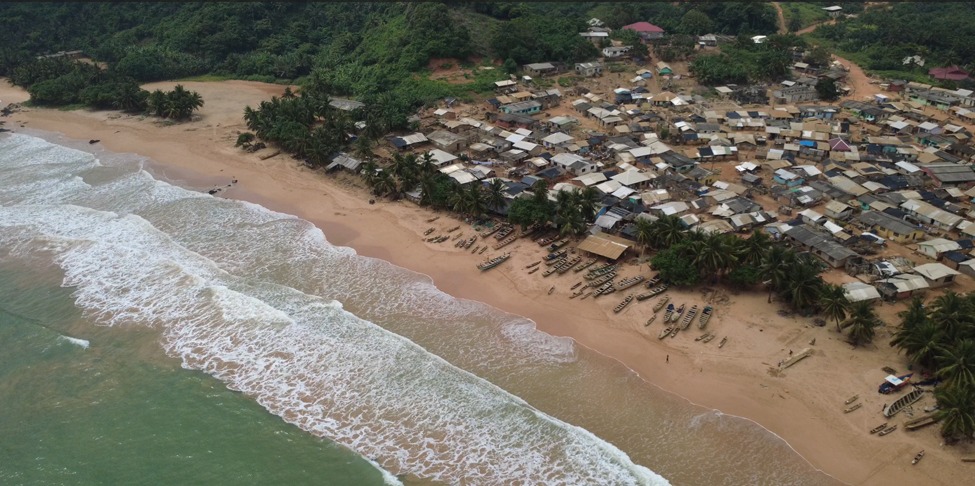
Aeriel view of Cape Three Points village
Fishing families in the area say their livelihoods are already strained by offshore oil exploration activity, which they blame for recurring incidents of fishing gear becoming entangled in sea weeds, encounters they describe as dangerous. Despite deep scepticism about the MPA, residents say they would support it if government addressed more immediate needs first: functional roads, support for their children’s education, and food security.
Some have proposed that residents inside the MPA enclave be considered for compensation given the strain they have endured; others have appealed for support to train young people in vocational skills such as hairdressing, soap-making and fashion design as alternative sources of income.
“If nothing at all, we at Cape Three Points could be awarded some stipend to compensate for any losses we might incur.”, James Neneh, local fisher demanded.
“That is our only source of livelihood,” said another fisher, Matthew Cobbinah. “It is our prayer that the government support us financially to be able to fund the education of our wards, and even feed the family.”
Cecilia Essoun, a fish processor at Cape Three Points
Cecilia Essoun, a fish processor in the community, put the stakes plainly: “It will be problematic if this MPA fails. This is our only source of livelihood and hope. There are no jobs in this community. At least we can earn some decent income through some smaller business ventures.”
An Alternative to Cash Payments
Anticipating community demands for direct compensation, Dr Arizi was candid that government is unlikely to offer coastal residents monthly cash stipends, calling the idea financially unworkable. The more realistic route, he said, is developing eco-tourism around the MPA, with visitor fees eventually generating income for adjoining communities, alongside government-led improvements to roads serving the area.
He argued that if local economic activity is boosted through tourism and related ventures, residents would ultimately earn more than any stipend government could realistically offer.
The Ministry’s written response sets out the livelihood measures it proposes to fund: low-PAH (polycyclic aromatic hydrocarbon) Ahotor smoking ovens for women fish processors, vocational training for youth through TVET, micro-credit facilities, and social security and insurance linkages with the State Insurance Company (SIC) and the Social Security and National Insurance Trust (SSNIT). It does not mention eco-tourism, road improvements or cash compensation.
The idea is not without precedent elsewhere in the world, it is, in effect, a smaller-scale version of exactly what Belize’s PACT and the Philippines’ Tubbataha model already do by law: channel a fixed share of tourism-linked fees directly back to the communities and management systems around a protected area.
The difference is that in Belize and Tubbataha, that channel is written into legislation as a guaranteed percentage. In Ghana, for now, it remains an aspiration Dr Arizi is asking coastal residents to trust.
He also sought to reassure communities that their input is shaping the outcome. The management plan, he said, is being developed with community participation and will be validated by residents before moving through the Ministry, Cabinet and ultimately Parliament for approval, a process he said would give the plan legal permanence regardless of which political party is in power once it is adopted. “So, once it is approved, whichever political party comes into power… the rules are there already,” he said.
“In the plan, it will be explicitly stated that the community members be involved in the activities surrounding the MPA. As a matter of fact, we want the people to own the MPA.”
A Road Map, and a Deadline
The road map guiding the MPA’s creation envisages a completed management plan by December 2026, with implementation beginning in January 2027.
“Without it, you cannot manage, enforce, or implement any conservation measures,” Kankam said.
He listed the plan’s core objectives: recovering fish stocks, ending illegal, unreported and unregulated (IUU) fishing within the MPA’s boundaries, sustaining education and awareness campaigns on the MPA’s benefits, and, he stressed, introducing alternative and diversified livelihoods for the affected communities.
“Without livelihood improvements that are tangible, I don’t think we can have a successful MPA implementation,” he said.
The Ministry’s written response sets out its own phasing. Phase I, described as immediate and running through 2026, covers operationalising the MPA management framework, setting up stakeholder committees and initial donor grant disbursements. Phase II, from 2028 to 2031, covers medium-term market rollout and the scaling of Blue Finance instruments under the National Blue Finance Facility and the Ghana Blue Economy Investment Fund. Beyond that, the Ministry projects phased expansion of additional MPAs and other effective area-based conservation measures (OECMs) through 2040 to meet national ocean governance and 30×30 targets.
HOW OTHER COUNTRIES FUND THEIR MPAS
Country
Funding Mechanism
Is It Written into Law?
Belize
Protected Areas Conservation Trust: ~50% of a visitor conservation fee, 15% of cruise-passenger tax, 20% of park concessions, 20% of recreation fees
Yes, fixed percentages set by the PACT Act (1996, amended 2015)
Philippines (Tubbataha)
Fees covered up to ~74-80% of budget in peak years; more recently a ~1/3-1/3-1/3 mix of government, fees, and private sector. 10% of fees always returned to community
Yes, the 10% community share is fixed by the TRNP Act of 2009
Seychelles
Debt-for-nature conversion trust, reinforced by a sovereign Blue Bond
Yes, established through a legislated debt-conversion agreement
USA (federal)
Annual congressional appropriation (~$55M/yr for 16 sanctuary sites)
Partial, the system is authorised by law; funding is not a fixed formula
Kenya / Tanzania
Park fees, national budget lines, NGO and donor co-financing
No, enabling Acts authorise MPAs but set no funding ratio
Ghana
Fisheries Development Fund (licence fees, penalties, government, donors) plus ad hoc donor grants (USAID, UK Blue Planet Fund and others, including Bloomberg Philanthropies, Oceans 5 and Norway); Blue Bonds and debt-for-nature swaps listed as prospective; ~$1.5M still needed to fund the Cape Three Points management plan
No, Act 625 (2002) and Act 1146 (2025) authorise MPA declaration, not a funding formula
A Model for West Africa, If the Money Follows the Law
Ghana’s Marine Protected Area has cleared the hurdle that stops many conservation efforts before they start: it has a legal mandate, a Cabinet approval, a zoning concept and a management timeline. What it does not yet have is the one thing that has determined whether comparable projects elsewhere endured or unravelled, a financing mechanism written into law with the same permanence as the protection itself.
Belize, the Philippines and Seychelles each answered the funding question by fixing a number into legislation, insulating their marine parks from the year-to-year uncertainty of national budgets or foreign aid decisions. Ghana, for now, is financing its flagship MPA the way Kenya and Tanzania finance theirs: through a legally sound but financially improvised mix of government intent, donor goodwill and NGO bridge funding; a mix that a single funding freeze, as 2025 already demonstrated, can disrupt. The Ministry’s response to this reporter lists sovereign Blue Bonds and Debt-for-Nature Swaps, the instruments Seychelles used, as prospective mechanisms, but places their scaling in 2028-2031.
For the fishers, processors and families of Cape Three Points, none of this is abstract. It is the difference between an MPA that delivers the alternative livelihoods, roads and eco-tourism income officials have promised, and one that becomes, in Cecilia Essoun’s words, one more “problematic” initiative in a community that has already learned to be sceptical of promises. With the management plan due by December 2026 and implementation set for January 2027, the coming months will show whether Ghana closes its $1.5 million question, or leaves its newest MPA to find out, the way so many others have, that legal protection and financial protection are not the same thing.
This story was produced with support from Internews’ Earth Journalism Network.
By Abraham Mensah