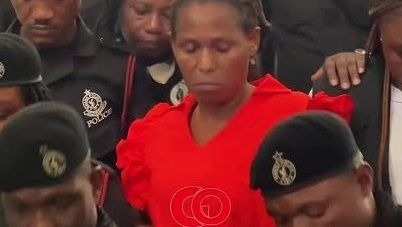

The one-year jail sentence handed down to TikToker Camilla Alhassan by an Accra Circuit Court following her conviction for ‘offensive conduct’ and ‘publication of false news’ is, indeed, alarming and harsh.
While the comments and actions of Camilla are despicable by all standards, the one-year jail term is tantamount to killing an ant with a sledgehammer.
The Media Research Institute (MRi), therefore, calls on President John Dramani Mahama to, as he did in the case of the ‘Montie Three’, exercise his right to pardon to free Camilla and help restore some credibility to political activism in the country.
In that case, three contemnors who were sentenced to four months’ imprisonment by the Supreme Court for scandalising the apex court were granted presidential pardon after serving only one month. The ‘Montie Three’ were sentenced by the Supreme Court on 27 July 2016, a decade ago, and perhaps quite strikingly, almost 10 years after the reprieve granted them on August 22, 2016, we are still in the throes of dangerous political rhetoric.
Evidence abounds that such wild political rhetoric has become symptomatic of politics in Ghana, and activists on both sides of the political divide are guilty of this indecorous conduct. Invariably, and, interestingly, anytime prominent politicians make similar vulgar or despicable comments, the law goes to deep sleep.
We have been witnesses to the brazen attack of politicians, including MPs, on some judges, who, in the discharge of their duties, had incurred the displeasure of these powerful politicians.
In May this year, the Minority Leader of Parliament, Alexander Afenyo Markin, threw wild vituperation at a Circuit Court Judge, in what was generally believed to be a brazen assault on the sanctity of the court. He described the judge in question as an “NDC Judge” who should be “ashamed of himself”.
The GBA rightly condemned his conduct, expressing disappointment in him for acting “unprofessionally and unethically”. Yet, he walked freely and was never cited for contempt or offensive conduct. In another instance in early September 2024, Malik Basintale, then a Deputy National Communication Officer of the NDC, alleged that pork was the favourite meat of Dr Mahamudu Bawumia, who is a Muslim.
Indeed, it is common knowledge that Muslims don’t eat pork, and such allegations, which border on religious beliefs, can be very sensitive issues. Malik Basintale’s allegation was after Mr. Atta Akyea, a respected lawyer and former Minister, urged the electorate in late August 2024 to vote for Dr. Bawumia, a ‘distinguished economist’ who does not drink alcohol, rather than voting for a ‘drunkard’.
Nobody was arrested, prosecuted, and sentenced for such reckless allegations. Placing such selective application of the law against the background that Camilla pleaded guilty to the charges preferred against her, we find the sentence alarming and harsh.
It is becoming alluring for law enforcers to apply two sets of laws: one that clears and cleans the powerful and another that drags the poor in the mud for walking on the very paths these politicians have carved.
The incarceration of Camilla only emphasises the selective application of the law; the kind of justice handed to an unguarded woman who may have been inspired to go on such a reckless tangent by the example set by powerful politicians.
Thus, this case also brings to the fore the gradual degeneration of free speech as a right only to the ‘powerful’ in our society. The MRi believes this sentence is not only high-handed but also a dangerous precedent that presents a veritable threat to free speech.
This is not how to build a free and independent society. While law enforcers may succeed in pleasing the powerful political elite with the selective application of the law, it may simply be counterproductive as a precedent that could stifle free speech and grossly undermine democracy.
The criminalisation of speech relative to the poor in society attacks the very foundation of democracy; for democracy is not built solely on the authority of the powerful elite who form the minority, but more importantly, on universal suffrage and the resilience of the poor masses who provide votes and the authority to the powerful elite.
Definitely, there is a need to enhance our democracy by instilling a sense of decency in conversations on both traditional and new media platforms; however, actions to address excesses must not be seen as extreme and high-handed.
In that respect, we call on the government to capacitate the National Commission for Civic Education (NCCE) to enable it to undertake effective civic education on good political conduct.
We also urge faith-based organisations (FBOs) and civil society organisations (CSOs) to make a strong impact on civic education to address such culture of indecency in political communication.
It is also time to have open and constructive discussions on the continuous existence of such obnoxious laws in our statutes, and we urge the relevant agencies and institutions to rise to the challenge and build a system that respects the right to free speech for all irrespective of differences in status and influence in society.
It is important to urge the general public to demonstrate decorum and decency in conversations on social media. The citizenry should be reminded that while their right to free speech is a cherished right, it comes with responsibilities.
Social media should not be a vent for reckless political effusions that can only serve to create a polarized political environment inimical to our collective interest.
Political parties must advise their followers to be decent and respectful on social media. More importantly, political leaders should lead by example and avoid incendiary political language that is not only populist but dangerous to our democracy.
By Dr. Daniel Nkrumah
Executive Director of Media Research Institute