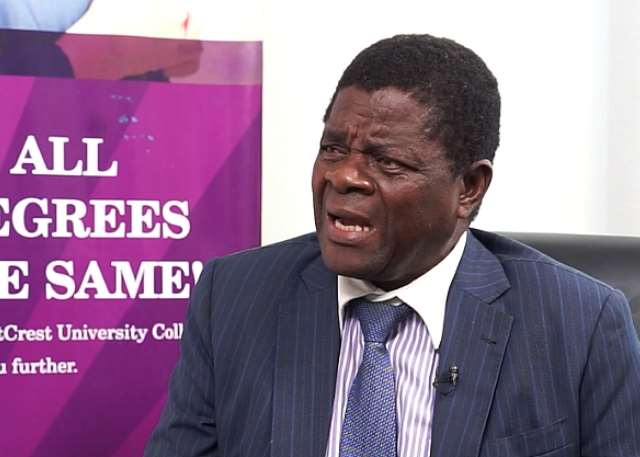

Former Ghana School of Law Director, Kwaku Ansa-Asare, has cast doubt on the viability of the Chief Justice’s case at the ECOWAS Court, calling it a misguided attempt to override Ghana’s well-established legal processes.
Ansa-Asare argued that Ghana’s rules of evidence and court procedure are based on local laws not ECOWAS standards and cannot simply be substituted or overruled by a regional body.
“Our procedures are firmly embedded in the High Court rules and the Evidence Act of 1975,” he said.
“ECOWAS does not have a sub-regional procedure that we are violating,” he noted.
He believes the Chief Justice’s decision to seek intervention from the ECOWAS Court is legally flawed and unlikely to achieve the result she’s hoping for.
“Taking the matter out of the purview of our courts to the ECOWAS Court is not going to achieve the desired purpose. It will be defeated.”
Ansa-Asare added that the CJ is “shooting herself in the foot” and worsening her own predicament through missteps.
“She’s making her bed and lying in it. It saddens and pains me that she is adding insult to injury.”
He concluded that while legal battles are part of due process, self-inflicted procedural blunders, especially by someone of her legal standing, are difficult to justify.
On the other hand, a private legal practitioner, Martin Kpebu has clarified that the ECOWAS Court of Justice has jurisdiction to hear the Chief Justice’s case, even if she’s still going through legal processes within Ghana.
Speaking on TV3’s KeyPoints on July 12, he addressed confusion around whether local court proceedings could block access to regional courts.
“Under ECOWAS jurisprudence, having a case before a domestic court is not a bar to filing before the ECOWAS Court,” Kpebu said.
Citing specific cases like Registered Trustees of HEDA Resource Centre vs Republic of Nigeria (2021) and SERAP vs Nigeria (2016), Kpebu explained that the ECOWAS Court has consistently ruled that citizens can seek regional remedies while local cases are ongoing.
“Unless a case is being heard by another international court like the African Court, it is not a problem. Lawyers, journalists, everyone needs to understand this clearly,” Kpebu noted.
He encouraged the public and professionals alike to research these rulings and understand the region’s human rights protection framework, especially in politically sensitive cases like the one involving Gertrude Torkornoo.