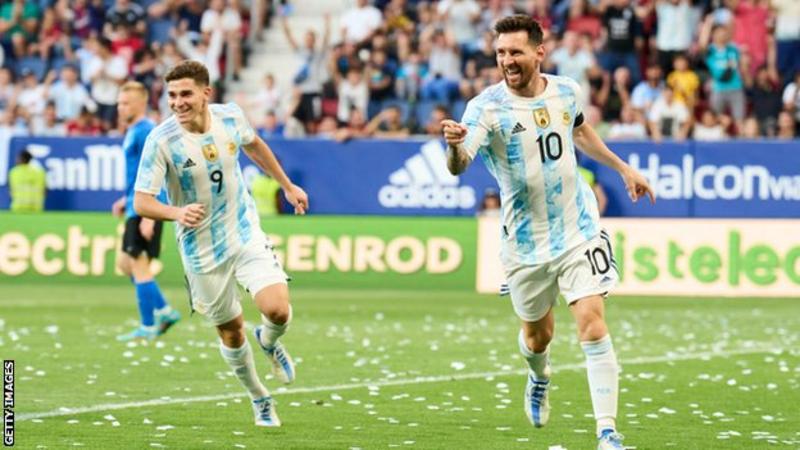

Argentina are throwing everything at the defence of their World Cup title – and they have needed to.
After being expected to steamroller past Cape Verde and Egypt in the first two knockout rounds, La Albiceleste had to fight tooth and nail for 3-2 victories.
But the win over Egypt came with an edge as the African nation asked Fifa to kick the officials in charge of their last-16 defeat out of the tournament.
Egypt have alleged bias in favour of Argentina and favouritism towards their star player, Lionel Messi.
After the game, coach Hossam Hassan said Egypt had been “treated unfairly” and “suffered injustice”.
Hassan went on to allege some kind of bias from Fifa.
“Perhaps they wanted to keep the world champion in the competition. Perhaps they wanted Messi to stay in the running,” he said.
Argentina then needed help from the video assistant referee (VAR) to reduce Switzerland to 10 players, winning the quarter-final 3-1 after extra time.
And then a few decisions went in their favour in the 2-1 semi-final win over England.
BBC Sport examines whether there is anything in the conspiracy theory that everything is being set up for Argentina to succeed.
Argentina go through against 10 man Switzerland
Switzerland were in the ascendancy against Argentina, with Dan Ndoye having scored a 67th-minute equaliser in Kansas City.
Five minutes later, Breel Embolo went down looking for a free-kick for a challenge by Leandro Paredes.
Portuguese referee Joao Pedro da Silva Pinheiro duly obliged, and booked the Argentina defender.
The VAR decided that this was mistaken identity, that Embolo had won the foul through simulation. The referee was advised to go to the pitchside screen.
One problem for Embolo – he was already on a booking.
So when Pinheiro switched Paredes’ yellow to Embolo, the Switzerland striker was sent off.
However, there have been questions raised about how this can be mistaken identity, when it was a referee simply getting a decision wrong.
Indeed, Uefa has instructed its VARs not to get involved in simulation as mistaken identity. It believes this is a misapplication of the protocol.
Without this, Argentina would have been playing against 11.
Argentina get all the decisions against England
Argentina adopted a physical approach for their semi-final against England.
Just three minutes into the game, Enzo Fernandez challenged Elliot Anderson from behind, pushing his hand into the back of the England player’s neck.
There was a case for violent conduct because of the nature of the challenge.
Fernandez was not even cautioned.
Indeed, the VAR red card shown to South Africa’s Themba Zwane in the opening game against Mexico was probably less clear for violent conduct.
England fans were also convinced that Argentina’s winning goal should have been ruled out for a foul by Lionel Messi on Djed Spence.
There were similarities to the goal Egypt had ruled out against Argentina.
But this goal stood, and Argentina went through 2-1.
Was there any merit to Egypt’s complaints?
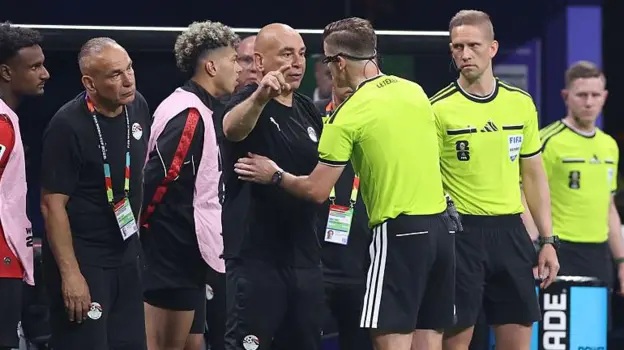
It is easy to understand why Egypt would feel so frustrated after their 3-2 defeat in the last 16.
The Africans had led 2-0 with 11 minutes to play, and were on the brink of a historic first-ever quarter-final appearance.
But it all went wrong as Argentina stormed back and scored the winner in stoppage time.
Egypt said there was something more suspect at play. They put their exit down to “serious refereeing mistakes” and “double standards” from French referee Francois Letexier and his team.
The Pharaohs had a goal ruled out through a VAR intervention.
They also claimed Argentina’s winner should have been disallowed, and a penalty awarded to them instead.
Mostafa Zico’s brilliant goal was chalked off after Marwan Attia was penalised for stepping on the foot of Lisandro Martinez at the start of the move.
It was controversial, but they were leading 1-0 and did score a second goal nine minutes later. You cannot prove the game would have taken a different path had Zico’s goal stood.
Egypt believed there were two potential penalty claims in their favour before Fernandez headed home the clinching goal.
Hamdi Fathy went to ground claiming he was held by Alexis Mac Allister, which was unclear on replays, while Mohamed Salah felt he was tripped by Julian Alvarez.
There were some similarities between the Martinez and Salah situations, with foot-on-foot contact, but not enough to constitute a penalty.
Egypt stood a better chance of getting the goal chalked off if Salah had been outside the area. The VAR would merely be judging a foul – as was the case with Martinez – rather than a penalty.
Controversial? Absolutely. But it is hardly proof of a conspiracy in favour of Messi.
France faced a complete team of Argentine officials
The appointments for the quarter-final between France and Morocco raised an eyebrow or two.
For the first time at this World Cup, the whole on-field officiating team – referee, both assistants, fourth official and the reserve – were from the same country.
And that country was Argentina.
Later, Fifa announced that the lead VAR would also be Argentine.
For Facundo Tello’s other two appointments, the fourth official and reserve were first from Saudi Arabia, and then Colombia.
The argument was that Argentina would want France to be knocked out. After all, they are the tournament favourites.
This was one of the biggest games of Tello’s career, his second World Cup quarter-final in successive tournaments. Such a high-profile referee was not going to act without the utmost integrity.
But perception is often just as important, and appointing Argentine officials against France in the quarter-finals was not a great look.
There was no controversy in the game, however, as France eased to a 2-0 win.
Messi avoids a red card and goes on to score five goals
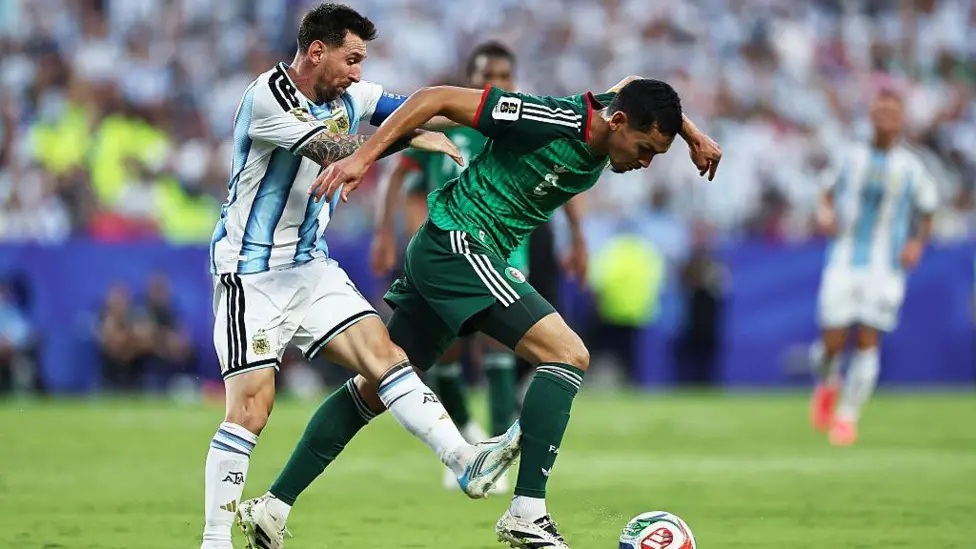
Cast your minds back at the start of the tournament and a potential red card for Messi.
Messi did not even receive a booking for his challenge on Algeria captain Aissa Mandi.
Then came one of the most high-profile incidents of this World Cup.
Folarin Balogun was sent off on VAR review against Bosnia-Herzegovina in similar circumstances. Both made contact on the opponent’s upper calf.
The United States are believed to have made this point when fighting to get Balogun’s ban removed.
If sent off, Messi would not have scored his second and third goals against Algeria, nor the double against Austria, as he would have been banned – unless Fifa decided to enact article 27 as it did with Balogun.
Messi would also have been unavailable for the final group game against Jordan when he again scored.
That would have taken away five of the eight goals he has scored at the tournament.
Was this special treatment of Messi?
How Infantino has ensured Messi’s presence before
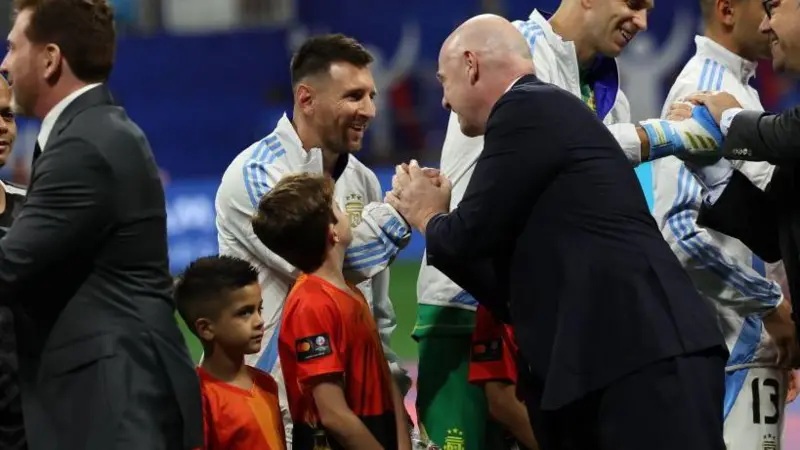
Fifa president Gianni Infantino seems to like having Messi at his tournaments.
Take the inaugural Club World Cup last year, held in the United States.
There was a bit of a delay before it was confirmed which team from the host country would take part.
Surely it would be the 2025 champions? After all, this is a tournament for the best teams based on defined merit.
Close, but not quite.
Inter Miami won the 2024 MLS Supporters’ Shield, which is awarded to the team with the most points.
But it was LA Galaxy who went on to be crowned champions, winning the play-offs.
Yet Inter Miami were chosen for the Club World Cup.
That allowed Messi to play in the opening game, at Inter Miami’s Hard Rock Stadium, against Al Ahly.
The World Cup bracket favoured Argentina
Fifa made a small but significant tweak to the World Cup draw in December.
The top four nations in the Fifa world ranking – France, Argentina, Spain and England – were drawn into separate quarters.
If those countries were to win their groups – which they did – they would not be able to meet until the semi-finals.
France and Spain were in one half, with Argentina and England in the other.
The idea is it limits the chance of marquee ties early in the tournament.
But, depending on how the groups finish up, it also gives those countries a more favourable path.
In the first two knockout rounds, there were only two meetings of the world’s top 10 – Netherlands v Morocco and Spain v Portugal.
Argentina would appear to have been given the kindest route, even though they only just beat Cape Verde (67th in the world) and Egypt (29th) 3-2. Then in the quarter-finals it was Switzerland (19th).
England did not face one of the top 10 until they came up against Argentina. They did have to beat Mexico (14th) in the Azteca.
Spain beat Portugal (fifth) and then Belgium (ninth), while France met Morocco (seventh) in the quarters.
Argentina have had the best of this.
The penalties keep stacking up for Argentina
When Argentina won the World Cup in 2022, they set a new record in the process.
The five penalties they were awarded was the most any team had ever received in one tournament.
In 2026, they again lead the way with three spot-kicks – though Messi has missed two of them, against Austria and Egypt.
Brazil, England, France and Switzerland have been awarded two.