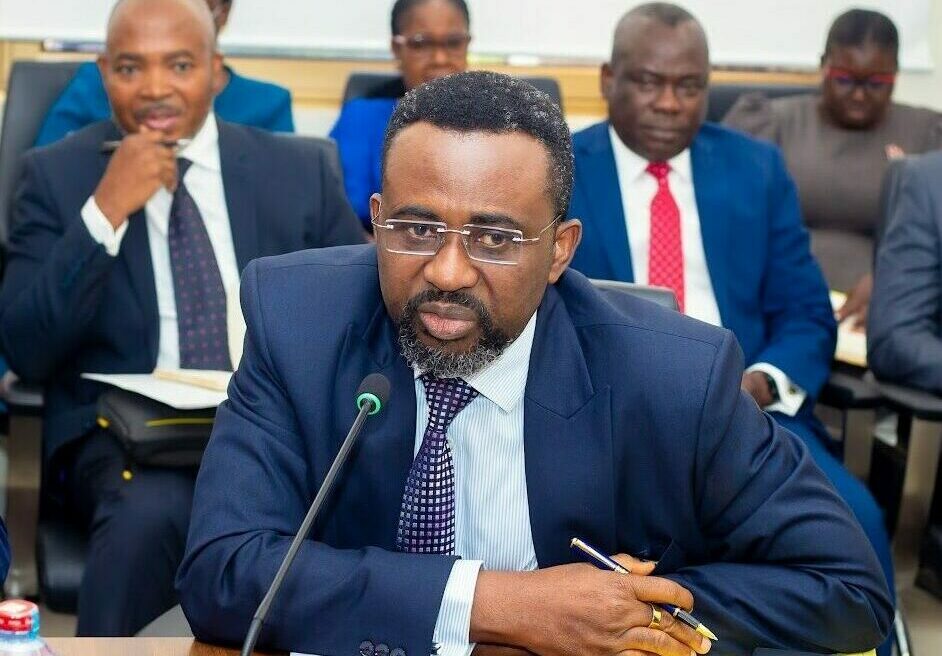

Governor of the Bank of Ghana (BoG), Dr Johnson Asiama, has said that he cannot unilaterally decide to restore the licenses of the banks that collapsed during the banking sector cleanup.
He says the board of the Bank of Ghana will act when a court makes an order.
He said this when asked whether he is under pressure during the 125th Monetary Policy Committee (MPC) press conference in Accra on Wednesday, July 30.
“Not at all,” he answered. Dr Asiama added that “Remember, the resolution for the framework is working. I came into office to find that a lot of progress had been made. Some cases are in court, some cases are undergoing certain forms of settlement, and so the process is on, and we will follow on the process in that regard.
“With the issue of what to do, it depends, for example, if a court reaches a decision and instructs us to go in a particular way, the board of the Bank of Ghana will look at that. But from where I sit, there is no pressure on me to restore any such unilaterally.”
The question was asked on the back of a campaign promise made by President John Dramani Mahama when he was in opposition ahead of the 2024 general elections.
It is recalled that while delivering his formal acceptance speech at the University of Development Studies (UDS) on Monday, May 15, 2024 after his victory as flagbearer of the National Democratic Congress (NDC) on Saturday, May 13, 2024 Mr Mahama said “we shall promote robust, local participation in our banking and financial, telecommunication, tourism, mining and agric and manufacturing sectors to grow our economy and create sustainable employment for our youths.
“We will restore indigenous Ghanaian investments in the finance and banking sector and we will create a tier banking system that will serve various segments of the market.
“We will give the opportunity to experience banking hands who were laid off needlessly to secure their careers once more and move away from the menial jobs that they were compelled to take.
“As far as practicable the banking licenses that were unjustly canceled by this government will be restored.”
Some local banks collapsed when the central bank revised the minimum paid-up capital for existing banks and new entrants from GHS120 million to GHS400 million in 2018.
According to the regulator, this was to test the viability of the banks. The banks that were unable to meet this new requirement were either merged or collapsed.
Some nine local banks, 23 savings & loans companies, 347 microfinance institutions, 39 finance houses and 53 fund management companies closed down during the exercise.
UniBank, The Sovereign Bank, The Beige Bank, Premium Bank, The Royal Bank, Heritage Bank, Construction Bank, UT Bank, Capital Bank all collapsed. Some analysts and observers criticised the BoG and the Finance Ministry over the collapse of the banks because, in their view, these banks could have been saved to continue employing Ghanaians.