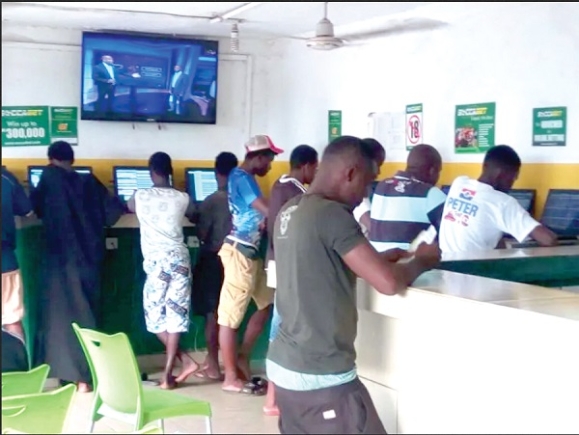

The Gaming Commission of Ghana has issued a 14-day ultimatum for all licensed operators to integrate with NIA biometric verification platform.
This is contained in a press release signed by the Ag. Commissioner of the Commission, Emmanuel Quainoo, dated August 11.
“To this end, all licensed operators are directed to immediately begin onboarding with the NIA. The Commission expects confirmation of integration plans within fourteen (14) days from the date of this communication, and completion of biometric access system testing and deployment within thirty (30) days,” it directed.
Mr Quainoo said, “Failure to comply will attract regulatory sanctions, including the suspension of operational licenses and the risk of non-renewal during the next licensing cycle. Compliance with this directive is being actively monitored, and the outcomes will form part of each operator’s operational audit.”
He added that, “We trust that all operators will cooperate fully with this directive and contribute meaningfully to raising industry standards in line with international best practices and national development imperatives.
For technical support and integration procedures, operators are advised to contact the NIA Technical Services Unit via email at [email protected], with a copy to the Gaming Commission at [email protected].
Read full press release below:
The Gaming Commission of Ghana hereby issues a regulatory directive requiring the immediate implementation of biometric identity verification for all individuals participating in any form of gaming activity within the Republic of Ghana.
This includes but is not limited to sports betting, online and retail betting, casino operations, and promotional gaming schemes.
Effective immediately, all licensed gaming operators must integrate their identity verification systems with the database of the National Identification Authority (NIA). Verification must be conducted using biometric authentication—either fingerprint or facial recognition—at two critical points: first, at the point of placing a bet, and secondly, at the point of payout or withdrawal of winnings.
This directive has been instituted as pan of a broader regulatory collaboration between the Gaming Commission and the NIA and is aligned with Ghana’s national policy mandating the Ghana Card as the only legally recognized identity for civic and financial transactions. This directive is backed by Legislative Instrument (L.I.) 2111, which designates the Ghana Card, issued by the National Identification Authority (NIA), as the sole and mandatory biometric identity verification tool for all transactions requiring identity authentication in Ghana.
Accordingly, no other form of identity verification—manual or electronic—shall be accepted in the implementation of this directive.
This policy is imperative for several reasons. Firstly, it will eliminate underage and fraudulent participation in gaming activities by using biometric verification to prevent impersonation and the use of false identities. Secondly, it enhances national security and the integrity of our financial systems, especially considering that the gaming sector is increasingly becoming vulnerable to money laundering and illicit financial flows.
By enabling traceability of all transactions, this measure will safeguard the industry from criminal exploitation. Additionally, this policy will support responsible gaming practices. By linking participation to verified biometric identities, operators will be able to track player behaviour, enforce betting limits, and implement exclusion frameworks for vulnerable or self-excluded individuals.
Finally, this integration aligns with Ghana’s national digital policy, which is steering all regulated sectors toward identity-based service delivery as a standard for accountability and service quality.
To this end, all licensed operators are directed to immediately begin onboarding with the NIA. The Commission expects confirmation of integration plans within fourteen (14) days from the date of this communication, and completion of biometric access system testing and deployment within thirty (30) days.
Failure to comply will attract regulatory sanctions, including the suspension of operational licenses and the risk of non-renewal during the next licensing cycle. Compliance with this directive is being actively monitored, and the outcomes will form part of each operator’s operational audit.
We trust that all operators will cooperate fully with this directive and contribute meaningfully to raising industry standards in line with international best practices and national development imperatives.
For technical support and integration procedures, operators are advised to contact the NIA Technical Services Unit via email at [email protected], with a copy to the Gaming Commission at [email protected].
Sincerely,
Emmanuel Quainoo Ag. Commissioner Gaming Commission of Ghana