
Ghana is set to abolish the minimum capital requirement for foreign investors under a planned review of the Ghana Investment Promotion Centre (GIPC) Act.
The reform, announced by President John Dramani Mahama in Tokyo, is aimed at boosting Ghana’s competitiveness as an investment destination by lowering entry barriers and attracting more global capital. It forms part of ongoing efforts by policymakers to expand private sector investment and accelerate job creation.
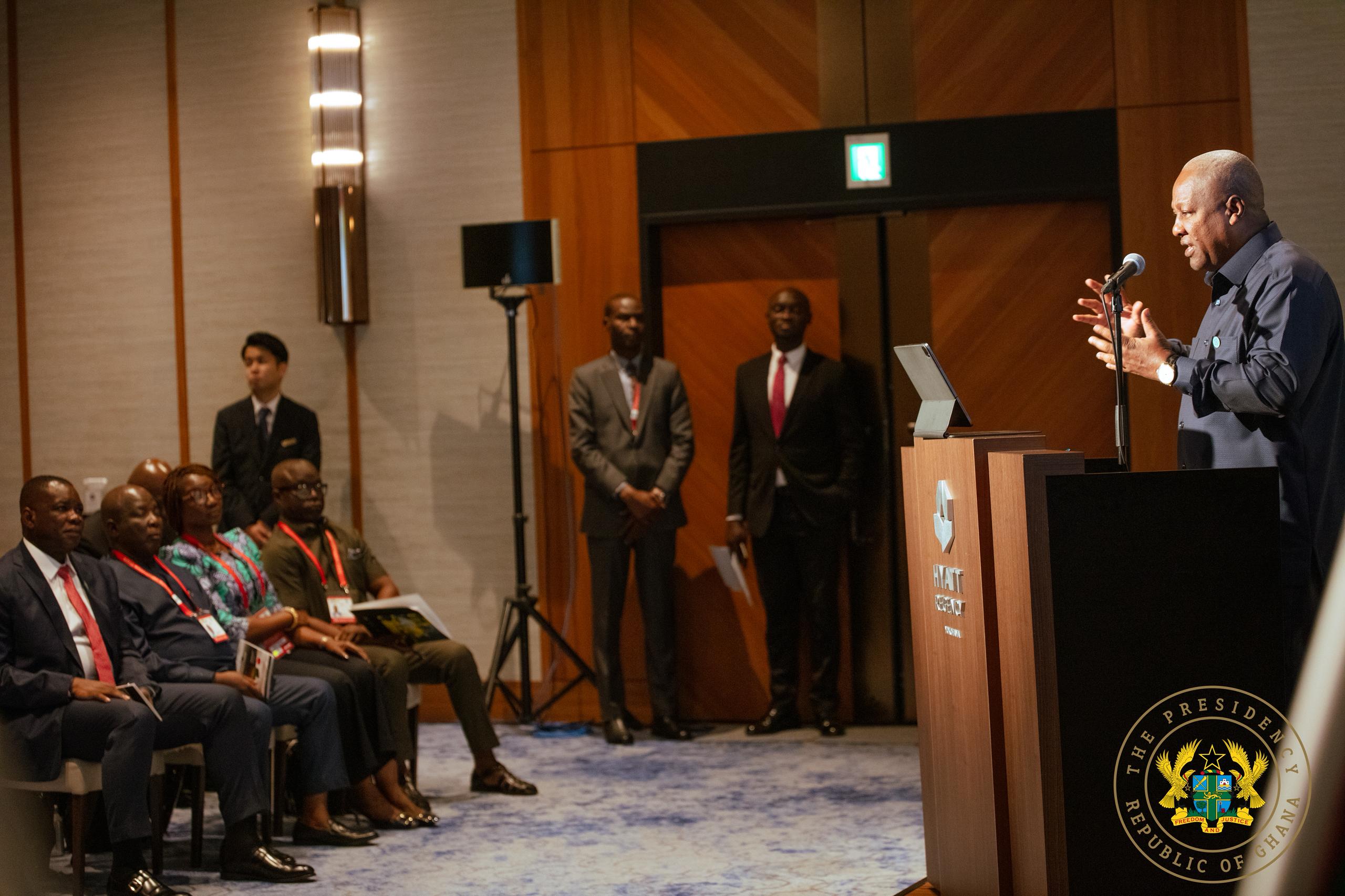
Speaking at the Presidential Investment Forum on the sidelines of the 9th Tokyo International Conference on African Development (TICAD IX), President Mahama assured investors that Ghana remains open for business.
“We are open for business and working to review the Ghana Investment Promotion Centre Act. Some barriers were put to foreign investment. You had to prove that you had brought in a certain amount of money to be classified as a foreign investor.
“In the reviewed Ghana Investment Promotion Centre Act, we are removing those minimal capital investments. This will enable any investor, however little money you have—100,000 dollars, 50,000 dollars—to be able to come in and set up a business in Ghana,” Mahama explained.
The President highlighted improving macroeconomic indicators as evidence of Ghana’s turnaround, citing the cedi’s strong performance, falling inflation, and recent sovereign credit upgrades.
“We are re-establishing macro stability and the growth momentum of the economy. Inflation rose to a high of almost 23% in 2024 and is currently down to 13.7%, and we expect that by the end of the year to hit single digit. Our cedi has stabilized.
“We have been upgraded from junk status to B minus with a stable outlook, and I am certain that in the next review, we are going to be upgraded again,” he added.
Mahama further urged Japanese investors to take advantage of opportunities in key sectors such as automobile assembly, agribusiness, manufacturing, energy, and digital services, noting that several Japanese companies already operate successfully in Ghana.
On her part, the Minister for Trade, Agribusiness and Industry, Elizabeth Ofosu-Adjare, described Ghana as a gateway to West Africa and a strategic entry point for Japanese businesses seeking to expand under the African Continental Free Trade Area (AfCFTA).
“Let us therefore move forward with determination, turning today’s dialogue into joint ventures, industrial clusters, and supply chains that carry the stamp of both Ghanaian resilience and Japanese excellence,” she said.
The proposed reform is expected to significantly open Ghana’s economy to small and medium-scale foreign investors, aligning with the government’s broader vision of fostering inclusive growth and stronger global partnerships.