
Fifty-year-old single parent Ama Attah is ecstatic, feeling a heavy weight lifted from her shoulders. For the first time in years, she will not have to struggle to buy exercise books for her three children in basic school, thanks to her Member of Parliament, Lawyer Blay Nyameke Armah, who is now fulfilling a pledge.
“I want the best for my kids, especially when it comes to their education,” she said on Connect FM. “I don’t joke with it. I work my socks off, and I go to every length to ensure they get what they need for school.”
That determination has been constantly tested. With sales at the market dwindling, Ama admits she has often struggled to buy even the most basic learning materials. So, when news broke that her Member of Parliament, Lawyer Blay Nyameke Armah, was providing every student in Sekondi’s basic schools with 20 exercise books, her reaction was nothing short of jubilant.

For Ama, it means 60 books for her three children, an outlay of about Ghc300 had she bought them herself. “That’s about a week of good sales. So you understand why I cannot stop singing the praise of our caring MP,” she says, adding that she can now redirect that money to other pressing needs.
Ama’s relief is not unique. Across the country, thousands of parents grapple with the hidden but persistent costs of education. Stories of children using a single exercise book for two subjects are not uncommon, particularly in low-income communities. It is this gap between policy and practice that Mr. Nyameke Armah, who represents Sekondi in Parliament, says he is trying to address. And it is not only Ama Attah, but thousands of parents in Sekondi are benefitting from the free exercise book initiative.
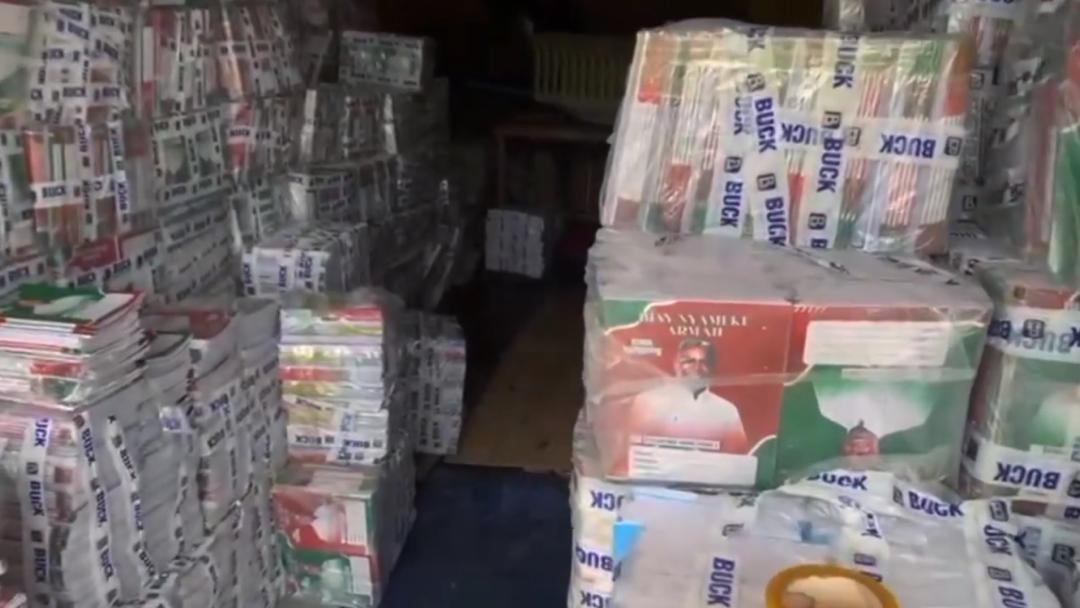
“In my quest to support education in Sekondi, I have secured 300,000 exercise books for distribution to basic school students in the constituency, and it is absolutely free,” he said
The gesture, though political in origin — a campaign promise made during the 2024 parliamentary elections — touches a real nerve in the country’s education system which is the challenge to balance access with affordability.

Mr. Nyameke Armah, who is affectionately known as “Cool Running”, argues that education remains the best investment and therefore his desire to ensure parents have a “cool running” this and subsequent new academic calendar. His initiative spans both public and private schools in Sekondi, with a notable inclusion where students who live in Sekondi but attend schools outside the constituency will also benefit, provided parents can verify their ward’s enrollment.
“Parents with children schooling outside Sekondi are to simply present their Voter’s ID along with the child’s birth certificate or postnatal record and evidence of the child’s enrollment for verification and collection of the books at the MP’s office.”
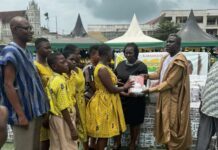
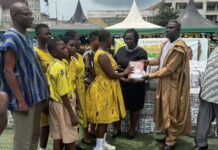
Over the weekend, an articulated truck was spotted offloading stacks of the books for onward distribution.
But the initiative goes beyond basic education. For students entering boarding in secondary school Mr. Nyameke Armah is providing 700 chop boxes and 700 trunks, easing what is often an expensive rite of passage for families.
Day students, too, are being promised free transport to and from school. “Every student deserves a strong start,” the MP insists.
In Ghana, the transition to secondary school is often a make-or-break moment. The government’s Free Senior High School (Free SHS) programme, launched in 2017, has dramatically increased enrollment but has also strained parents and schools alike with issues ranging from overcrowding to shortages of supplies. In this context, local-level interventions especially from politicians like Mr. Nyameke Armah often serve as crucial stopgaps.
While the MP’s intervention is applaudable, critics argue that such schemes risk being seen as political handouts rather than long-term fixes. For parents like Ama, however, the politics matters less than the practical relief. “At least for now, my children will not lack exercise books. That is what is important to me,” she said with a smile.
Her story is a reminder of the everyday struggles many Ghanaian families face in bridging the gap between the promise of free education and its lived reality. And in Sekondi, at least for this school year, some of that burden has been lifted.