
Once again, residents of Tarkwa in the Western Region have been served a crude reminder of an imminent danger — one that creeps closer with each passing day. If the effects of unsanctioned gold mining once felt distant and met with a laissez-faire shrug, this time the danger tolled agonizingly at home.
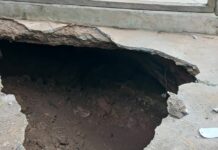
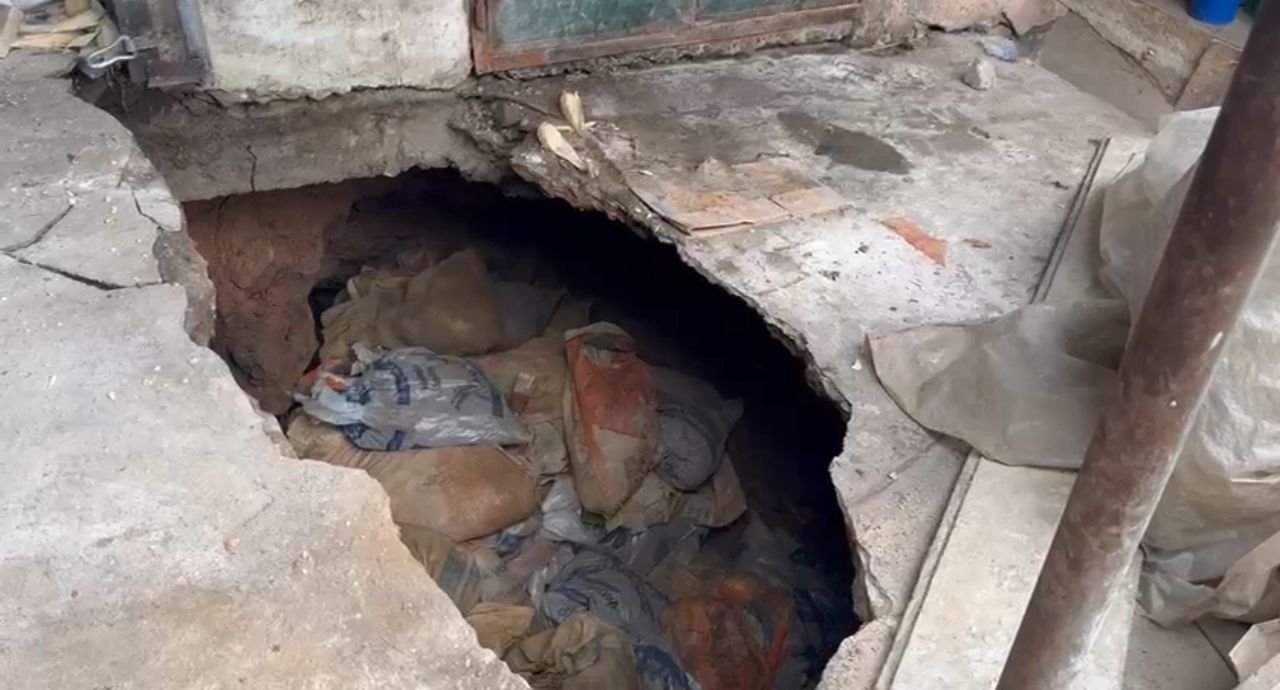
On Monday morning, September 8, 2025, traders at Tarkwa’s Women Market — Mbesiafo Gua Mu — unlocked their shops expecting another ordinary day. Instead, they were confronted with the unsettling sight of a gaping void. The frontage of two stores had collapsed overnight, revealing a deep, jagged hole that extended towards other stores.
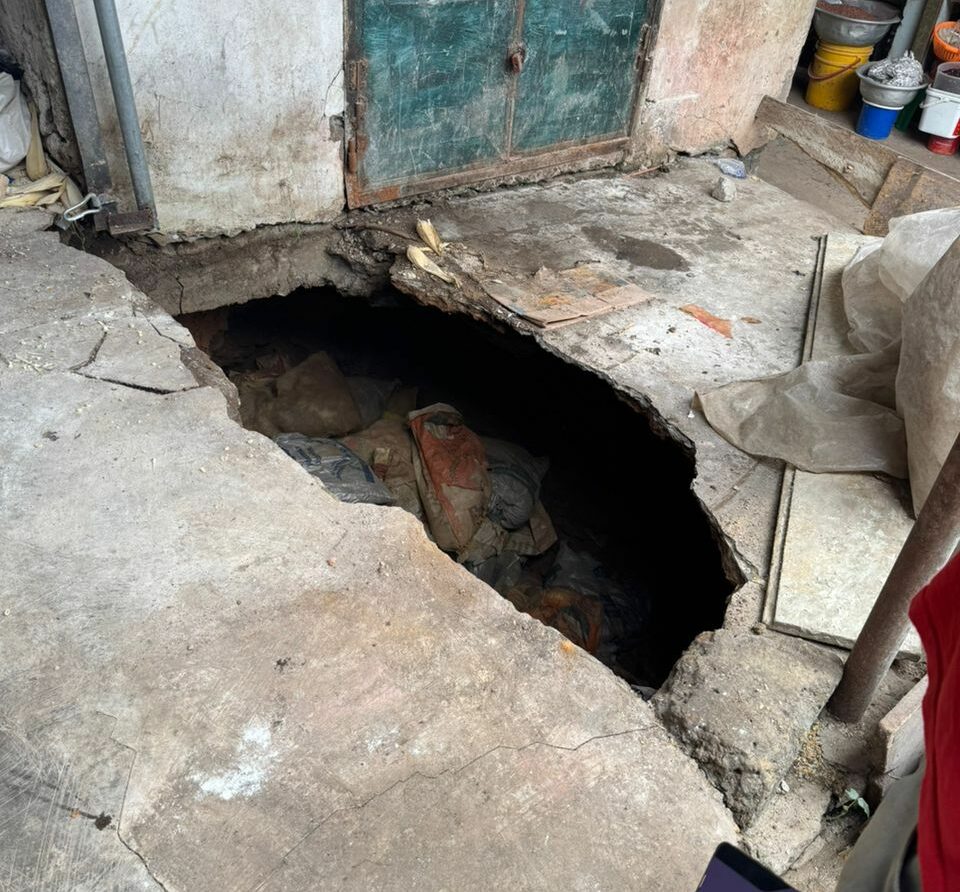
For a moment, there was unease. Traders muttered words of sympathy to their affected colleagues, glanced nervously at the hole, then resumed business. A few shifted their wares to safer ground, grateful that the collapse had not happened during trading hours.
Strangely, the two affected traders displayed their wares and carried on, even without the hole being covered. Their main worry was that customers might now avoid their shops. But as the market came back to life, the realization lingered: the ground beneath Tarkwa may not be as solid as it looks.
Tarkwa has been built quite literally on tunnels, shafts, and excavations. From the colonial era to the present, its soil has been burrowed and blasted in search of ore. Today, both large-scale firms and artisanal miners continue to dig. The result is a town seemingly perched on fragile ground.
“This is not the first time such a cave-in has happened in Tarkwa and its environs,” Esi Brew Monney, a journalist with Space FM who covered Monday’s incident, told ConnectNews.
“Similar but smaller ones have been recorded, but are often left unreported. Most of them are covered up immediately.” Last year, she recalls, portions of the Nana Angu Road — commissioned only in 2019 — caved in, disrupting traffic. The incident barely made headlines before it was patched and forgotten.
But elsewhere in Tarkwa, the consequences have been deadly. In 2021, a galamsey pit collapsed near Bonsawire, killing seven people. More recently, in 2023, an underground cave-in was reported at the Tarkwa Community Mine.
As Monday’s market collapse shows, the risks are no longer confined to miners. Ordinary residents and traders — people who have no part in extracting gold — are increasingly vulnerable. “Sometimes I feel like the whole of Tarkwa is hanging,” a resident once remarked in an interview — an expression that captures both anxiety and geological truth.
Researchers back those fears. A 2023 study mapped land subsidence vulnerability across the Tarkwa–Prestea belt, warning of “dead zones” where ground collapse is highly probable.
The University of Mines and Technology (UMaT), based in Tarkwa, has the tools to conduct seismic and geophysical surveys. The Ghana Geological Survey Authority has also experimented with seismic refraction and tomography in the region. Their conclusion is consistent: more systematic mapping is urgently needed.
When ConnectNews contacted the Municipal Chief Executive, Ebenezer Cobbinah, he admitted the incident “had not come to [his] notice,” and asked for the location where it happened. It was at the time of filing this report.
Tarkwa’s story is one of a paradox. Its gold has enriched Ghana, funded development, and sustained global industries. But the wealth extracted has left behind a precarious landscape and communities exposed to risks they did not choose. The latest cave-in at the Women Market is more than a local inconvenience; it is a warning tremor. Without proactive measures, a larger disaster — perhaps under a residential block, a school, or a busy lorry park — is not just possible, but inevitable.
The call for action is clear. Seismic and geophysical surveys must be expanded to map the most dangerous areas in Tarkwa. As the old saying goes, a stitch in time saves nine.
Eric Yaw Adjei|ConnectFM|Takoradi