
In a bustling gold mining town where the rumble of heavy trucks often drowns out conversation, one taxi driver has chosen a different kind of engine noise: the quiet hum of kindness.
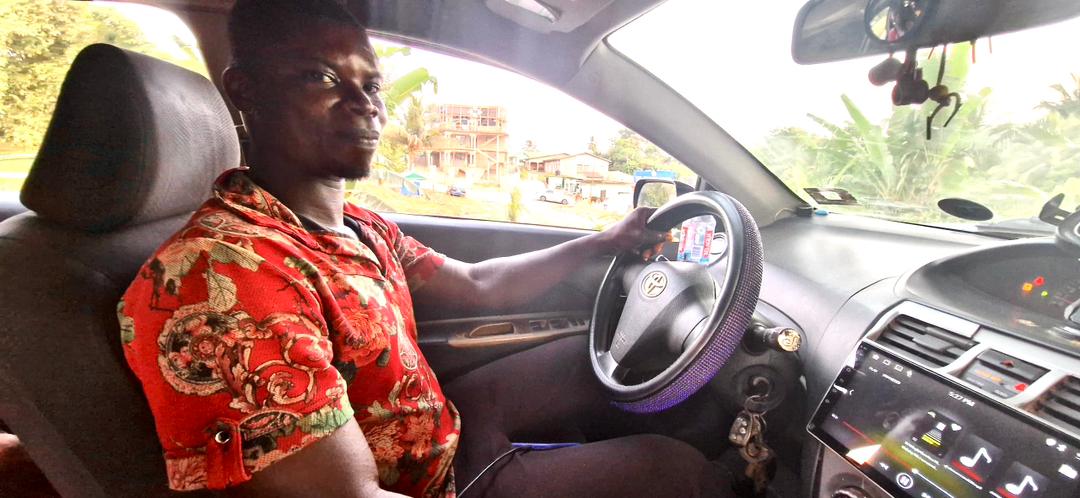
For three years, 34-year-old Nicolas Enyaah has navigated the dusty, potholed roads of Tarkwa and its surrounding communities.
He knows every junction, every market day rush, and every passenger’s silent prayer for a safe ride home. But for the past twelve months, Nicolas has been driving for a reason that has nothing to do with his meter.
He has stopped charging the elderly and physically challenged passengers who step into his Blue-and-yellow Toyota Yaris with registration number GN 3530-20.
“It started small,” Nicolas says, wiping his brow after a morning drop-off near the Tarkwa Municipal Hospital.
“I picked up an old woman leaning on a stick at the roadside. Three other taxis had passed her. When we got to her destination, she started counting coins from a small black polythene bag. It was all she had. I told her, ‘Mama, keep your money.’ She cried.”
That was the moment Nicolas made a quiet vow. For the next years ahead, any passenger who was visibly aged or living with a physical disability would ride for free.
It hasn’t been easy. Taxi driving in Tarkwa is a daily grind, long hours, rising fuel costs, and the constant pressure to make enough to save for a rainy day. Nicolas rents his taxi from the owner, meaning he must first earn the daily “drop” before he earns a single cedi for himself.
“Some days I make my target late because I gave three, four free rides,” he admits. “Other drivers call me foolish. They say, ‘Nico, you are not an NGO. You are a taxi driver.’ But I tell them, an NGO cannot see the old man struggling to fold his wheelchair into a trunk. I see it.”
Over the past year, word has spread slowly but surely through Tarkwa’s tight-knit communities from the stalls of the Market Circle to the benches of the old persons’ center at Abosso.
Passengers now know that if they see Nicolas’s car, with its slightly faded “God Is Love” sticker on the rear window, they can breathe easier.
Maame Esi Quansah, 78, a retired fish seller who uses a walking frame, has been a regular passenger for six months.
“I used to wait an hour for a taxi. Some drivers would see my frame and just wave ‘no,’” she says, seated on a wooden chair outside her modest home. “But Nicolas? He jumps out. He holds my elbow. He folds my frame into the back seat like it’s made of glass. And when I try to pay, he smiles and says, ‘You already paid by being my grandmother for today.’ I have a son his age. My son does not do that.”
For those with more severe physical challenges, Nicolas has gone further. He has learned by watching online videos and asking a nurse friend how to safely help passengers transfer from wheelchairs or crutches into his front seat. He carries a small foldable stool to help with step-in height.
“Dignity,” he says. “That’s what they miss most. Not just the money. The dignity of being treated like any other passenger.”
The irony is not lost on Nicolas. He works in Tarkwa, a town built on gold, yet he finds his richest moments in giving something away for free.
“Gold is underground,” he says, tapping his chest. “But humanity is here. If you lose your humanity, all the gold in Obuasi and Tarkwa cannot buy it back.”
When asked what he hopes for in the next year, Nicolas doesn’t ask for money, sponsorship, or recognition. He says quietly:
“I hope other drivers see that the meter doesn’t measure a person’s worth.
And I hope my passengers know the old ones, the ones who struggle to walk they are not forgotten.”
Then he glances at his phone. A regular customer, a 72-year-old man with a cane, needs a ride to the clinic. Nicolas stands up, grabs his keys, and heads for the door.
Another day. Another free trip.
Another reminder that in a town that moves fast on the back of mining trucks, the slowest, kindest taxi driver is the one leaving the biggest mark.
By Ebenezer Atiemo