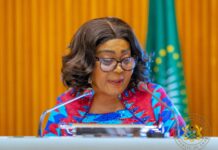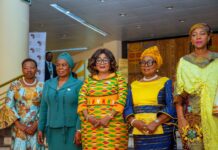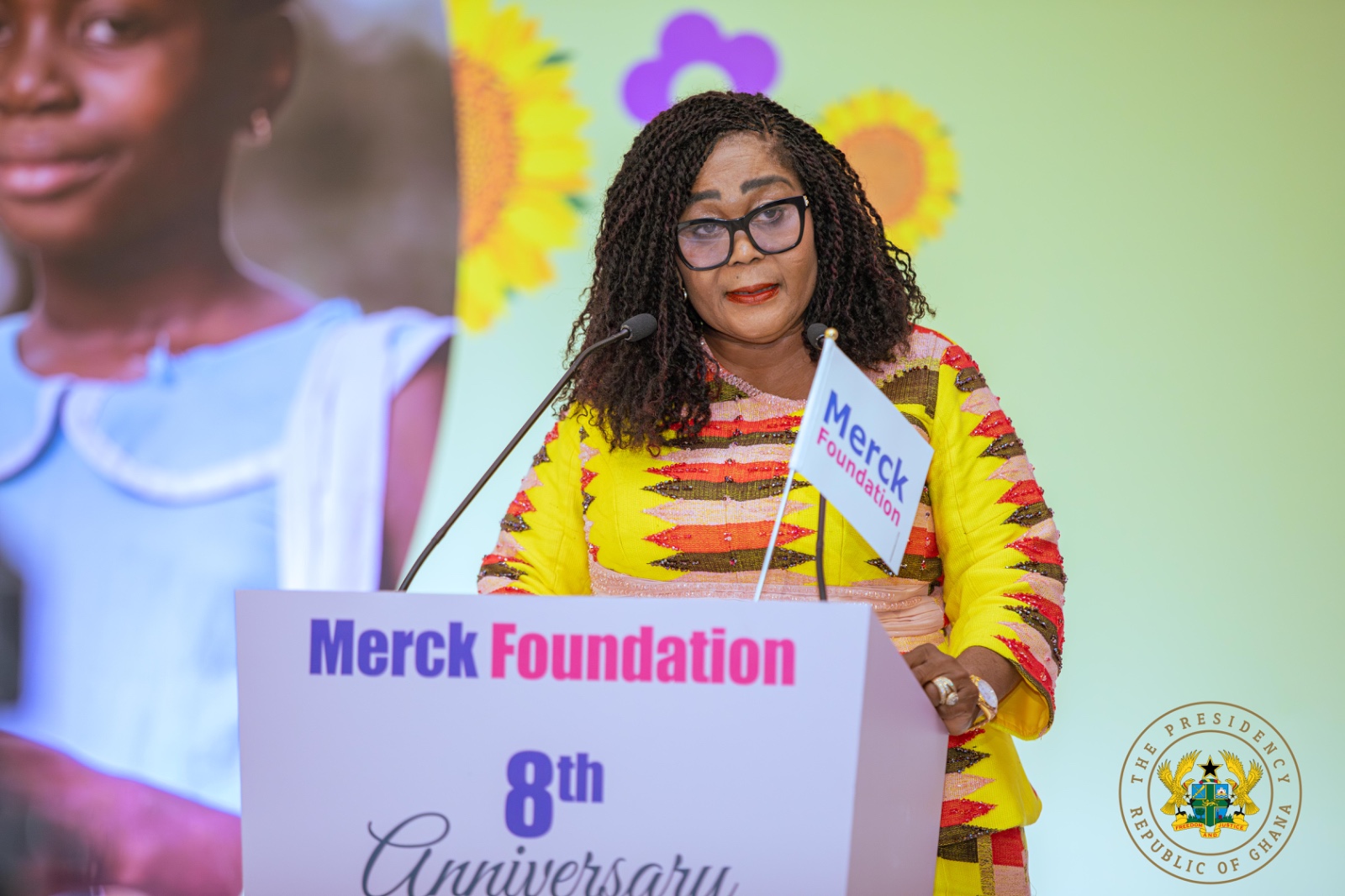

The First Lady, Lordina Mahama, through the Deputy Chief of Staff Nana Oye Bampoe Addo, has highlighted some of the key reforms undertaken by the Mahama administration to boost education in Ghana.
In a speech read on her behalf during the 79th Speech and Prize Giving day of the Aburi Girls Senior High School on Saturday, November 29, she said that senior High School Education occupies a very critical position in Ghana’s educational framework because it helps shape the ideologies, work ethics, patriotism, and character of our young men and women.

Under the leadership of His Excellency John Dramani Mahama, she said, the national Reset Agenda has targeted every level of the education chain, especially Senior High Schools, to ensure that schools like Aburi Girls are supported, lifted, and strengthened to produce morally grounded, academically excellent future leaders.
The key education reforms and achievements thus far under President Mahama’s leadership, she highlighted included:
- National Education Consultative Forum: On 18th February 2025, President Mahama set the tone for an all-inclusive reset agenda by launching the National Education Consultative Forum. This forum engaged parents, teachers, students, and civil society to forge deeper collaborations and hold discussions on a number of educational reforms. The outcome was represented as the report on Transforming Education for a Sustainable Future. The report proposes a comprehensive framework for improving infrastructure, enhancing access, increasing accountability and ensuring quality teaching and learning.
- Sustaining and improving upon Free SHS Policy: Ladies and Gentlemen, critics once said H.E. the President was going to abolish the free SHS policy. However, today, we are all witnesses to not just a sustained policy, but also a reliable source of funding through the Ghana Education Trust Fund (GETFund) allocation. GETFund is now uncapped and amount of 5 billion cedis has been allocated to ensure this policy is continued and improved. Today, we have rather said “bye-bye” to the double track that disrupted quality study hours for our children.
- GHC 33.3b allocation to complete E-blocks and the expansion of infrastructure under the 2026 budget allocation: Out of this amount, GH¢ 2 billion will be used in the construction of 200 new JHS blocks, 200 primary schools, 200 kindergartens, 400 teacher bungalows, and 400 sanitation facilities; GH¢ 157 million Capitation Grant to support teaching and learning; GH¢ 292 million for Free sanitary pads for girls. In addition, an additional GH¢ 9.9 billion is budgeted for the GETFund to help undertake various developmental projects as well as grant scholarships for brilliant but needy students.
- Decentralised School Feeding Programme: On 7th November, 2025, Cabinent approved a new arrangement where CHASS will now handle the procurement of six key grain and legume items; maize, gari, beans, peanut, millet and soybeans, while NAFCO and the Ghana Commodity Exchange will supply twelve other essential food items, including rice, vegetable and palm oil, margarine, tomato paste, flour, milk, hot chocolate, sardine, mackerel, sugar and tombrown.

Importantly, the procurement of all grains, poultry and eggs will be sourced exclusively from local Ghanaian producers, reinforcing government’s commitment to the Made-in-Ghana campaign and supporting local farmers and agribusinesses. Following this directive, we are happy to note that outstanding feeding claims and issues have been resolved in our various senior high schools “No Fees, No Stress” – Free Tertiary for First-Year Students: On 5 July 2025,
Mahama launched the “No Fees Stress” policy, covering academic fees for all first-year students in public tertiary institutions. As of September 2025, over 120,000 students have received refunds under this policy. He has also urged transparency in implementation and linked the policy to a revamped Student Loan Plus scheme. For you in SHS, it means the moment you finish, the financial barrier that normally blocks many graduates from moving forward is removed.
- Free Education for Persons with Disabilities: In launching the Free Tertiary Education for Persons with Disabilities initiative on October 24, 2025, our government reaffirmed its commitment to inclusive education. The program covers full tuition fees for eligible individuals with disabilities attending public tertiary institutions, managed through a revamped and digitalised Students Loan Trust Fund (SLTF).
- Use of Mother-Tongue Instruction in Basic Schools: Under Mahama’s Reset Agenda, the Minister of Education has made mother-tongue instruction compulsory across all basic schools. This is part of a broader effort to strengthen foundational learning by allowing children to learn in a familiar language first.
- Restoration of Parent-Teacher Associations (PTAs): On 17th July 2025, the Ghana Education Service (GES) directed all public pre-tertiary schools to reinstate Parent-Teacher Associations (PTAs) following a presidential directive.
This aligns with President Mahama’s belief that communities and parents must play a role in shaping education outcomes.
- Curriculum Reform and Moral Education: Our government is also seeing to the implementation of a new curriculum for technical, STEM, and other schools, reinventing syllabus content to match national development needs. He also emphasised the reintroduction of Religious and Moral Education (RME) and civic education is also to be reintroduced to strengthen character formation. In an era of AI and technology, it is refreshing to note that we are leveraging these tools to improve teaching and learning. In various senior high schools, applications have been developed on specific subjects to help teachers in making their lesson notes simpler.
- Teacher Welfare & Rural Teacher Support (Teacher Dabr3): The Ministry of Education has started a review of the ‘Teacher Dabr3’ initiative as part of a broader plan to improve teacher housing across the country. On November 19, 2025, the Ministry announced that 400 teachers’ bungalows announced in the national budget formed part of the revived Teacher Dabre programme.

Government is also working with GETFund, the District Assemblies Common Fund and teacher unions on a long-term plan to deliver 50,000 housing units for teachers.