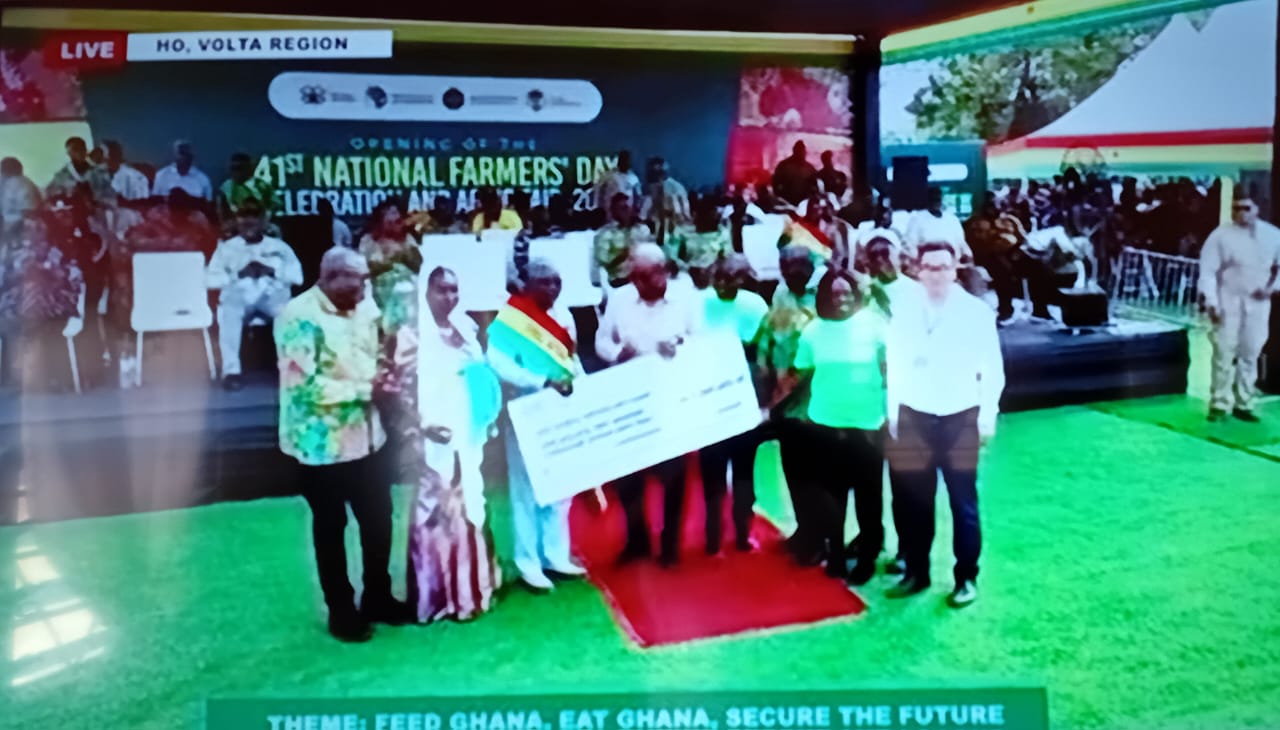

An 82-year old man, Mr Opanyin Abraham Kwaku Adusei has been adjudged the Overall Best National Farmer for 2025.
The 1st runner up was Osman Kadiri while the 2nd runner up went to 63-year-old Charles Gyato from the Oti Region.
The received cash prizes for their hard work.
The awards were presented to them by President John Mahama during the 41st National Farmers Day Awards Ceremony in Ho, the Volta Regional Capital.
In his speech, President John Dramani Mahama touted the benefits of farming to all Ghanaians.
The President told, especially those in formal employment that they could do so as an additional source of income.
The President made the call when he addressed famers and other stakeholders at the 41st National Farmers’ Day Celebration in Ho on Friday, December 5.
“Agriculture isn’t only for the village folks,” he said.
He added “You can work and still be a farmer. Teachers and civil servants can go to work and have farms, and the money from the farm can supplement their incomes.”
The President stated that many professionals—teachers, civil servants, and private sector workers—can successfully combine their regular jobs with farming.
He stressed that embracing agriculture as a secondary enterprise would not only improve household finances but contribute to national food security and reduce Ghana’s dependence on food imports.
The President reiterated his administration’s commitment to creating an enabling environment that makes farming more attractive and profitable for all categories of workers.
Meanwhile, the Minister of Food and Agriculture, Eric Opoku, has appealed to corporate Ghana to partner with the Ministry to support farmers.
“I want to urge Cooperate Ghana to partner with the Minister,” he said.
Earlier, the Minister underscored the importance of timely and accurate weather information to agriculture.
He makes the point that agricultural success today depends not only on land and labour, but on timely and accurate weather information.
“Climate variability and unpredictability are among the greatest risks our farmers face — and responding to these requires systems that generate, analyse, and disseminate data in real time,” he said recently during the Government Accountability Series Session.
He highlighted that the Ministry has made significant strides in transforming Ghana’s agro-meteorological landscape.
Earlier, the Minister of Food and Agriculture, Eric Opoku, appealed to corporate Ghana to partner with the Ministry to support farmers.
Addressing the 41st Farmers’ Day celebration in Ho in the Volta Region on Friday, December 5, he said there is a renewed national commitment to supporting agric.
“I want to urge Cooperate Ghana to partner with the Minister,” he said.
Earlier, the Minister underscored the importance of timely and accurate weather information to agriculture.
He makes the point that agricultural success today depends not only on land and labour, but on timely and accurate weather information.
“Climate variability and unpredictability are among the greatest risks our farmers face — and responding to these requires systems that generate, analyse, and disseminate data in real time,” he said recently during the Government Accountability Series Session.
He highlighted that the Ministry has made significant strides in transforming Ghana’s agro-meteorological landscape.
Automated Weather Stations (AWS)
He said they have installed twenty automated weather stations across the country under the Ghana Meteorological Agency (GMeT). These stations, unlike manual ones, collect data automatically 24/7, ensuring: Higher accuracy and consistency; Faster data transmission to GMeT’s central database; Elimination of manual dependency for readings; Enhanced forecasting and climate modelling for disaster prevention and farm planning.
Read also: The peace of Ghana will be defended, the country will remain secure, stable and just – Mahama
Out of the 20 Automated Weather Stations, he said, 11 are located in Senior High Schools, where Climate Clubs have been formed to promote environmental literacy and ownership. This does not only provides physical security for the instruments, but also educates the next generation about climate-smart agriculture, he said.
The Automated Weather Stations allow us to provide farmers with precise and hyper-local advisories on rainfall patterns, temperature trends, wind conditions, and soil health – directly influencing planting, harvesting, and fertiliser application decisions.
To integrate and analyse data from both manual and automated weather stations, the Ministry is establishing a Management Information System (MIS). The system will enable real-time analysis, visualisation, and dissemination of weather forecasts to support cropping decisions, food system planning, and early warning mechanisms.
The supplier for the MIS has been shortlisted and the evaluation report has been submitted to the World Bank for approval. Once completed, this MIS will serve as the digital backbone of Ghana’s agro-meteorological intelligence