
India and the European Union have concluded a landmark Free Trade Agreement (FTA), marking a major breakthrough in India’s global trade engagement.
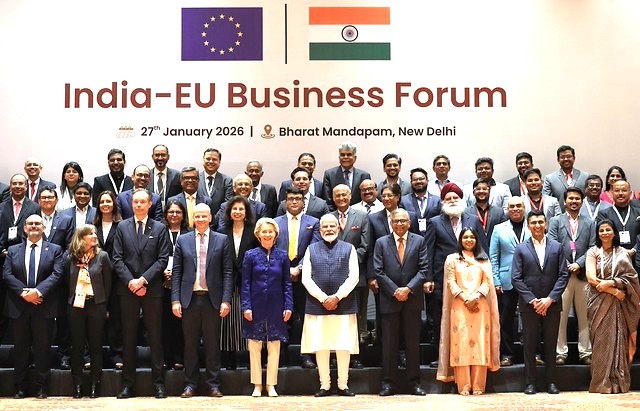
The historic announcement was made at the 16th India–EU Summit by the Prime Minister of India, Shri Narendra Modi, and the President of the European Commission, H.E. Ursula von der Leyen.
The agreement brings together the world’s fourth-largest economy, India, and the second-largest economy, the European Union, which together account for nearly 25 percent of global GDP. The FTA is expected to significantly boost trade, investment, job creation, and innovation between the two partners.
Massive Market Access for Indian Exports
Under the agreement, over 99 percent of Indian exports will receive preferential access to the EU market, creating unprecedented opportunities for Indian businesses. Exports worth USD 75 billion are expected to gain from the deal, including USD 33 billion from labour-intensive sectors such as textiles, leather, marine products, gems, and jewellery.
The agreement is also expected to create new opportunities for MSMEs, women, artisans, youth, and professionals, while strengthening the Make in India initiative through reciprocal market access.

Boost for Agriculture and Food Exports
India’s agricultural and processed food sectors are poised for major growth under the FTA. Products such as tea, coffee, spices, fresh fruits, vegetables, and processed foods will gain enhanced competitiveness in the EU market.
At the same time, India has safeguarded sensitive sectors including dairy, cereals, poultry, soymeal, and selected fruits and vegetables, ensuring a balance between export growth and domestic priorities.
Services, Mobility, and Digital Trade
The agreement provides commercially meaningful market access in services, including IT and IT-enabled services, professional services, education, finance, tourism, and construction. Indian service providers will gain predictable access to 144 EU service sub-sectors, while EU firms will access 102 Indian sub-sectors.
A future-ready mobility framework will facilitate business travel, intra-corporate transfers, contractual service suppliers, and independent professionals. The agreement also supports student mobility, post-study work opportunities, and constructive engagement on social security agreements.
Innovation, Sustainability, and Regulation
The FTA includes forward-looking provisions on carbon border adjustment mechanisms (CBAM), regulatory cooperation, and non-tariff barriers. It also promotes collaboration in artificial intelligence, clean technologies, and semiconductors.
Intellectual property protections are reinforced in line with international standards, while recognising India’s Traditional Knowledge Digital Library (TKDL).
A New Chapter in India–EU Relations
The India–EU FTA marks a new era in bilateral economic cooperation, strengthening trade, innovation, and strategic partnership between India and the 27-member EU bloc.
The agreement is expected to integrate Indian businesses more deeply into global value chains and open up the entire European market for Indian exporters especially when combined with India’s recent trade deals with the UK, EFTA, Oman, and Australia, and the newly concluded agreement with New Zealand.
Aligned with India’s vision of “Viksit Bharat 2047,” the FTA positions India as a dynamic and trusted global partner, laying the foundation for inclusive, resilient, and future-ready growth for both India and the European Union.