

A Political Science lecturer at the University of Ghana, Dr. Kwame Asah-Asante, has outlined what he believes the opposition New Patriotic Party (NPP) should do, if they really want to win power in 2028.
His comments are with regards to the candidate they elect to lead them as flagbearer in today’s presidential primary.
Dr. Asah-Asante noted that “it’s not about who the polls is saying is winning or not.” However, he explained that the party needs a candidate with less baggage and ideas that transcend beyond the party to the general populace.
According to him, the track-record of the party is also going to be a major factor aside from the traits of the candidate in question.
“If NPP really want power, they need to look for somebody with less bargaining. Two, you need to have somebody whose ideas and vision goes beyond the NPP to cover the whole state. You need somebody who is alive to the problems of this country and he also have solutions to the problems of the country,” he explained.
Meanwhile, the political scientist believes the most important trait the candidate should possess is one whose strategies resonates with the masses.
“And above all, you need somebody who has the numbers, and the numbers is a function of your track record, the record of your government or previous government and you should be able to have somebody who can develop strategies, messages, that will resonate with people,” he explained.
“These are the canons that we are going to use to judge whoever will become the flagbearer of the party. If you lack these qualities, I’m afraid you’re not going to have the 2028 elections as easy as you think. It’s going to be a daunting task for that individual,” he cautioned.
A total of 211,849 delegates are expected to take part in the NPP’s presidential primary today, Saturday, January 31, 2026, according to official data from the party.
The delegates are drawn from the party’s 16 regions, the national headquarters, and the diaspora, following adjustments for deceased members and forfeitures.
Originally, 213,617 delegates were on the register, but 2,827 deaths and 653 forfeitures have reduced the final voting strength.
According to the data, the Greater Accra Region has emerged as the single largest voting bloc, with 40,162 delegates, representing approximately 19 per cent of the total electorate.
Closely behind is the Ashanti Region, traditionally the party’s strongest base, contributing 36,620 delegates, or about 17 per cent.
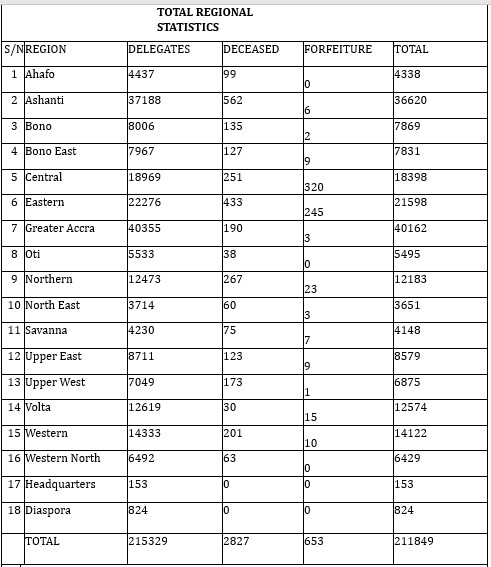
The Greater Accra and Ashanti regions together account for over one‑third of all delegates, making them decisive battlegrounds for all flagbearer hopefuls.
Also, the Eastern region, often described as a political bellwether within the NPP, contributes 21,598 delegates, representing about 10 per cent of the total.
This places it third on the list and firmly positions it as a region candidates cannot afford to overlook.
The Central Region follows with 18,398 delegates (9 per cent), while the Western Region accounts for 14,122 delegates (7 per cent).
Together, these three regions add more than 54,000 votes, reinforcing their strategic importance in a tightly contested primary.
Meanwhile, in the Volta enclave, where the NPP has been working to expand its support base, 12,574 delegates (6 per cent) are expected to vote.
The Northern region contributes 12,183 delegates (6 per cent), highlighting its growing influence within the party’s internal elections.
The Bono, Bono East, and Upper East regions each provide between 7,800 and 8,600 delegates, accounting for roughly 4 per cent apiece.
The Upper West and Western North regions contribute 6,875 and 6,429 delegates respectively, each representing about 3 per cent of the total vote.
Smaller regions and special voting centres
Among the smaller voting blocs, the Oti region will field 5,495 delegates, while the Ahafo region contributes 4,338 delegates.
The Savanna region has 4,148 delegates, and the North East region records 3,651 delegates, each accounting for about 2 per cent of the national delegate pool.
In addition, the NPP National Headquarters will have 153 delegates, while the Diaspora chapter contributes 824 delegates, reflecting the party’s growing international footprint, though together they make up less than one per cent of the total vote.
Deaths and forfeitures
The regional statistics also reveal the scale of attrition within the delegate list.
The Ashanti region recorded the highest number of deceased delegates (562), followed by Eastern (433) and Central (251).
The Central region also recorded a notably high number of forfeitures (320), with Eastern (245) and Northern (23) also affected.
With more than 211,000 delegates voting nationwide, today’s primary is expected to be one of the largest internal elections in the party’s history.
It’s a fact Bawumia was sidelined as Vice President – Kofi Bentil