
As a long-standing practitioner in the West African cocoa sector, I have observed the ongoing debate regarding the state of Ghana’s cocoa industry with deep anxiety and profound alarm.
My position is clear: the government and the leadership of the Ghana Cocoa Board (COCOBOD) must move beyond partisan finger-pointing and confront systemic issues head-on.
Failure to do so will transition the Ghanaian cocoa farmer from a state of mere struggle to one of abject, irreversible poverty and a further weakening of the sector.
The Living Income Quandary
Typically, the Ghanaian cocoa farmer sadly does not earn a “Living Income”. By definition, a living income is the net annual income a household is required to afford a decent standard of living, including food, housing, healthcare, and education.
While the Living Income benchmark for a rural cocoa household in Ghana is estimated at $5,500 to $6,500 per annum, most studies indicate that our cocoa farmers earn 50% less than this target.
Despite the introduction of the Living Income Differential (LID) in 2019/2020, external economic shocks continue to widen the gap. Therefore, the recent reduction in the producer price by the government of Ghana – slashing it from approximately GH¢3,625 to GH¢2,587 per bag in February 2026, does more than just tighten belts; it decimates the livelihood of our cocoa farmers – the very people who sustain our economy.
Ghana’s Cocoa Production under Existential Threat
Cocoa remains the historical backbone of our economy, yet it currently faces an existential threat that transcends partisan blame. We have plummeted from a record peak of over 1 million metric tonnes in 2021 to a struggling estimate of 600,000 metric tonnes for the 2024/2025 cocoa season.
This downward trajectory, if left unchecked, will see Ghana overtaken by the likes of Ecuador and Indonesia, relegated from our world number two spot to a secondary player. To save this industry, we must apply “brute honesty” to our technical, environmental, and financial realities.
Financial Realities vs. Political Rhetoric
The 28% reduction in the producer price is set to cause irreparable hardship. In this context, I was deeply unsettled by recent public comments made by the CEO of COCOBOD, Randy Abbey. His rhetoric suggests a lack of appreciation for how the words of a regulator can trigger volatile reactions on the international market.
In the commodities world, it is an established fact that when the CEO of a major producing origin comments on internal issues – be it the severity of Cocoa Swollen Shoot Virus Disease (CSSVD), El Niño, or Galamsey – the market reacts to the implied supply shortfall. It is undeniable, that official comments confirming that over 40% of our farmlands are diseased caused global cocoa futures to surge, as traders realized the “pipeline” of future supply was broken.
Furthermore, we cannot downplay the importance of Forward Sales and Rollovers. COCOBOD traditionally sells a large portion of the harvest forward. When leadership makes frantic political comments about a “buyer-funded model” or “uncompetitive pricing,” it triggers a “Short Squeeze. International buyers, fearing Ghana cannot meet its contracts, rush into the “spot” market, driving prices to record highs (as seen in the $12,000/tonne peak of 2024).
Conversely, admitting our beans have become “too expensive” signals buyers to shift capital to Ecuador, Brazil, or Ivory Coast, leading to a liquidity crisis as international lenders withdraw financing. It was heartwarming to see Hon. Michael Aidoo, the MP for Oforikrom analyze this phenomenon creditably.
The Biological and Environmental Siege
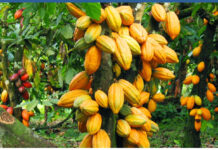
It is important to mention that the productivity of our “Gold in a Pod” is being decimated by two primary factors that require swift action by government:
The CSSVD Pandemic: This is a national emergency. Approximately 60% to 80% of Ghana’s cocoa farmlands are currently infected. We are looking at a scenario where nearly half our productive capacity is decimated. While the Cocoa Rehabilitation Programme initiated by the NPP administration was a necessary start, its success depends on enhanced financial resourcing and the provision of social safety nets for farmers during the five-year gestation period before new trees mature.
The ‘Galamsey’ Menace: Incidentally, cocoa production thrives in our gold and other mineral resources areas. Illegal mining is not merely destroying cocoa lands; it is poisoning future generations. The use of mercury and cyanide renders soil unfit for cocoa production for decades. When farmers trade ancestral lands for short-term mining cash, they are effectively liquidating their children’s inheritance.
The EUDR Regulatory Ticking Clock
The government and the current COCOBOD leadership must realize that the European Union Deforestation Regulation (EUDR) clock is ticking. The EU, which consumes over 60% of our beans, is no longer “requesting” traceable and sustainably produced beans – they are demanding it.
By late 2026, the EUDR will be in full force. If Ghana cannot prove via a verifiable rigorous traceability system that its cocoa is “deforestation-free,” we will lose our primary market. This is a market requirement, not a political choice, and the cost of mapping smallholder farms is a burden COCOBOD must prioritize over media optics.
The Social Crisis of Ageing Farmers
The average cocoa farmer in Ghana is now between 55 and 60 years old. Our youth (including graduates from our Schools and Colleges of Agriculture and Agribusiness) do not see cocoa farming as an attractive career; they see it as a “poverty trap.”
Without mechanization and a clear path to profitability therefore, the migration from rural cocoa belts to urban centers will continue, leaving our farms to fallow or be swallowed by illegal miners.
Some recommendations for Urgent Reform
Considering these challenges, the leadership of COCOBOD does not have the luxury of even a single minute to spare on unproductive theatrics of media circus. The CEO must trade the “political suit” for wellington boots, sit with farmers at the ‘kokoo aboye’ (pod-breaking sites on cocoa farms), and listen to the unadulterated intricacies of the sector.
I propose the following immediate actions:
Depoliticize COCOBOD: Embark on a structural reform of the Board, ensuring it operates as a technical regulator rather than a political tool, while implementing a robust debt management programme to address the GH¢32.9 billion debt burden.
Aggressive Value Addition: We must revisit and work to realize President Kufuor’s vision of processing significant percentage of our cocoa beans locally (at least 50%). This requires Public-Private Partnerships (PPP) that guarantee local processors a steady supply of beans.
Land Tenure Reform: Modernize our sharecropping systems (the age-old Abunu and Abusa) to provide legal security for farmers, encouraging long-term investment in soil health.
Integrated Galamsey Response: COCOBOD must partner with the Ministry of Lands and the Minerals Commission to create a tailor-made “Cocoa Environmental Governance Regime” that protects cocoa production zones from mining and deforestation. Ghana must enhance its implementation of the Cocoa and Forests Initiative (CFI).
Revisit the CEPPP model: The defunct Cocoa Extension Public-Private Partnership spearheaded by the COCOBOD proved to be an effective and efficient model for providing extension service to cocoa farmers.
For a number of years, it served as an enabler for adoption of good agricultural practices for increased productivity and production of sustainable cocoa beans. This important intervention should be revisited, reviewed and possibly implemented again in partnership with sector stakeholders.
Utilize the GCSDS II: The Ghana Cocoa Sector Development Strategy II, which I had the privilege of helping prepare under the auspices of World Cocoa Foundation, World Bank and the Ghana Cocoa Board, should be revisited and utilized as a primary guidance document for the sector’s reform.
The cocoa sector is at a crossroads. We can either continue the path of political finger-pointing or we can embark on an agribusiness transition that restores Ghana to its rightful place as a global leader. The time for the latter is now.
By Vincent Frimpong Manu, ESQ
The author is a Former Ghana Country Director for the World Cocoa Foundation and Former Ghana Country Manager for Solidaridad West Africa. He has coordinated flagship cocoa projects across Cameroon, Côte d’Ivoire, Ghana, and Nigeria.