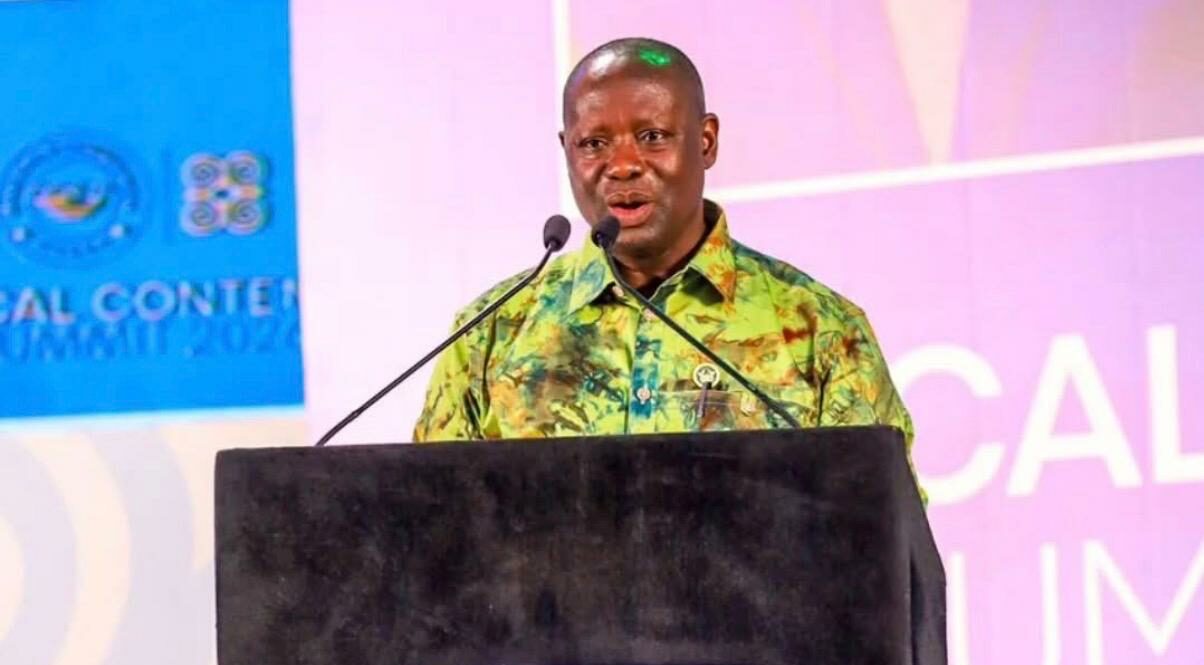

The Lands and Natural Resources Minister, Emmanuel Armah-Kofi Buah, has stirred a debate on the need to re-examine how mining proceeds are shared particularly the benefits accruing to host communities that bear and live with the direct, and often life-changing, effects of mining.
He raises a question that goes to the heart of Ghana’s extractive economy and perhaps exposes the structural weakness that continues to deny the country and especially mining host communities the full benefits of their mineral wealth.
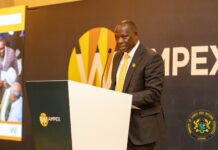
Speaking at the maiden Local Content Summit in Takoradi in the Western Region, Armah-Kofi Buah argued that the issue is no longer about how much Ghana extracts, but how much value it retains.
For decades, mining has generated billions of cedis in export earnings, “yet local businesses capture less than 40 per cent of procurement spend, while over 70 per cent of high-value services are sourced from abroad”. Engineering design, specialised technical support and equipment supply, where the real margins lie, remain largely foreign-dominated. The result is a sector that produces wealth without anchoring prosperity.”

This imbalance, the Minister suggested, explains why mining communities often remain underdeveloped despite sitting atop some of the world’s richest mineral deposits.
Roads deteriorate, youth unemployment persists, and local economies stagnate, even as gold bullion is shipped out of the country. Retention, therefore, is not a slogan; it is the missing link between extraction and development, Richard Ellimah of Centre for Social Impact Studies has always argued
The Minister’s argument is in tandem with civil society organisation’s clamour that unless a larger share of mining revenue is retained within Ghana and deliberately channeled into host communities, the sector will continue to operate as “an enclave—productive, but detached”. Retained revenue means local procurement, local employment, skills development and infrastructure that outlives the mine itself. It is how mineral wealth is converted into social stability and long-term growth.

But retention is impossible, he warned, when fronting remains widespread.
The practice of foreign companies hiding behind Ghanaian fronts, he said, drains the economy of revenue and hollows out the very idea of local participation. Profits are expatriated, taxes are minimised, and Ghanaian “partners” are reduced to nominal shareholders with no real influence, capital accumulation or technology transfer.
In such arrangements, Ghana loses twice: first through lost fiscal revenue, and again through lost opportunity to build competitive indigenous firms. The Minister’s condemnation was unequivocal, describing fronting as a betrayal not only of the law but of the national interest.
Drawing lessons from the petroleum sector, the Minister recalled how local content enforcement faced stiff resistance but ultimately delivered stronger Ghanaian participation. Economic sovereignty, he argued, is secured not by goodwill, but by regulation that is applied without fear or favour.

Beyond enforcement, the Minister linked retention to value addition. Ghana, he said, must move beyond exporting raw minerals to refining gold locally, supporting a domestic jewellery industry, and leveraging lithium deposits to power industrialisation rather than merely feed foreign battery markets. These steps would ensure that value is captured at multiple points along the supply chain, multiplying jobs and income long after extraction ends.
“Our minerals are finite,” he noted, “but the industries we build from them need not be.”
In invoking Dr. Kwame Nkrumah and his insistence on control over the commanding heights of the economy, the Minister placed the mining debate within a broader historical frame. Political independence, without economic control, remains incomplete.
His question —gold leaves, but poverty stays—now demands an answer in policy, not rhetoric. “Retention is the test. Enforcement is the tool. And for communities living with the costs of mining, the outcome will determine whether Ghana’s mineral wealth finally translates into shared and lasting prosperity. And the Minister and the Ministry should be seen as leading the charge of moving from speeches, warnings and cracking the whip,” Richard Ellimah, told ConnectNews.
Eric Yaw Adjei