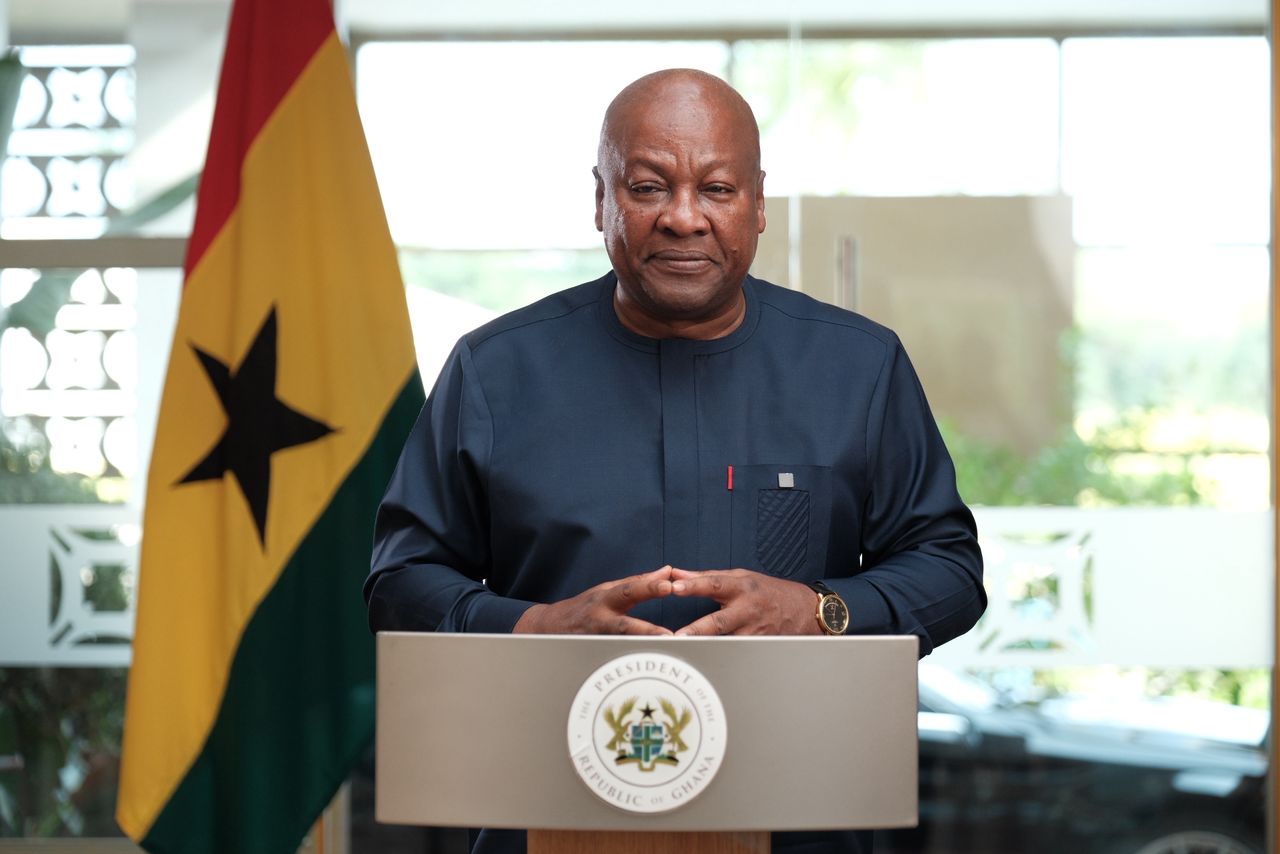

President John Mahama has reiterated his resolve to uproot corruption in Ghana.
Describing it as a “cancer”, President Mahama said practice is eating “the soul of our nation.”
“Let me speak plainly about a cancer that was allowed to eat at the soul of our nation for too long: corruption. Every cedi stolen from the public purse is a hospital bed that remains empty, a classroom without textbooks, a road left unmotorable, and a young graduate without opportunities.
Corruption mocks the sacrifices of our independence heroes. It betrays the trust of hardworking citizens who pay their taxes faithfully, expecting the government to be a faithful steward,” he said on March 6 in the 69th Independence address at the Jubilee House.
The President assured that, “Under my leadership, we will not pay lip service to fighting corruption. The war has been waged against it, and the fight will be intensified. I have insulated anti-corruption bodies from political interference and made it clear that no one, regardless of position or party, is above the law.
But the government alone cannot win this fight. We need a cultural revolution that invokes in us all the values of honesty, diligence, and accountability that our forebears held dear. We must teach our children that integrity is not negotiable, that wealth acquired through dubious means is a curse and not a blessing, and that true success is measured not by what we accumulate, but by what we contribute.”
He therefore charged Ghanaians to put their shoulders to the wheel in support of the fight against corruption.
“Countrymen and women, independence came with freedoms, but freedoms come with responsibilities. We must restore discipline to our national life. Discipline in how we handle public resources. Discipline in how we conduct ourselves in traffic, in queues, in public spaces.
Discipline in paying our taxes, obeying our laws, and holding ourselves to the highest standards. We must reignite patriotism, not the chest-thumping, superficial kind, but the quiet, consistent patriotism that makes a citizen pick up litter even when no one is watching, that makes a public servant treat every person with dignity, that makes an entrepreneur choose to invest at home rather than send capital abroad,” President Mahama urged.
Please read the full speech below:
Your Excellency, Vice President Jane Naana Opoku-Agyemang
Your Excellency, First Lady Lordina Dramani Mahama
The Honourable Prime Minister of St KiIs and Nevis,
Your Lordship, Chief JusLce Paul Baffoe Bonnie
Your Excellencies, former Presidents John Agyekum Kufuor and Nana Addo Dankwa Akufo-Addo
The Chief of Staff and senior government officials
Ministers and deputy ministers
Your Excellencies, Members of the DiplomaLc Corps
Honourable Members of Parliament
Naa-Mei, Nananom
Officers and Men of the Ghana Armed Forces and other Security Services,
Our school children and young Ghanaians
Countrymen and women
On this sacred day, the 6th of March, we gather once more to commemorate the freedom that our forebears won for us 69 years ago. We stand here not merely as witnesses to history, but as architects of our collective destiny, united by the red of our courage, the gold of our wealth, the green of our forests, and the black star that shines as a beacon of hope for all of Africa.
Today, as we commemorate our 69th year of independence, we do so under the clarion theme: “Building Prosperity, Inspiring Hope.” This reflects the covenant between the government and the citizenry. It is and must remain a sacred promise that guides every decision we make, every policy we craft, and every dream we dare to pursue.
Seven days ago, I stood before Parliament and presented the State of our Nation. I spoke candidly about our challenges and proudly about our progress. Today, I speak to all of Ghana, to every farmer in the northern savannah belt, every trader at Makola, every teacher in our classrooms, every nurse in our health faciliLes, every young entrepreneur with a smartphone and a dream, and every Ghanaian wherever they may be.
This is our story. This is our moment. We cannot speak of Ghana’s present without genuflecting at the altar of our past. Sixty-nine years ago, Osagyefo Dr Kwame Nkrumah, the founder of our nation, declared to the world: “The independence of Ghana is meaningless unless it is linked up with the total liberation of the African continent.”
Nkrumah did not merely give us a country; he gave us a consciousness. He reminded us that we are not just Ghanaians but Africans, with a sacred duty to lead, inspire, and uplift. He and the valiant men and women of the Big Six, alongside countless unnamed heroes and heroines, sacrificed comfort, liberty, and in some cases their very lives, so that we might breathe free.
Today, I say let us also remember those who came a[er them. Every president, every leader who, in their own time and with their own vision, contributed to building this nation. From Dr Kofi Abrefa Busia to General Akwasi Afrifa, from Flight Lieutenant Jerry John Rawlings to President John Agyekum Kufuor, from the late Professor John Evans Atta Mills to President Nana Addo Dankwa Akufo-Addo.
Each administration, regardless of political colouration, has laid bricks in the edifice we call Ghana. We may have differed in methods and philosophies, but we have been united in our love for this nation.
Today, I salute them all. Our democracy is stronger because we have learned to disagree without being disagreeable, to compete without destroying, and to transiLon power peacefully as a testament to the maturity of our people.
Your Excellency, Dr. the Honourable Terrance Drew, Prime Minister of St Kitts and Nevis, your presence here today is profoundly symbolic. Your visit, Wednesday’s bilateral discussions and your tour of the Cape Coast are not mere diplomatic courtesies. It is a homecoming, a reconnection of branches torn from the same ancestral tree.
The Caribbean and Ghana share blood, culture, and a painful history. The dungeons of Cape Coast and Elmina witnessed unspeakable horrors as millions of our ancestors were stolen, shackled, and shipped across the Middle Passage to lives of brutal servitude.
Their forced labour built the wealth of empires while our continent was drained of its human treasure. But from that darkness came resilience. From that suffering came culture, creativity, and an indomitable spirit that no chain could bind.
Today, Ghana is leading Africa’s charge for justice. This month, I will present to the United Nations a historic resolution declaring slavery and the slave trade the gravest crime against humanity. A crime without statute of limitations, a wound that demands healing, and an injustice that demands reparations.
This is not about reopening old wounds; it is about acknowledging that they never properly healed. Reparations are not charity. They are compensation. They are justice delayed but not denied. And Ghana, the first sub-Saharan nation to gain independence, will once again lead the way in securing dignity and recompense for the descendants of those who suffered.
Your Excellency, Prime Minister Drew, your visit marks the deepening of the bonds between Ghana and the Caribbean. Great bonds of trade, culture, and shared destiny.
Countrymen and women, when I assumed office, I came with a clear mandate from you to Reset Ghana. Not to merely manage our challenges, but to fundamentally transform our approach to governance, development, and national prosperity. Resettng Ghana means restoring integrity to public life and reviving industries that were left dormant.
It means rekindling hope in the hearts of our young people. I am proud to report that over the past year; we have made significant strides. We have begun the difficult but necessary work of stabilising our economy, bringing down inflation, strengthening the cedi, and restoring investor confidence.
We have renegotiated our debts on terms more favourable to our people. We have cut wasteful expenditure and redirected resources to criLcal sectors like health, educaLon, and agriculture.
But economic statastics, though important, do not tell the full story. Resetting Ghana is about resetting values, resetting expectations, and resetting the very relationship between leaders and the led.
Let me speak plainly about a cancer that was allowed to eat at the soul of our nation for too long: corruption. Every cedi stolen from the public purse is a hospital bed that remains empty, a classroom without textbooks, a road left unmotorable, and a young graduate without opportunities.
Corruption mocks the sacrifices of our independence heroes. It betrays the trust of hardworking citizens who pay their taxes faithfully, expecting the government to be a faithful steward.
Under my leadership, we will not pay lip service to fighting corruption. The war has been waged against it, and the fight will be intensified. I have insulated anti-corruption bodies from political interference and made it clear that no one, regardless of position or party, is above the law.
But the government alone cannot win this fight. We need a cultural revolution that invokes in us all the values of honesty, diligence, and accountability that our forebears held dear. We must teach our children that integrity is not negotiable, that wealth acquired through dubious means is a curse and not a blessing, and that true success is measured not by what we accumulate, but by what we contribute.
Countrymen and women, independence came with freedoms, but freedoms come with responsibilities. We must restore discipline to our national life. Discipline in how we handle public resources. Discipline in how we conduct ourselves in traffic, in queues, in public spaces.
Discipline in paying our taxes, obeying our laws, and holding ourselves to the highest standards. We must reignite patriotism, not the chest-thumping, superficial kind, but the quiet, consistent patriotism that makes a citizen pick up litter even when no one is watching, that makes a public servant treat every person with dignity, that makes an entrepreneur choose to invest at home rather than send capital abroad.
We must embrace nationalism, the kind that recognises that our first loyalty is to Ghana, that we rise or fall together, and that our diversity of ethnicity, religion, and language is our strength, not our weakness. And we must embody loyalty to country above all else, above loyalty to party, tribe, or person.
Ghana is bigger than any one of us. Long after we are gone, this nation will remain. What legacy will we leave?
Young people of Ghana, I see you. I hear you. And I believe in you. You possess skills and talents that previous generations could only dream of. In your hands, a smartphone is not just a device; it is a business, a classroom, a studio, a bank. But I also know your frustrations. I know that too many of you have brilliant business ideas, but cannot access capital.
My government is committed to creating an environment where your talents can flourish. We are removing bureaucratic barriers to business registration. We are investing in digital infrastructure to support tech entrepreneurship. We are reforming our educational curriculum to align with the demands of the 21st-century economy.
We are working with the private sector to create internship and apprenticeship opportunities that bridge the gap between classroom and career. We are establishing innovation hubs and incubation centres across the country, not just in Accra, but in Kumasi, Tamale, Takoradi, Koforidua, and Ho.
But I must also challenge you: Hone your skills relentlessly. The world is competitive, and sympathy is not a currency in the global marketplace. Excel at what you do. Be disciplined. Be professional. Be reliable. Opportunities favour the prepared. Entrepreneurship is not just about apps and tech. We need young people innovating in agriculture, transforming our farms with technology.
We need young people in manufacturing to turn our raw materials into finished products. We need young people in the creative arts to tell our stories to the world. Ghana is open for your business. Ghana is ready for your creativity. Ghana needs your energy. Do not wait for permission. Begin where you are, with what you have. The nation is counting on you.
At this point, let me congratulate the 52 students who were honoured on Wednesday at the President’s Independence Day Awards for School Children, where I was represented by the Vice President and sponsored by Nestle Ghana. I also recognise Keta Secondary Technical School for emerging winners of the 69th Independence Day Quiz Competition and Nkransa SHS, winners of the 69th Independence Day national debate.
Countrymen and women, I am pleased to announce once again that I have assented to the 24- Hour Economy Authority Bill, and it is now law. This is a major economic transformation. We will now roll out the incentives we have for businesses that are ready to extend operating hours to 24 hours, optimise national productivity, and create hundreds of thousands of new jobs.
Factories will run multiple shifts. Services will be available around the clock. Businesses will have flexibility to operate when it suits them and their customers best. This means more jobs for security personnel, for transport operators, for service providers of all kinds. It means Ghanaian businesses are becoming more competitive globally. It means using our infrastructure more efficiently. Why should our factories, our equipment, our buildings sit idle for two-thirds of the day?
This is how we build prosperity. This is how we inspire hope. And speaking of hope, I am thrilled to announce that we are in the final stages of establishing the Women’s Development Bank.
The process is being diligently led by the Vice President. For too long, women entrepreneurs have been the backbone of our informal economy, but they struggle to access affordable credit. They have been forced to rely on predatory lenders or limited microfinance options that charge exorbitant interest rates.
The Women’s Development Bank will change this. It will provide accessible, affordable financial services tailored specifically to women in business. Whether you’re a farmer in the Volta Region, a hairdresser in Nima, a seamstress in Komenda, or a tech entrepreneur in Accra.
This bank will offer business training, mentorship, and networking opportunities. It will recognise that when you empower a woman, you empower a family, a community, and ultimately a nation.
Countrymen and women, Ghana’s destiny has always been intertwined with Africa’s destiny. Nkrumah knew this. Every pan-Africanist who has called Ghana home has known this. And we must never forget it.
Today, Africa stands at a crossroads. We have a combined population of over 1.4 billion people. We have the youngest population of any continent. We have abundant natural resources. We have been tested in creativity and resilience through centuries of adversity.
But we also face challenges. Climate change is threatening our agriculture, youth unemployment is creating desperation, conflicts are destabilising our neighbours, and neo-colonial economic structures still extract our wealth.
Ghana must continue to lead Africa by example. We must show that democracy works. We must demonstrate that African countries can manage their own affairs with competence and integrity. We must prove that we can industrialise, innovate, and compete globally without sacrificing our values or our environment.
The African Continental Free Trade Area, headquartered right here in Accra, represents our collective ambition. A single market of 1.4 billion people. Imagine Ghanaian goods moving freely to Nairobi. Nigerian entrepreneurs investing in Ghana. South African technology is scaling across the continent.
We must make this vision real. And Ghana, true to our history, will be at the forefront of breaking down the barriers, building bridges, and demonstrating what African unity can achieve.
As we approach the milestone of our 70th anniversary next year, let us commit to a vision for the next decade:
A Ghana where no child goes to bed hungry.
A Ghana where quality education is truly free and accessible to all.
A Ghana where healthcare is excellent and affordable.
A Ghana where our roads, railways, and ports are world-class.
A Ghana where we produce what we consume and consume what we produce.
A Ghana where talent, not connections, determines success.
A Ghana that is digitally connected from Aflao to Hamile.
A Ghana that is safe, secure, and at peace with itself.
A Ghana where the environment is protected for generations yet unborn.
A Ghana where every citizen, regardless of ethnicity, religion, gender, or background, can pursue happiness and fulfilment.
My countrymen and women, sixty-nine years ago, our nation was born in hope. Today, we renew that hope. We renew our commitment to the ideals of freedom, justice, and prosperity for all. The journey has not been easy. We have stumbled. We have made mistakes. We have disappointed ourselves and each other.
But we have never given up. That is the Ghanaian spirit. As your President, I make this pledge: I will serve with integrity, humility, and unwavering commitment to your welfare.
I will surround myself with competent, patriotc individuals. I will listen to your concerns and be accountable for my actions. I will work tirelessly to ensure that Ghana fulfils its promise. But I cannot do this alone. I need you. Ghana needs you. Whatever you do, wherever you are, do it with excellence.
Do it for Ghana.
Do it for Africa.
Do it for the generations watching and waiting to see what we will make of the opportunities our forebears fought so hard to secure.
Building Prosperity, Inspiring Hope is not just a theme for today. It is a mandate for every day.
Today, let us celebrate how far we have come.
Tomorrow, let us work toward how far we can go.
May God bless our homeland, Ghana, and make our nation great and strong.
Long live Ghana!
Long live Africa!
Long live freedom!
Thank you, and Happy Independence Day