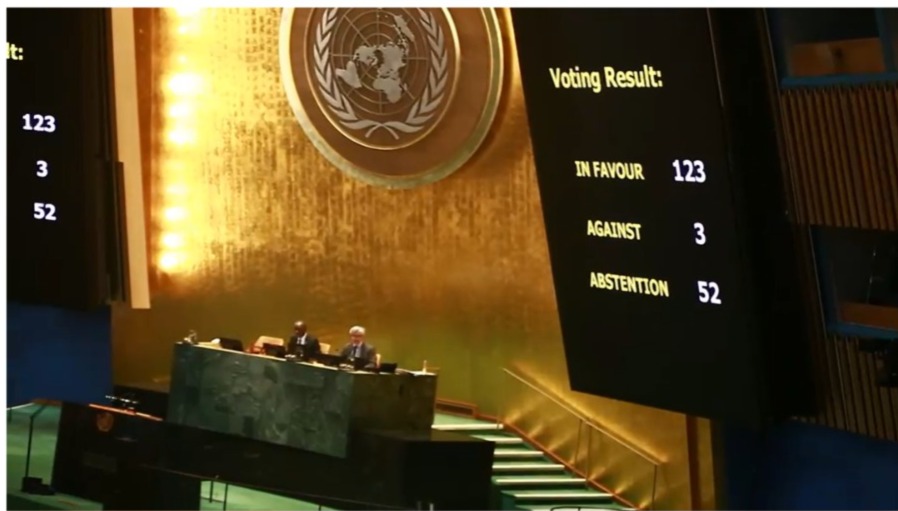

At the end of voting in respect of President John Mahama’s motion at the United Nations against transatlantic slave trade, one hundred and twenty-three countries expressed their support.
Three countries voted against the motion while fifty-two abstained.
Earlier, 3news’ Martin Asiedu-Dartey, who is in New York, reported that from Latin America to Asia from Africa to Europe including the Vatican, country after country that spoke at the United Nations General Assembly on the Day of Remembrance of the Victims of Slavery and Transatlantic Slave Trade threw their countries’ weight behind Ghana’s motion filed at the United Nations.
Tabling the motion which seeks to declare the transatlantic slave trade as the gravest crime against humanity, President John Mahama in his speech encouraged member states to “stand on the right side of history” and vote in support of the motion.
The resolution according to the president “is the result of months of consultation and consensus-building by continental bodies, nations, experts, scholars, and jurists, with the sole aim of achieving a united front and grounding the final outcome in truth, compassion, and moral conscience, remembrance, education, and dialogue.”
Representatives from the Asian Pacific states, Latin American states, Western Europe and all fourteen (14) countries of the Caribbean Community (CARICOM) acknowledged Ghana’s motion urging colleague member states to not only recognize the evils of the transatlantic slave trade but to push for reparative justice, appropriate compensation and return of stolen artifacts belonging to the plundered countries.
Lebanon, Cuba, UK, Bangladesh, Venezuela, Ethiopia, Nigeria, Vietnam, The Holy See (The Vatican) Burkina Faso, Guinea, Russia are but a few countries and territories who spoke publicly at the UN General Assembly in support of the motion.
Voting for the motion is expected to climax what has been months of campaign by Ghana on behalf of the African Union led by president John Mahama who is the AU’s champion of reparation.
By Martin Asiedu-Dartey
New York, USA