
The Chairman of the Public Interest and Accountability Committee (PIAC), Richard Ellimah, has disclosed that the Government’s “Big Push” initiative has received US$434.55 million of Ghana’s petroleum earnings through the Annual Budget Funding Amount (ABFA).
He made this known during the launch of the 2025 PIAC Annual Report in Accra on Wednesday, April 8.
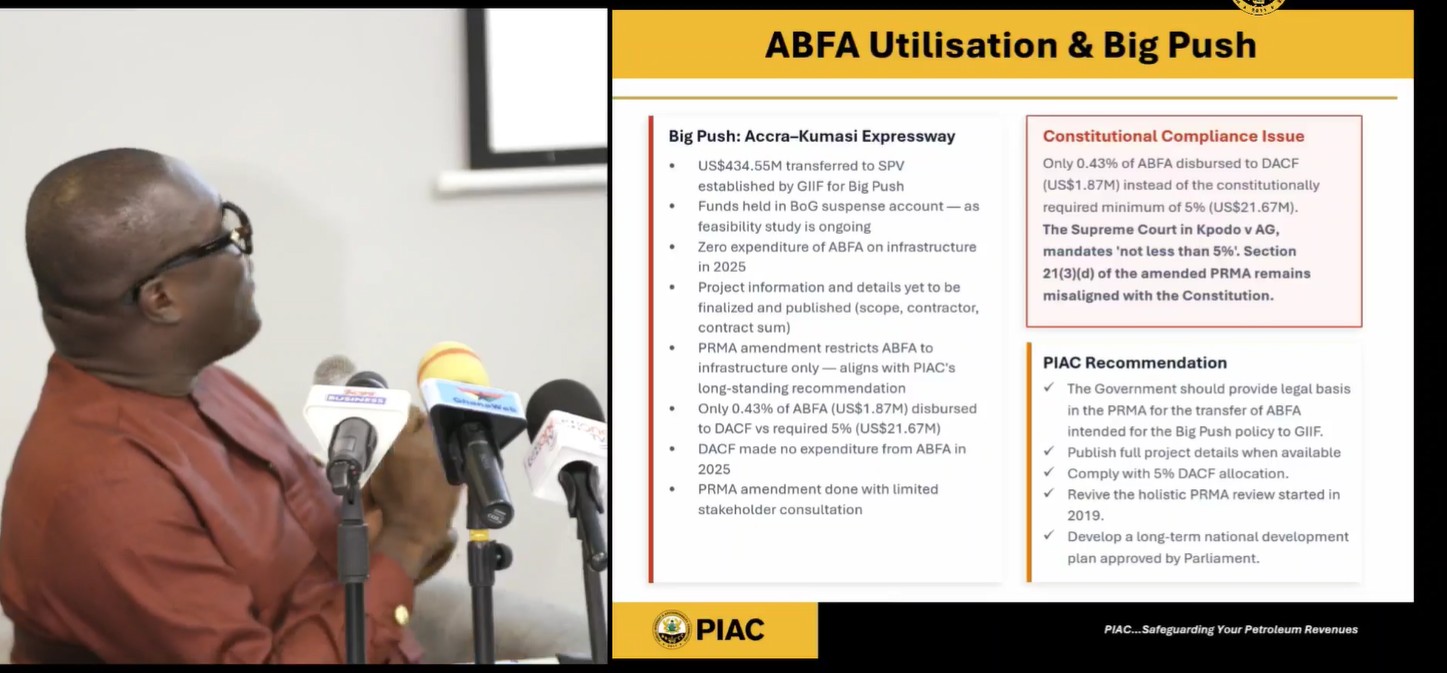
“The Kumasi-Accra Expressway is the flagship programme under the Big Push Agenda. Now US$434.55 million has already been transferred to an SPV established by the Ghana Infrastructure Investment Fund (GIIF) for the Big Push,” he disclosed.
PIAC Chairman explained that since last year when the new government took office, Petroleum Revenue Management ACT (PRMA) was amended for almost all the ABFA to be moved into the government’s infrastructure programme or the Big Push.
“So, what has happened is that 95% of the ABFA is now devoted to the Big Push which is basically an infrastructure driven agenda,” he noted.
Mr Ellimah explained that the funds are currently being held by the Bank of Ghana, pending onward release for the Big Push programme, as feasibility studies on the projects are still ongoing.
“And the funds are held at the Bank of Ghana,” he said.
PIAC says in its 2025 Annual Report, it observed that only 0.43% of the ABFA was disbursed to the District Assemblies Common Fund, a figure far lower than the 5% than what the law recommends.
PIAC has therefore recommended that Government provide legal basis in the PRMA for the transfer of the ABFA intended for the Big Push to the GIIF.
“So, in the 2025 report, we noticed that only 0.43% of the ABFA was disbursed to the District Assemblies Common Fund, far lower than the 5% that the law says we should give. It is something that we need to address.
“So we recommend that the Government should provide legal basis in the PRMA for the transfer of the ABFA intended for the Big Push to the GIIF,” PIAC Chairman stated.
According to the report, Ghana’s petroleum sector has generated a cumulative US$11.97 billion since 2011, highlighting the industry’s central role in national revenue mobilisation, despite signs of a gradual decline in production levels.