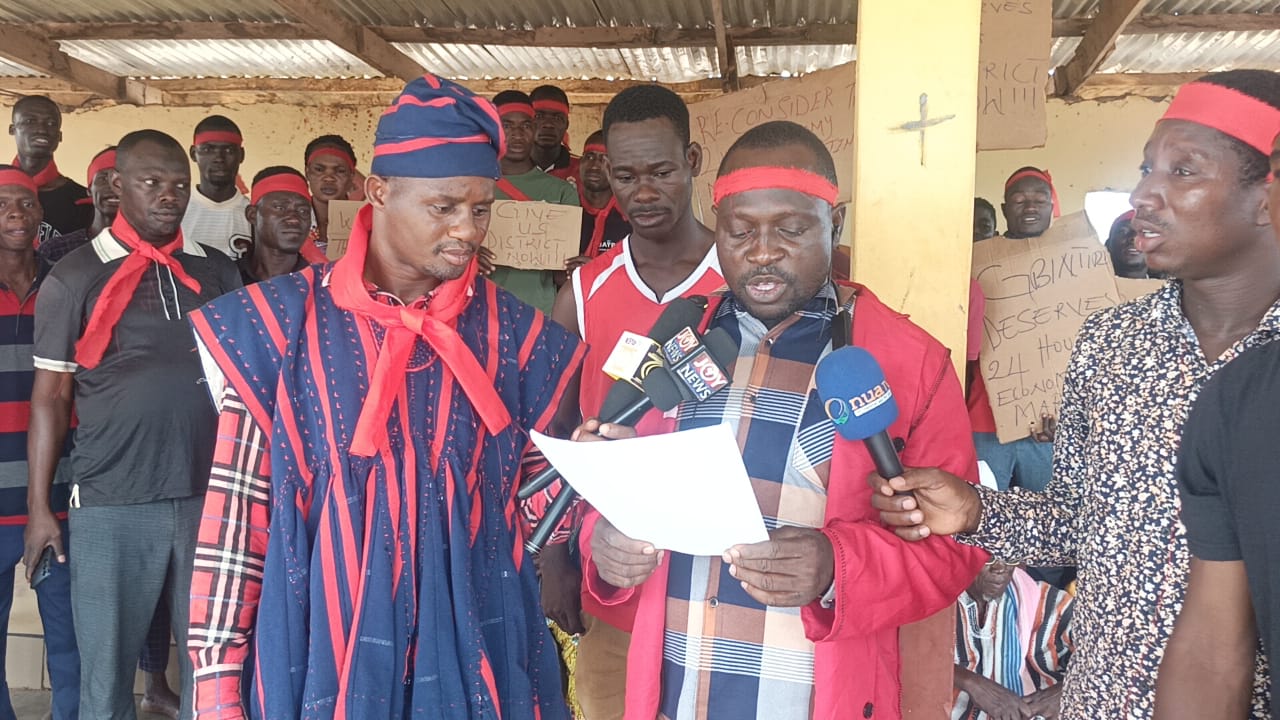

The traditional elders, youth, and business stakeholders of Gbintiri have officially served a seven-day ultimatum to the North East Regional Minister, Ibrahim Tia, and the East Mamprusi Municipal Chief Executive (MCE), David Bariche.
This action follows the controversial and exclusionary siting of the 24-hour economy market initiatives, which the community asserts have been diverted to the hometowns of the aforementioned officials, blatantly ignoring the superior economic viability of Gbintiri.
Gbintiri stands as the most significant commercial hub across the five northern regions, acting as a critical community for trade, transport and regional economic stability.
Stakeholders argue that the decision to bypass Gbintiri a location that inherently embodies the requirements for a 24-hour economy in favor of less viable sites, constitutes a failure of evidence-based policy.
They say that by prioritizing personal and partisan interests over objective economic data, the Regional Minister and the MCE have effectively subverted the development potential of the entire region.
The youth of Gbintiri have expressed deep concerns, accusing the Regional Minister and the MCE of utilizing their official positions to facilitate the allocation of state infrastructure to their own hometowns.
This perceived act of political patronage is viewed as a direct insult to the Konkomba people and the broader Gbintiri community, whose consistent electoral support and political loyalty have been fundamental to the region’s stability.
The stakeholders are calling for an immediate and public accounting from the Regional Minister and the MCE, specifically demanding:
Full Disclosure: The empirical criteria and feasibility studies utilized to determine the siting of the 24-hour economy markets.
Immediate Review: A formal reassessment of the project locations to include Gbintiri as a priority site.
Presidential Intervention: A direct appeal to H.E. John Dramani Mahama to investigate the conduct of the Regional Minister and the MCE regarding this blatant conflict of interest and administrative bias.
The leadership of Gbintiri, including its elders and the Concerned Konkomba Youth, emphasizes that their commitment to peace and democratic engagement should not be mistaken for weakness. The seven-day ultimatum serves as a final window for the government to rectify these injustices.
“The people of Gbintiri have been the backbone of the region’s economic and political success,” the stakeholders stated. “We will no longer tolerate being sidelined by leadership that chooses to serve parochial interests over the collective progress of our people.”
Failure to address these grievances within the seven-day timeframe will compel the community to pursue all lawful avenues to ensure that their voices are heard and that the principles of equity and distributive justice are upheld.
By Solomon Kanaluwe