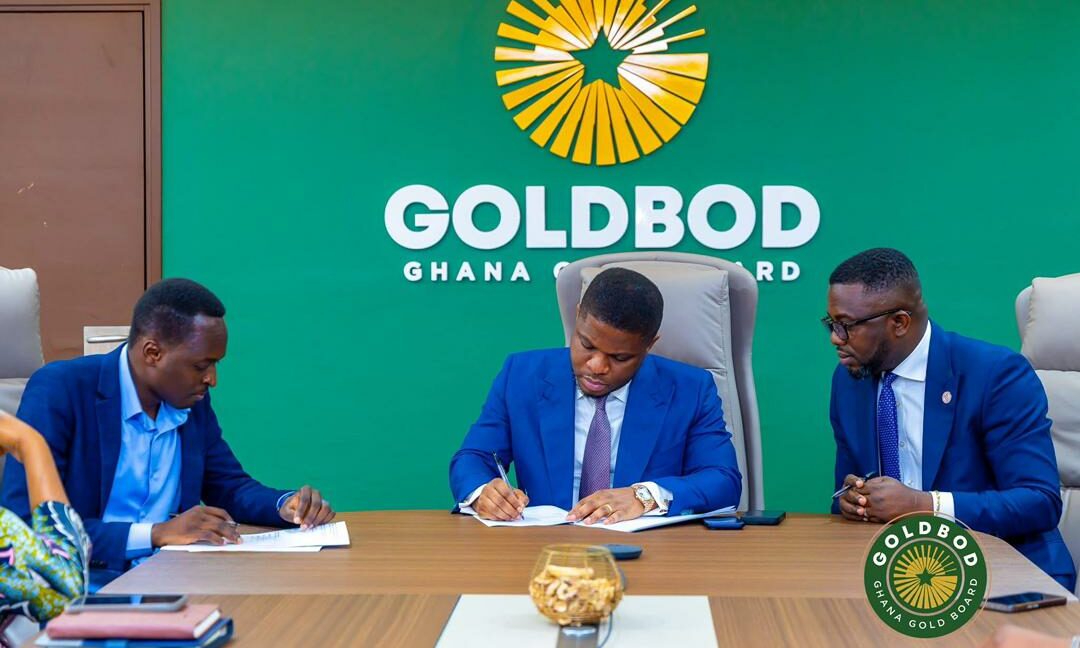

A total revenue of GH¢5.55 billion was recorded by the Ghana Gold Board (GoldBod) with an operational surplus of GH¢909.71 million for the year 2025.
This performance, from the Board’s financial report shows GoldBod generated a total revenue of GH₵¢5.56 billion against total expenditure of GH¢109.38 million, resulting in an overall surplus of GH¢5.45 billion.
In a Tuesday, April 28, 2026 statement issued by the GoldBod, it accounted GH¢959.72 million of the surplus to the GoldBod Jewellery Limited, leaving the final surplus at GH¢5.45 billion.
The data shows a significant improvement in the Board’s performance, where the 2024 fiscal year had the surplus standing at GH¢185.34 million after exceptional items.
Revenue basket
Last year, the government provided seed capital of GH¢4.54 billion to support gold purchasing, trading and export operations of the GoldBod.
In addition, the Board generated GH¢983.96 million in non-tax revenue and GH¢35.34 million in finance income.
The non-tax revenue stream was largely driven by Artisanal and Small-scale Mining (ASM) gold aggregation service charges, which contributed GH¢568.34 million, followed by assay fees of GH₵340.43 million, the statement added.
It said registration and licensing fees yielded GH¢30.77 million, while inspection fees from large-scale mining companies accounted for GH¢41.85 million.
Other revenue sources included commissions on diamond exports, amounting to GH¢1.62 million and Diamond Licensed Buying Companies fees of GH¢770.70 million.
On the expenditure side, GoldBod recorded total spending of GH¢109.39 million, down from GH¢129.66 million in 2024 despite its expanded operations in 2025.
The statement said compensation of employees amounted to GH¢37.38 million, use of goods and services was GH¢28.14 million, specialised expenses was GH¢38.92 million, and depreciation charges of GH¢4.95 million.
“Notably, the institution recorded no finance costs in 2025, compared with GH¢46.04 million in 2024, reflecting improved financial efficiency and reduced debt-servicing obligations,” it said.
The statement added: “Expenses were largely driven by task force deployment, which cost GH¢14.29 million, followed by corporate social responsibility and the Special Intervention Programme (SIP) at GH¢11.25 million.”
It said establishment costs stood at GH¢5.8 million, while monitoring and inspection and assay services accounted for GH¢1 million and GH¢618,206, respectively.
Surplus breakdown
The statement explained that the surplus recorded during the year included an operational surplus of GH¢909.71 million generated from core non-tax activities and an unutilised government subvention of GH¢4.55 billion.
GoldBod’s balance sheet also showed strong liquidity and a solid asset base. Total assets as of the end of last year stood at GH¢9.55 billion, registering a growth of 468 per cent over the fiscal year. Total liabilities amounted to GH¢3.95 billion, resulting in net assets position of GH¢5.60 billion.
Cash and Cash equivalents rose sharply to GH¢8.77 billion from GH¢738.18 million in 2024, supported by strong operating cash inflows of GH¢8.06 billion during the year from its operations.
Accumulated surplus stood at GH¢5.58 billion, further strengthening the institution’s financial position.
Current liabilities included trade payables of GH¢3.88 billion, with GH¢3.78 billion relating to amounts payable to the Bank of Ghana under the Domestic Gold Purchase Programme.
Long-term borrowing reduced to GH¢17 million from GH¢30 million in 2024. These obligations relate to legacy facilities with Royal Bank and Unibank Ghana Limited inherited from the defunct Precious Minerals Marketing Company (PMMC).
The Board of Directors expressed satisfaction that GoldBod had adequate resources to continue operating for the foreseeable future and consequently prepared the financial statements on a going concern basis.
Juaben MP questions legal basis for GoldBod’s GHC 27.5m agreement for geological investigations