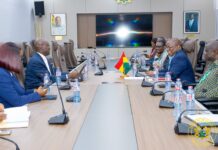

On 29 April 2026, an IMF team led by Dr Ruben Atoyan lands in Accra for a two‑week verdict.
If the final review under the $3 billion Extended Credit Facility succeeds, Ghana exits the programme in August with a final $360 million cheque and the formal end of a rescue born in the fires of 2022. The numbers being presented are, by any standard, impressive.
Real GDP grew 6.3 % in the first half of 2025. The primary balance swung from a deficit of 2.9 % of GDP to a surplus of 2.6 %. Public debt tumbled from 61.8 % to 45.3 % of GDP, beating the IMF’s 2034 target by nearly a decade.
Inflation, which had scorched households at 54 % in December 2022, was wrestled down to 13.7 % by mid‑2025 and, by March 2026, sat at a quiet 3.2 %.
The Fund projects it will drift back to 7.9 % by year‑end, and GDP growth of 4.8 % in 2026, slightly above the sub‑Saharan average.
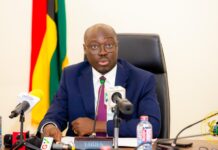
Finance Minister Dr Cassiel Ato Forson, receiving the mission, called the reform journey “long, demanding, but ultimately transformative” and, “in every material sense, a success.” The IMF team echoed the sentiment, describing the moment as a significant milestone.
Good numbers, however, have a dangerous habit of hiding bad structures. Imagine the economy as a tripod. One leg is fiscal, how the state collects and spends.
The second is structural or real, the farms, factories, energy grids, ports and skills that produce value. The third is monetary, the central bank’s management of prices, credit and the currency. A stable nation walks on all three.
What Ghana has done in recent years is more precarious: it has balanced almost the entire recovery on the third leg, using it to prop up the first, while the second, the one that actually builds wealth, remains dangerously thin.
The cedi’s comeback and a central bank fighting alone
The fight against inflation was won not only by high interest rates but by a dramatic appreciation of the cedi. After losing more than half its value in 2022, the currency staged a ferocious rally.
By October 2025 it had gained 37 % against the dollar, ranked as sub‑Saharan Africa’s best performer over eight months. By April 2026, cumulative appreciation topped 40 %, gross international reserves hit $12 billion, and import cover reached 5.8 months.
The central bank, having held the line, delivered its largest rate cut on record in July 2025, slashing the Monetary Policy Rate from 28 % to 25 %.
The exchange rate was the transmission belt that made the disinflation story credible. Imported goods, from fuel to food, are priced directly off the cedi. A strengthening currency compresses pass‑through into domestic prices faster than any interest rate alone can. It also anchors the daily expectations of businesses and households, who watch the cedi the way a patient watches a pulse.
Yet this triumph belongs largely to the Bank of Ghana, fighting almost alone. The fiscal leg, despite headline surpluses, relied heavily on cash rationing.
Parliament authorised capital spending of 1.5 % of GDP. According to the Minority in Parliament, the government implemented only about 0.5 %, a $1.1 billion shortfall in public investment.
Structural hole: energy bleeds the budget
The IMF’s sixth review places structural reforms at the top of the agenda, and no issue is more urgent than energy. The Fund estimates the annual power‑sector shortfall at $2.2 billion, driven by massive commercial and technical losses at the Electricity Company of Ghana and sluggish tariff adjustments.
The government paid $1.47 billion in 2025 alone to clear legacy debts and restore a depleted World Bank guarantee. Cumulative liabilities across the sector run into tens of billions of cedis, a drain the World Bank warns could cost the government $2 billion a year by 2026, roughly 20 % of the national budget.
This is not operational friction; it is structural haemorrhage. Unmetered streetlights, power theft, procurement inefficiencies and distribution losses swallow resources that could otherwise fund schools, roads, or agricultural extension.
The IMF has repeatedly flagged weaknesses in state‑owned enterprises, especially energy, as persistent fiscal risks. Nationally, electrification stands at a laudable 90 %, yet rural access is stuck near 50 %. Electricity is available; reliability and affordability are not.
Beyond power: the hardware of an economy is missing
Energy is the most visible wound, but the structural deficit runs wider. Cocoa, which contributes a tenth of GDP, saw output crash to 425,000 tonnes in 2023/24, a 22‑year low, before recovering to a forecast 650,000 tonnes in 2025/26 on better weather, higher farm‑gate prices and a crackdown on illegal mining.
The rebound is welcome, but it exposes how much of the productive base remains hostage to rain, price cycles and environmental decay, not anchored in processing and value addition.
Agriculture employs roughly one‑third of the workforce and contributes a fifth of GDP. Yet post‑harvest losses, low mechanisation and weak industry linkages cap its potential.
Manufacturing, the classic engine of transformation, is stuck in reverse: value‑added fell to 10.1 % of GDP in 2024, down from the year before. The informal sector, where nearly 80 % of working Ghanaians earn a living, produces only 27 % of GDP, a staggering productivity chasm.
The composition of recent growth deepens the worry. The 6.3 % expansion in the first half of 2025 was services‑heavy, led by ICT, finance and trade.
Construction and manufacturing lagged. Ghana is not building the productive base that sustains jobs and incomes over decades; it is consuming and transacting its way to growth that could evaporate with the next external shock.
Finance Minister Forson, even while welcoming the IMF team, named the silent threat: youth unemployment. “If we do not create the conditions for the private sector to absorb our young people,” he warned, “the pressure on the state to provide jobs will become unsustainable.”
The fiscal leg: the revenue trap and a historic legal break
All three legs converge on a stubborn number: the tax‑to‑GDP ratio has hovered below 14 % for years, roughly half the average of lower‑middle‑income peers.
Without structural transformation, the tax base cannot broaden. The government is forced to borrow domestically. Banks now hold GH¢162.9 billion in government instruments against GH¢89.2 billion in private‑sector loans, a lopsided allocation that starves the very enterprises that might create jobs and pay taxes.
Parliament’s December 2025 amendment to the Bank of Ghana Act prohibits the central bank from buying government securities on the primary market, a clean break from the printing‑press financing that fueled the 2022 crisis.
That legal barrier is essential, but it cannot substitute for a growing real economy. If the structural leg does not strengthen, the fiscal numbers will wobble again, and the monetary leg will once more be asked to carry the weight.
A scaffold, not a building
The IMF mission will now draft its report. A Board meeting within weeks could clear the final disbursement and close the programme. African Department Director Abebe Aemro Selassie was blunt before the mission left Washington: “This is not for the IMF, this is for the people of Ghana, the government, private sector and civil society.”
The World Bank’s 2025 Policy Notes frame the long game: Ghana can triple per‑capita income from $2,200 to $6,600 by 2050, but only with deep reforms that restore macro‑financial stability, lift productivity, manage natural resources and strengthen institutions.
The pillars are indivisible. Fiscal discipline without structural reform is nothing but austerity. Monetary tightening without credit to the real sector is stagnation.
The macro‑stabilisation Ghana has delivered, anchored by a resurgent cedi and falling inflation, was necessary and genuinely hard‑won. The IMF programme provided the framework, the financing and the external discipline.
But it is a scaffold, not a building. Exchange rate appreciation and reserve accumulation buy time. They do not, by themselves, modernise a port, repair a distribution line, or move a farmer from subsistence to agro‑processing.
For as long as the monetary leg props up the fiscal leg without the structural leg bearing weight, stability in Ghana will remain borrowed, from the IMF, from foreign reserves, from deferred public investment. The final review is a moment of truth. Not for the Fund. For Ghana.
Structural transformation is not a slogan. It is the unglamorous, granular, politically costly work of making the Electricity Company of Ghana collect what it bills, of turning cocoa beans into chocolate, of giving small and medium enterprises cheaper capital than the government, of making rural electrification mean power that stays on, not just a wire that passes through.
The tripod can stand. But only when all three legs are planted in the ground.
By Professor Eric Fosu Oteng-Abayie, PhD, Department of Economics, KNUST ([email protected])