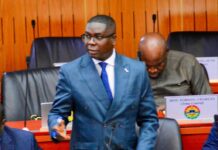

Tano North Member of Parliament Dr Gideon Boako has been assessing the International Monetary Fund (IMF) July 2026 Selected Issues paper on Ghana (IMF Country Report No. 26/213).
He observes that the report examines the Domestic Gold Purchase Programme.
While acknowledging that the programme contributed to strengthening Ghana’s foreign reserves and supporting exchange-rate stability, the IMF points out that it generated substantial financial losses of about $1.7 billion (1.5% of GDP) that weakened the balance sheet of the Bank of Ghana.
Dr Boako noted that the loss, among other things, primarily emanates from assay and fees paid to GoldBod, and discount on gold sold to off-takers (exporters).
This is quite concerning, he said.
“Responsibility for this loss has now been transferred to GoldBod for onward absorption by government, effective July 2026.
“This raises important questions about the management of these fiscal risks and the transparency with which they will be handled going forward,” he wrote in a statement.
Closely related to this is the financial position of the Bank of Ghana itself, he added.
“Although macroeconomic conditions have improved, the IMF notes that the central bank continues to carry significant losses and negative equity arising from recent quasi-fiscal operations and the domestic debt restructuring programme.
“Restoring the financial health of the central bank therefore remains an important element of Ghana’s long-term macroeconomic strategy.”
Below is his full assessment of the report…
The gboako Economic Digest – #001/26
The IMF’s Cautionary Assessment: Ghana’s Recovery Must Move from Stabilisation to Transformation
This is what the Report Says in brief
The International Monetary Fund latest assessment of Ghana’s economy presents a balanced but important message. On the one hand, the IMF recognises the significant progress Ghana has made in restoring macroeconomic stability. However, the IMF is equally clear that macroeconomic stabilisation should not be mistaken for economic transformation.
This is practically important because generations always inherit an economy. Some merely manage it while others fundamentally redefine how it is understood. Ghana’s challenge has never been simply to achieve economic growth, single digit inflation or fiscal stability. Several governments have done that. The deeper challenge is to ensure that national progress is experienced not only in government accounts, but in everyday lives of ordinary citizens. The ultimate test of economic policy is not the strength of the statistics it produces, but the opportunities it creates, the dignity it protects, and the prosperity it delivers to households.
The report observes that while the immediate crisis may have eased, Ghana continues to face significant structural vulnerabilities that could undermine the sustainability of the recovery if left unaddressed. One of the IMF’s foremost concerns is Ghana’s growing dependence on gold exports. The report notes that more than half of Ghana’s exports are now derived from gold, meaning that much of the country’s recent external sector improvement has been supported by exceptionally favourable gold prices rather than broad-based diversification of the economy. This leaves Ghana increasingly exposed to future fluctuations in international commodity markets.
The IMF raises concerns about the extent to which Ghana is benefiting from its mineral wealth. Despite being Africa’s largest gold producer, fiscal revenues from the mining sector remain relatively modest, while weaknesses in transparency and fiscal reporting continue to limit public accountability. The implication is that Ghana’s abundant natural resources are not yet generating the level of public benefit they potentially could.
Illegal mining remains another major concern. The IMF estimates that billions of dollars’ worth of gold have escaped official trade records through smuggling, depriving the country of valuable revenue and foreign exchange. Beyond these fiscal losses, the report warns that illegal mining is inflicting serious environmental damage, destroying agricultural land, contaminating water bodies and threatening cocoa production. These developments, according to the IMF, have now become macroeconomic risks rather than merely environmental concerns.
The report also examines the Domestic Gold Purchase Programme. While acknowledging that the programme contributed to strengthening Ghana’s foreign reserves and supporting exchange-rate stability, the IMF points out that it generated substantial financial losses of about $1.7 billion (1.5% of GDP) that weakened the balance sheet of the Bank of Ghana. The loss, among other things, primarily emanates from assay and fees paid to GoldBod, discount on gold sold to off-takers (exporters). This is quite concerning. Responsibility for this loss has now been transferred to GoldBod for onward absorption by government effective July, 2026. This raises important questions about the management of these fiscal risks and the transparency with which they will be handled going forward.
Closely related to this is the financial position of the Bank of Ghana itself. Although macroeconomic conditions have improved, the IMF notes that the central bank continues to carry significant losses and negative equity arising from recent quasi-fiscal operations and the domestic debt restructuring programme. Restoring the financial health of the central bank therefore remains an important element of Ghana’s long-term macroeconomic strategy.
The IMF further cautions that while rebuilding international reserves is an important objective, accumulating reserves significantly above internationally accepted adequacy levels comes with considerable opportunity costs. Resources tied up in reserve accumulation could otherwise support productive investment, making it essential that policymakers carefully balance external resilience with domestic development priorities.
Another major issue highlighted by the IMF is the energy sector. Despite improvements elsewhere in the economy, the Fund identifies continuing financial and operational weaknesses within the sector as one of the country’s most significant fiscal risks. Without comprehensive reforms, these challenges could continue to place pressure on public finances for many years to come.
The IMF’s broader conclusion is therefore neither one of unqualified praise nor outright criticism. Rather, it is a call for Ghana to move beyond crisis management towards structural transformation. Stabilising inflation, improving the fiscal balance and strengthening the exchange rate represent important achievements, but they are only the first stage of economic recovery. The next stage requires economic diversification, stronger institutions, improved governance, sustainable domestic revenue mobilisation, productive investment and reforms capable of raising long-term productivity and living standards.
Ultimately, the IMF’s assessment reinforces an important lesson. Macroeconomic stability is the foundation of development, but it is not development itself. Ghana’s challenge is no longer simply to restore stability. The challenge is to transform that stability into a more resilient, diversified and inclusive economy that creates jobs, raises productivity and improves the everyday lives of ordinary citizens.