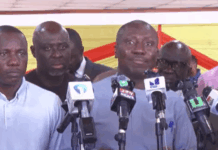
Director of Communications of the New Patriotic Party (NPP) Richard Ahiagbah has said that the cost of living in Ghana is still high despite the decision of the Bank of Ghana to spend GHS15 billion cedis to reduce inflation.
Ahiagbah called on President John Dramani Mahama to sack his appointees in charge of managing the economy due to the increasing cost of living.
“Good morning, President Mahama, according to the NDC, your BoG spent GH¢15.6 billion in 2025 to reduce inflation and stabilize the economy. Yet the stabilise, and the economy remains unstable in our homes. Mr. President, heads must roll,” he wrote on X.

The Bank of Ghana has rejected characterization of the Domestic Gold Purchase Programme (DGPP) as loss making.
BoG insists that what has been described in public discourse as a “loss” should be understood as a programme cost.
The BoG indicate that such costs were structurally foreseeable, given the mechanics of how gold purchases are executed and recorded. Paul Bleboo, Head of Gold Management at the Bank of Ghana, made this distinction during TV3’s The Keypoints programme on Saturday, May 5, 2026. “The DGPP loss should be interpreted as a cost of the DGPP, not a loss.”
He explained that the DGPP was launched in July 2021 as a key instrument for rebuilding Ghana’s foreign reserves and address Ghana’s macroeconomic instability.
This programme operates by purchasing gold from small scale and artisanal miners in the domestic market.
Payments are made in cedis at the prevailing forex bureau exchange rate. However, the accounting treatment creates an inherent and quantifiable gap: while the gold is purchased at the forex bureau rate, it is recorded on the Bank of Ghana’s books at the official exchange rate. Because the two rates are not identical, the spread between them appears in the accounts as a cost differential.
The distinction matters for public understanding. A commercial loss implies that an investment has generated a negative return relative to its cost.
A policy cost, by contrast, is a deliberate expenditure incurred to achieve a non commercial objective or public good. Evaluated on these terms, the programme’s “cost” represents the price paid for a set of policy goals. Therefore, the DGPP cost, properly contextualized is a deliberate policy expenditure rather than commercial loss.