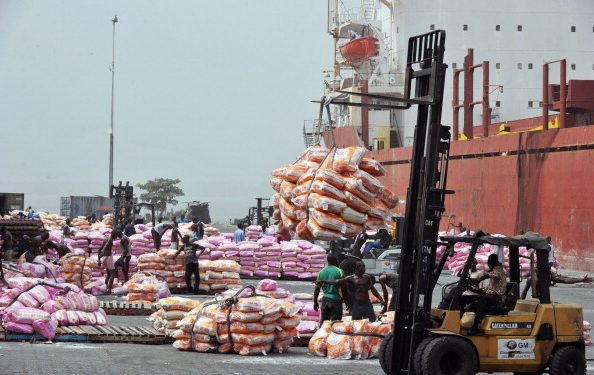

The Peasant Farmers Association of Ghana (PFAG) has called on the government to immediately implement a rice import quota policy and adopt a series of urgent interventions to address challenges confronting local rice producers and the wider agricultural sector.
While welcoming proposals aimed at regulating rice imports, the Association urged the Government to take immediate steps to protect local farmers from mounting losses caused by unsold stocks and declining farm-gate prices.
Among its key demands, PFAG is calling for a six-month moratorium on rice imports to allow locally produced rice already on the market to be sold.
The Association believes the temporary suspension will provide financial relief to farmers, stabilize prices and restore confidence in the domestic rice industry.
PFAG in a statement via its Facebook page urged the government to direct national security agencies to intensify efforts against rice smuggling at Ghana’s borders, describing the illegal trade as economic sabotage that undermines the livelihoods of local farmers.
The Association called for regular enforcement operations and public reporting on anti-smuggling activities.
The group further advocated the introduction of a legal and regulatory framework that would require all government ministries, departments, agencies, state-owned enterprises, public hospitals, schools, prisons, the military and other public institutions to procure locally produced rice and other staple foods.
According to PFAG, compliance with such a policy should be closely monitored and backed by sanctions for institutions that fail to comply.
The association also proposed direct procurement arrangements between public institutions and farmer organizations to ensure reliable supply and market access.
“Conduct an urgent and transparent review of the operational mandate, procurement processes, financing arrangements, and institutional capacity of the National Food Buffer Stock Company Limited (NAFCO). NAFCO must be restructured and adequately resourced to serve as ineffective, efficient, and accountable purchaser of locally produced agricultural commodities, especially during periods of market glut.
“Establish a dedicated price stabilization fund for rice and other strategic staples, to protect farm-gate prices and ensure farmers receive a fair and remunerative return on their investment, even during periods of oversupply.
“Invest in post-harvest infrastructure, including storage facilities, milling capacity, and market linkage platforms, to reduce post-harvest losses and improve the competitiveness of locally produced rice against imported alternatives,” PFAG said in a statement on June 4, 2026.
Beyond rice production, the Association warned that farmers cultivating cassava, maize, yam, soybean and cowpea are facing similar challenges, including poor market access, falling prices and significant post-harvest losses.
PFAG noted that the difficulties confronting farmers across multiple value chains pose a threat to Ghana’s food security and economic resilience. It therefore urged the government to adopt a comprehensive Agricultural Market Stabilization Policy to address issues of price volatility, storage, procurement and market access across the agricultural sector.
As the new planting season approaches, the Association said farmers need clear assurances that their investments will be protected and that markets will be available for their produce.
PFAG reaffirmed its commitment to working with government and other stakeholders to achieve food self-sufficiency, stressing that farmers are looking for concrete action to address the challenges facing the sector and safeguard the livelihoods of those who feed the nation.