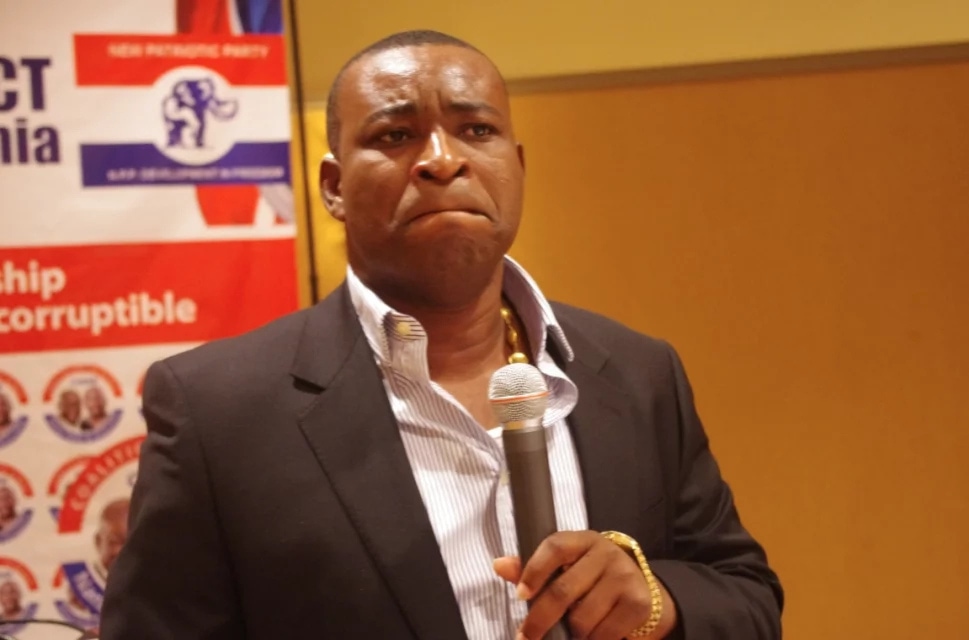

The Minority in Parliament has condemned the conviction of the Ashanti Regional Chairman of the New Patriotic Party (NPP), Bernard Antwi Boasiako.
Also known as Chairman Wontumi, Mr Boasiako was sentenced to twenty years imprisonment for illegal mining offences on July 20.
In a press release issued by the Minority Caucus in Parliament and signed by Alexander Afenyo-Markin, they stated that “the Minority will do whatever is lawfully and properly within its power, through Parliament and through public advocacy, to ensure that justice is done in this matter, and to ensure that the serious defects that have robbed this judgment of its legitimacy, the denial of counsel of choice, and the wrongful refusal to refer live constitutional questions to the Supreme Court, are confronted and corrected.
This is not a promise made lightly. It is a commitment we intend to keep, in full view of the public, until it is honoured.”
“We speak today not as advocates for any individual, but as custodians of a constitutional order that must apply equally to every Ghanaian, regardless of political colour. We speak from our institutional vantage point as the Minority in Parliament, whose constitutional duty is to interrogate the conduct of the State, including its prosecutorial and judicial processes, wherever the public interest so demands,” the statement read in part.
It added that, “We also flag, without developing the point today, that we have serious reservations about the circumstances in which the trial court lifted Akonta Mining Limited’s corporate veil and held Chairman Wontumi personally liable for acts alleged against the company. Piercing the corporate veil is an exceptional remedy, not a routine one, and the basis on which it was applied here deserves the closest scrutiny.”
The Minority therefore called on the Office of the Attorney-General to “publish, as a matter of transparency, its enforcement record on illegal mining across the political spectrum, including the current status of the Yamin/Abanga investigation and the Apinto concession takeover, so that the public may judge for itself whether enforcement has been even handed.”
They further urged the Court of Appeal to give full and rigorous consideration to any ground of appeal raising the absence of counsel of choice and the associated fair trial concerns under Article 19, and to any application for certiorari grounded in the trial court’s refusal to refer the Article 19(11) question to the Supreme Court, mindful of this Court’s own precedent in the Zanetor case that such a refusal is a wrongful assumption of jurisdiction, not a mere irregularity.
“The Judiciary to reaffirm, through appropriate guidance, the modest threshold for constitutional referral under Article 130, so that trial courts do not inadvertently narrow citizens’ access to the Supreme Court, and, in framing that guidance, to have express regard to the Supreme Court’s own decision in Republic v. The High Court, General Jurisdiction 6, Accra; Ex Pate Dr. Zenator A. Rawlings, which already sets out the standard trial courts must follow,” the Minority requested.
It also called on all Ghanaians, regardless of party, “to insist on consistency: that the standard applied to one mining concession be applied to all; that the standard applied to one political actor be applied to all; and that the standard which cleared Mr. Tsatsu Tsikata’s name in 2016, after his trial was found to have occasioned a miscarriage of justice, be demanded, with equal conviction, today.