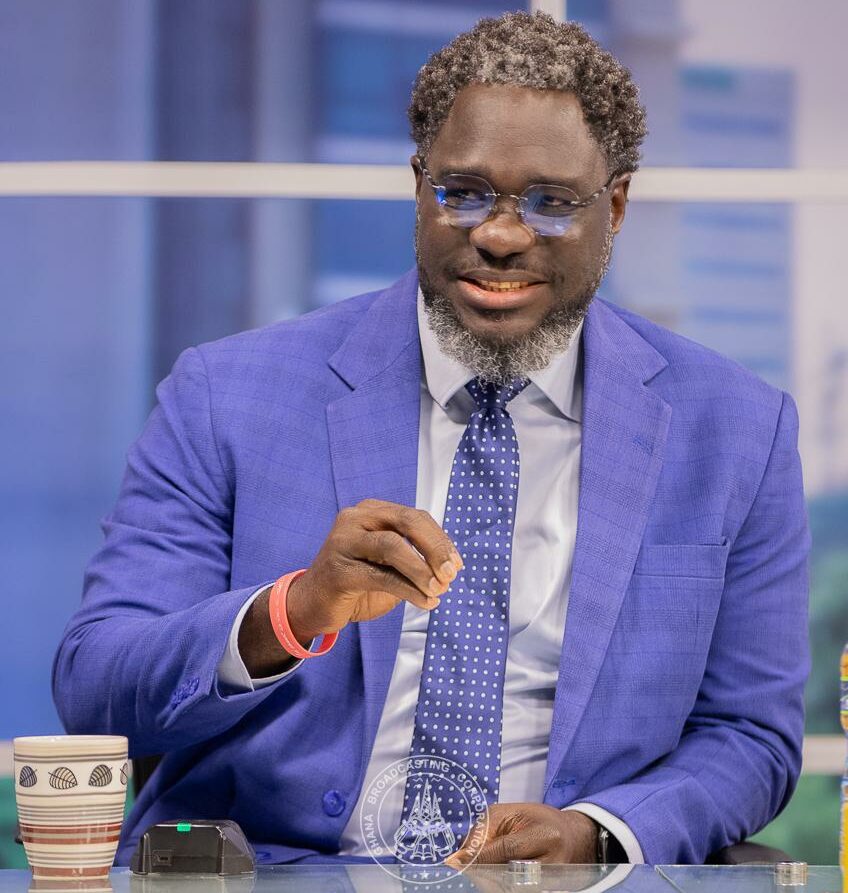

Dr Palgrave Boakye-Danquah, spokesperson for embattled Ashanti Regional Chairman of the New Patriotic Party (NPP), Wontumi, has said they are counting on “God’s will” to see how things go, following the businessman’s sentencing.
Bernard Antwi Boasiako, also known as Wontumi, the Ashanti Regional Chairman of the opposition New Patriotic Party (NPP), was sentenced to 20 years’ imprisonment on each of two counts by the Accra High Court on Monday, July 20, 2026, over illegal activities on a mining concession he owned at Samraboi in the Western region.
The sentences are to run concurrently. The court also fined him 10,000 penalty units on each of the two counts. Akonta Mining Limited, a company owned by Wontumi, which was convicted on two counts, was fined 15,000 penalty units on each count.
Reacting to his sentencing on TV3’s Ghana Tonight on Monday, July 20, Dr. Boakye-Danquah said the day was a rollercoaster for them.
“It’s been a very hard day on all of us. I’ve been full of tears, I’ve been thinking and wondering what’s been going on. I got lost of myself, not even knowing where my car was parked.”
According to him, they were hopeful of victory when they arrived in court yesterday, but the ruling didn’t go their way.
He disclosed that they have been saddened by the incident but are counting on God’s will to be fulfilled.
“We went to court this morning, myself and Chairman arrived very hopeful that victory would be on our side because of the cases that we had followed and the evidences that we had given and that be as it may, know the end of the judgement her ladyship gave. We are indeed saddened and troubled and praying that God’s will would be done.”
Wontumi was found guilty, got convicted and sentenced by the High Court in a trial in which he and his company, Akonta Mining Limited, were found guilty on six counts relating to the assignment of mineral rights without ministerial approval and facilitating an unlicensed mining operation.
That was after the court, presided over by Justice Audrey Kocuvie-Tay, held that the prosecution had proved its case that Chairman Wontumi and Akonta Mining permitted Henry Okoom and Michael Gyedu Ayisi to undertake mining activities on the company’s concession without securing the prior approval of the Minister for Lands and Natural Resources, and thereby facilitated illegal mining on the land.
In addition to the jail term, Chairman Wontumi will pay GH¢120,000, in default of which he will serve three years in prison.
His company, however, will pay GH¢180,000 on two counts.
Relying largely on circumstantial evidence, the court was of the view that the absence of ministerial approval was never contested by the defence, describing the admission as implicit since no application for approval had been been made by the company.
Chairman Wontumi had told the court he had granted Henry Okoom permission only to reclaim land by planting coconut, and not to mine.
He said he did not know Okoom was a small-scale miner, maintaining that Okoom had presented himself as a mine support service provider.
The court, however, held that this explanation could not stand.
It added that Chairman Wontumi led no evidence to verify Okoom’s claimed reclamation experience, and that Okoom, in unchallenged testimony, told the court he mined on unmined portions of the concession to recover costs after Chairman Wontumi failed to give him money for the reclamation work.
Relying on the principles of circumstantial evidence set out in Duah v The Republic [1987-88] 1 GLR 343, the court found that no reasonable explanation existed to rival the conclusion that Chairman Wontumi had knowingly permitted Okoom to mine.
It dismissed as an afterthought Chairman Wontumi’s later explanation that he expected Okoom to recover his costs from the eventual sale of matured coconuts.
Citing the exceptions in the seminal case of Morkor v Kuma, the court lifted Akonta Mining’s corporate veil, finding no functioning management or executive board within the company.
It held that Chairman Wontumi was the true de facto holder of the mineral right and the sole controlling mind of the company during the period the offences were committed.
“The A3’s corporate veil should be lifted as there is no real difference between the two (Chairman Wontumi and Akonta) in relation to dealing with the persons permitted to mine.
“There was no functioning management board and executive management board to deal as a company. All acts were done by Chairman Wontumi, the true de facto holder of the mineral right,” the judge said.
Several lawyers took turns to pray for mitigation and urged the court to impose the minimum sentence.
Meanwhile, the leadership of the NPP has announced its intentions to appeal the ruling, describing their Chairman’s sentencing as politically motivated.
‘Chairman Wontumi is a political prisoner’ – NPP’s General Secretary