
Mr Alban Sumana Kingsford Bagbin, Speaker of Parliament, on Tuesday evening described the erosion of public confidence in state institutions as the gravest threat facing Ghana’s democracy.
The Speaker made this statement as the Guest of Honour at the launch of a new book chronicling the turnaround of the National Investment Bank (NIB).
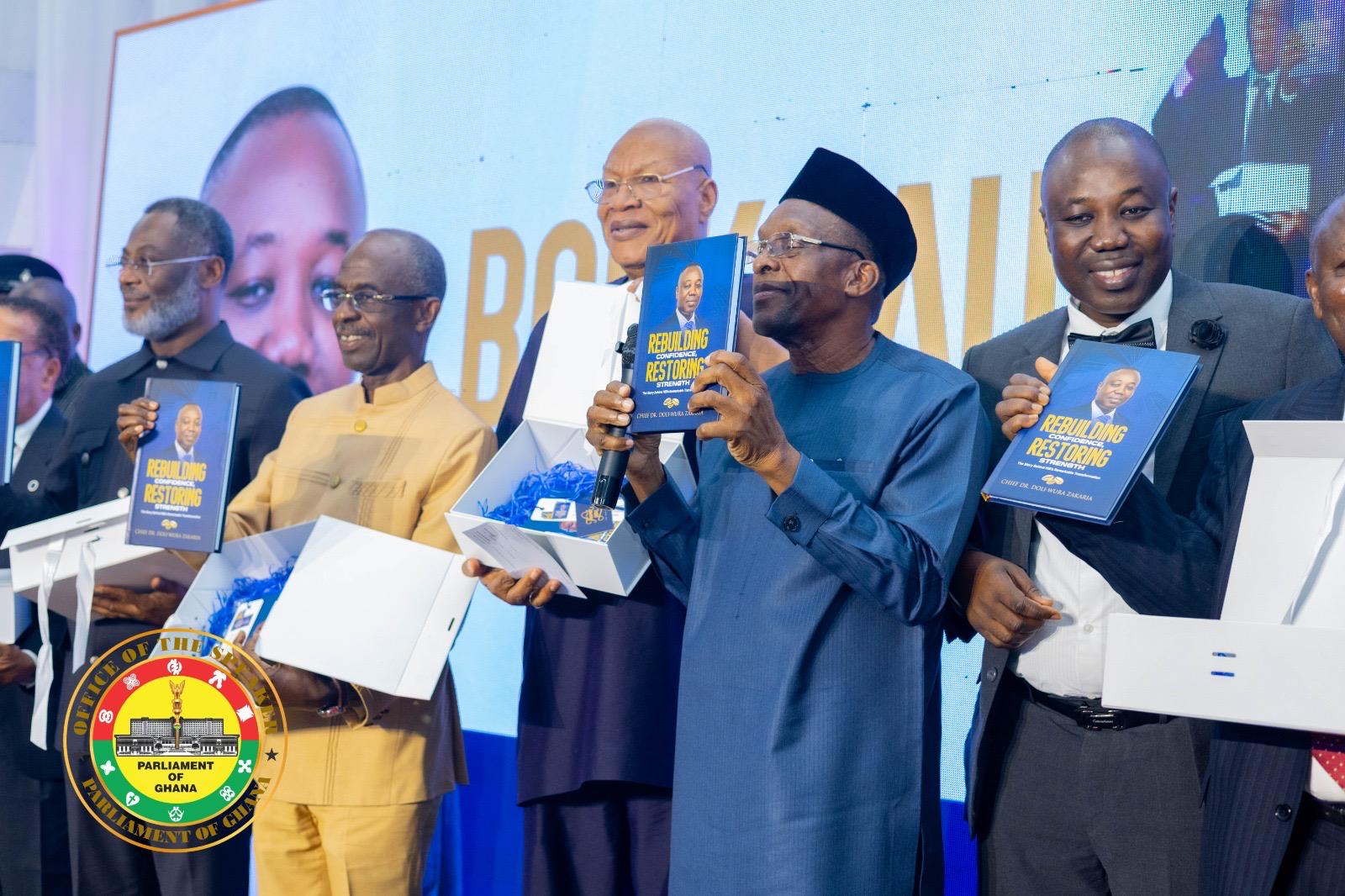
The book, “Rebuilding Confidence, Restoring Strength: The Story Behind NIB’s Remarkable Transformation”, authored by Chief Dr. Doliwura Awushi Abdul-Malik Seidu Zakaria, was launched at the British Council in Accra, drawing Members of the Council of State, Ministers of State, Members of Parliament, the Governor of the Bank of Ghana, chiefs and queen mothers, captains of industry, and management and staff of NIB.
Not Just a Story About One Bank
Speaking as Guest of Honour, the Speaker said his presence at the event was both personal and symbolic an opportunity to celebrate a “bosom brother” whose career, in his words, had transformed several state institutions, including the West Gonja District Assembly, the Land Title Registry, the Accra Metropolitan Assembly, the Controller and Accountant General’s Department, and the Ministry of Chieftaincy and Religious Affairs, before he was called upon to lead NIB.
Mr. Bagbin told the gathering that the book was, at its heart, an account of public trust. He said Ghanaians should ask themselves whether institutions built with public money can ever serve the public with fidelity, warning that when citizens lose confidence in the institutions established with their own resources, “democracy wobbles to the extent where no constitution or election can steady it.”
He recalled that NIB was established by Parliament in 1963 as Ghana’s first development finance institution, created to industrialize a newly independent nation, and credited with financing companies such as Nestlé Ghana and Aluworks, as well as giving rise to what is now the Agricultural Development Bank. He noted, however, that by 2024 the bank had gone more than a decade without publishing audited accounts — a governance failure he said the book “strips naked” for the public to confront.
The Speaker cautioned against the temptation to treat recapitalization alone as a cure for ailing state institutions, arguing that pouring funds into an organization with weak governance structures allows the money to “leak into an unretrievable abyss.” He said what changed NIB’s fortunes was not the size of any single cheque, but the discipline instilled in the bank’s systems ahead of new inflows of capital.
He commended the leadership of the bank’s Board, management and staff, and urged leaders of other state enterprises to emulate the candour with which the bank’s turnaround has been documented. He recommended the book to public sector leaders nationwide and closed his remarks with well wishes for the bank and the country.
Author Details the Numbers Behind the Turnaround
In his own remarks, Chief Dr. Doliwura Zakaria told guests that the book was written to document a collective effort rather than to celebrate any one individual, describing it as a “learning document” meant to guide future leaders of state institutions.
He recounted a childhood lesson from his late father, Alhaji Seidu Zakaria “what is unfinished does not disappear; it waits” as a guiding principle behind his account of NIB’s recovery.
Chief Dr. Zakaria outlined what he described as the key strategies behind the bank’s rapid turnaround over an 18-month period. He said the bank moved from a profit of GHS 3.1 million in 2024 to GHS 344 million in 2025, with a further GHS 94 million recorded in the first half of 2026 a combined profit of GHS 438 million over the period. He said customer deposits rose from GHS 6.4 billion in 2024 to GHS 12.9 billion, while total assets grew from GHS 5.8 billion to GHS 14.9 billion by June 2026.
According to the author, NIB became the first bank to complete recapitalization within four months, securing GHS 1.97 billion in total recapitalization funds. He said the bank’s negative total equity of GHS 851 million in 2024 had turned into positive equity of GHS 1.64 billion by June 2026, while its Capital Adequacy Ratio moved from negative 47 percent to a positive 48.1 percent over the same period. Non-performing loans, he added, fell from 76 percent in 2024 to 52.21 percent by mid-2026, alongside a 25 percent reduction in costs across the bank through the elimination of waste.
Despite the improved figures, Chief Dr. Zakaria cautioned that the work at NIB remains unfinished, noting that reforms are ongoing, systems are still being strengthened, and some branches are undergoing modernization. He said sustainable institutional change is built over years, not months, and stressed that people not buildings, technology or policy alone are what ultimately transform institutions.
He closed his remarks with a charge to leaders across sectors, describing institutional leadership as a form of stewardship rather than ownership, and expressed hope that the book would remind readers that “decline is not destiny” and that broken institutions can be rebuilt.
Source: PR Unit of Parliament