
The 2026 Mid-Year Fiscal Policy Review provides an important opportunity to assess the Government’s progress in implementing the commitments contained in the 2026 Budget Statement.
Unlike the annual budget, which outlines planned policy interventions and resource allocations, the mid-year review is expected to demonstrate how those commitments are being translated into action and whether public resources are producing the intended results.
For the education sector, the review presents encouraging evidence that Government has maintained its fiscal commitment. The Minister for Finance made it clear that no supplementary budget was being sought and that the approved appropriations for 2026 remained unchanged, with only internal expenditure realignments undertaken within existing budget ceilings.
This represents an important signal of fiscal discipline and suggests that Government has remained committed to financing the education sector as originally planned.
However, a comparison between the 2026 Budget Statement and the 2026 Mid-Year Fiscal Policy Review reveals that while the latter provides updates on several flagship programmes, it leaves out important policy commitments announced in the original budget.
The result is a review that effectively reports financial execution but provides only a partial account of the broader education reform agenda.
A Stable Education Budget with a Shift Towards Implementation
One of the most important findings from the comparison is that the education budget remained unchanged throughout the first half of 2026.
The 2026 Budget allocated approximately GH¢33.76 billion in Government of Ghana resources to the Ministry of Education, including about GH¢32.35 billion for compensation of employees, GH¢1.39 billion for goods and services, and GH¢20 million for capital expenditure, with additional financing expected from Internally Generated Funds (IGF), Development Partners and the Ghana Education Trust Fund (GETFund).
The Mid-Year Review confirms that these appropriations were maintained. Rather than requesting supplementary funding, Government focused on reporting expenditure releases and programme implementation.
This reflects a transition from budget planning to budget execution, with greater emphasis placed on demonstrating how allocated resources have been utilised.
Significant Progress on Flagship Education Programmes
The Mid-Year Review provides considerable evidence that several flagship education interventions have moved beyond policy commitments into implementation.
The most significant progress relates to the Government’s efforts to eliminate the double-track system in senior high schools.
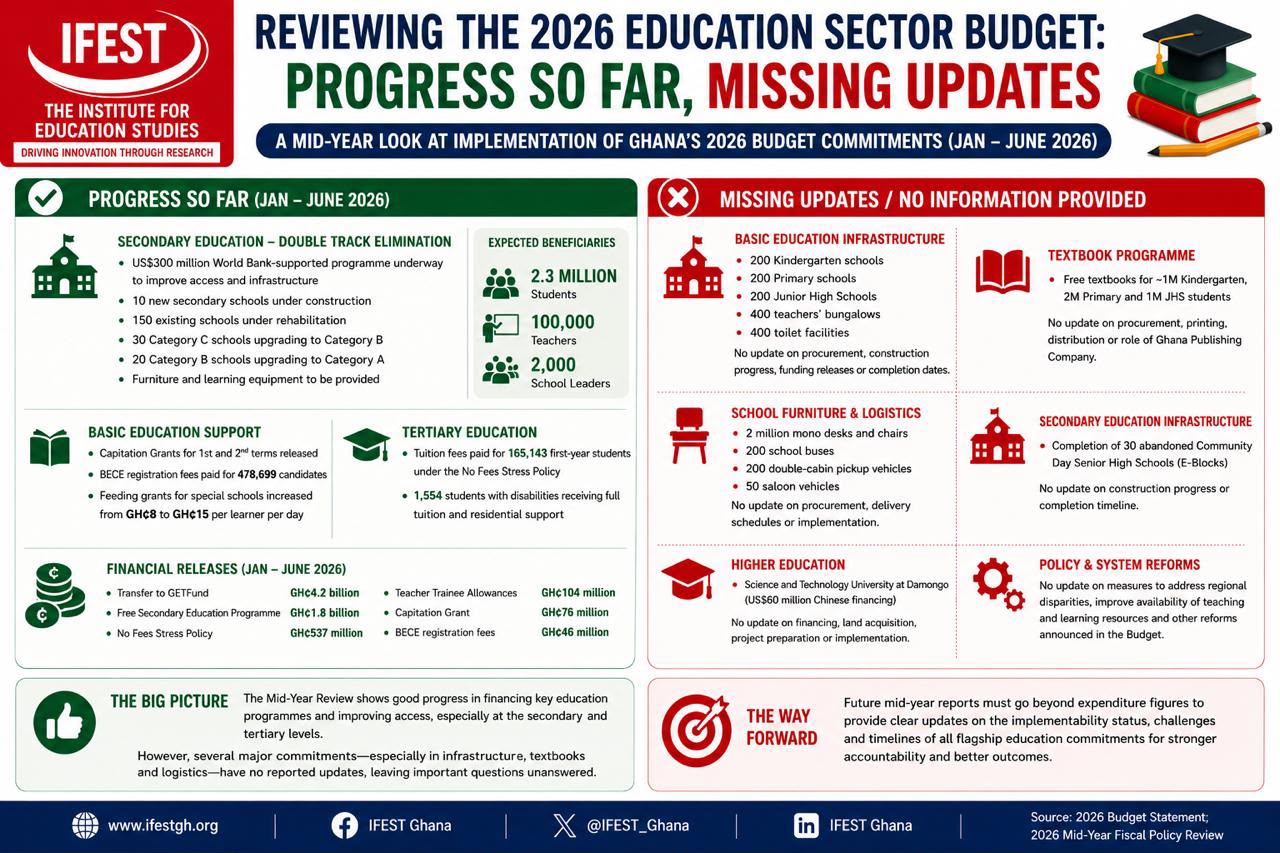
The Review reports the commencement of a US$300 million World Bank-supported programme that will finance the construction of ten new secondary schools, rehabilitate 150 existing schools, upgrade thirty Category C schools into Category B institutions, upgrade twenty Category B schools into Category A institutions, and provide furniture and learning equipment. Government estimates that these interventions will directly benefit approximately 2.3 million students, 100,000 teachers, and 2,000 school leaders.
The Review also reports encouraging progress in financing basic education. According to Government, Capitation Grants for the first and second terms of the 2025/26 academic year have been released, BECE registration fees have been paid for 478,699 public-school candidates, and feeding grants for special schools have been increased from GH¢8 to GH¢15 per learner per day. These measures demonstrate continued support for equitable access to education, particularly among vulnerable learners.
Progress is equally evident at the tertiary level. Under the No Fees Stress Policy, Government reports that tuition fees have been paid for 165,143 first-year tertiary students, while 1,554 students with disabilities have received full tuition and residential support.
The Mid-Year Review also provides evidence of actual financial releases to major education programmes. Government indicates that GH¢4.2 billion has been transferred to GETFund, GH¢1.8 billion has been released to support the Free Secondary Education Programme, GH¢537 million has financed the No Fees Stress initiative, GH¢104 million has been disbursed as Teacher Trainee Allowances, GH¢76 million has been released for the Capitation Grant, and GH¢46 millionhas been used to finance BECE registration fees. Unlike the Budget Statement, these figures represent actual expenditure rather than planned allocations, thereby providing stronger evidence of implementation.
Missing Updates on Basic Education Infrastructure
Despite these encouraging implementation updates, the Mid-Year Review omits several major commitments announced in the Budget Statement.
One of the most significant omissions concerns the ambitious basic education infrastructure programme. The Budget committed Government to constructing 200 kindergartens, 200 primary schools, 200 junior high schools, 400 teachers’ bungalows, and 400 toilet facilities in underserved communities. These projects were expected to create access for more than 200,000 additional pupils annually while reducing regional disparities in educational opportunities.
Yet the Mid-Year Review provides no information regarding procurement processes, contractors engaged, construction progress, expenditure incurred or expected completion dates. Given the scale and significance of these projects, the absence of implementation updates represents one of the most notable reporting gaps in the education sector.
Silence on the National Textbook Programme
Another major omission relates to the nationwide textbook distribution programme.
The Budget Statement announced Government’s intention to supply free curriculum-based textbooks to approximately one million kindergarten pupils, two million primary school pupils, and one million junior high school students, with production to be undertaken by the Ghana Publishing Company.
However, the Mid-Year Review provides no indication of whether procurement has commenced, contracts have been awarded, textbooks have been printed or schools have begun receiving these materials. Considering the central role that textbooks play in improving teaching and learning, the absence of any implementation update leaves an important gap in the assessment of education sector performance.
Educational Logistics Receive No Attention
The Budget also announced significant investments in educational logistics aimed at improving learning environments and strengthening education administration.
These included the procurement of two million mono desks, 200 school buses, 200 double-cabin pickup vehicles, and 50 saloon vehicles.
Yet none of these commitments is mentioned in the Mid-Year Review. The document provides no information on procurement, delivery schedules or implementation progress, making it difficult to determine whether these important investments remain on course.
No Update on the Completion of E-Blocks
The completion of thirty abandoned Community Day Senior High Schools, commonly referred to as E-Blocks, featured prominently in the Budget Statement as part of Government’s strategy to expand access to secondary education and reduce congestion in existing schools.
Surprisingly, the Mid-Year Review does not revisit this commitment. There is no discussion of construction progress, funding releases, contractor mobilisation or anticipated completion dates. Given the considerable public interest in these projects, an implementation update would have significantly strengthened the accountability function of the Review.
Higher Education Expansion Receives Little Attention
The Budget Statement also announced plans to establish a Science and Technology University in Damongo, supported by approximately US$60 million in financing from China. This institution formed part of Government’s broader strategy to strengthen science, technology and innovation within higher education.
The Mid-Year Review, however, contains no update regarding financing arrangements, project preparation, land acquisition or implementation timelines, leaving the status of this important initiative unclear.
From Policy Vision to Financial Reporting
Another important distinction between the two documents lies in their overall orientation.
The Budget Statement devoted considerable attention to explaining the policy rationale behind Government’s education reforms. It highlighted challenges such as overcrowding in secondary schools, infrastructure deficits, inequalities between Category A, B and C schools, shortages of teaching and learning materials, regional disparities in educational opportunities and the need to restore genuinely free and high-quality secondary education.
The Mid-Year Review adopts a markedly different approach. Rather than revisiting these policy challenges, it concentrates primarily on expenditure releases and completed activities. While this provides useful information about financial execution, it offers relatively little insight into whether these investments are beginning to improve learning outcomes, increase equity, reduce overcrowding or enhance educational quality.
Strengthening Mid-Year Budget Accountability
Mid-year fiscal reviews should serve not only as reports on expenditure but also as comprehensive instruments of public accountability. Beyond indicating how much money has been spent, they should demonstrate how effectively major budget commitments are being implemented, identify emerging challenges, explain delays where they exist and report progress against clearly defined performance indicators.
For the education sector, future Mid-Year Reviews would be considerably strengthened by providing systematic updates on all flagship commitments announced in the Budget Statement. This should include progress on major infrastructure projects, textbook procurement and distribution, school furniture acquisition, educational logistics, institutional development initiatives and measurable improvements in enrolment, retention, equity and learning outcomes. Such reporting would provide Parliament, development partners and citizens with a more comprehensive assessment of Government performance.
Conclusion
The 2026 Mid-Year Fiscal Policy Review demonstrates that Government has maintained its commitment to education financing and has made measurable progress in implementing several flagship programmes, particularly the Free Secondary Education Programme, the No Fees Stress initiative, GETFund transfers, Capitation Grants, Teacher Trainee Allowances and support for special schools.
Nevertheless, the Review falls short of providing a comprehensive account of all the commitments contained in the 2026 Budget Statement. Significant initiatives, including the basic education infrastructure programme, the national textbook distribution initiative, procurement of school logistics, completion of abandoned E-Blocks and the establishment of the proposed Science and Technology University, receive little or no attention.
As Ghana continues to strengthen programme-based budgeting and results-oriented public financial management, future Mid-Year Fiscal Policy Reviews should move beyond reporting financial execution to providing systematic updates on the implementation status of every major budget commitment. Such an approach would deepen parliamentary oversight, strengthen public accountability and provide a more complete picture of the extent to which public investments in education are delivering the transformative outcomes envisioned in the national budget.
By Peter Anti Partey, PhD
[Lecturer, UCC; ED, IFEST, Ghana]