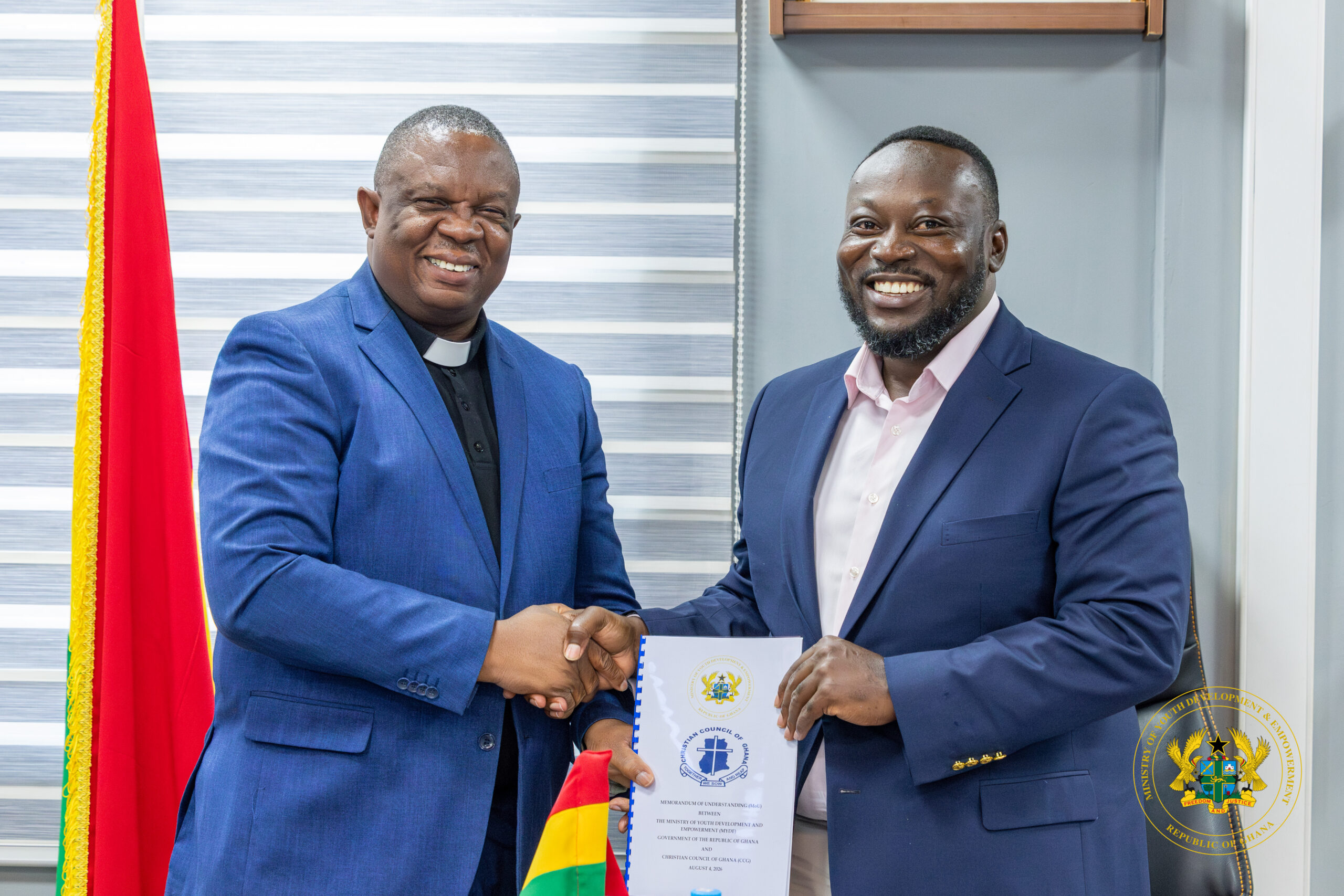

The Ministry of Youth Development and Empowerment (MYDE) and the Christian Council of Ghana (CCG) have signed a five-year Memorandum of Understanding (MoU) to roll out the ‘Sound Youth, Sound Nation'(SYSNA) programme.
SYSNA is a nationwide initiative aimed at tackling substance abuse, cybercrime and other social challenges affecting Ghana’s youth.
The agreement was signed in Accra on Tuesday, August 4, by the Minister for Youth Development and Empowerment, George Opare Addo, and the General Secretary of the Christian Council of Ghana, Rev. Dr. Cyril Fayose.
The partnership is expected to strengthen collaboration between government and faith-based organisations to address pressing issues confronting young people, including unemployment, teenage pregnancy, financial illiteracy, unhealthy sexual relationships, environmental pollution and responsible digital citizenship.
Speaking at the signing ceremony, Mr Opare Addo described the agreement as the culmination of months of engagement following the establishment of the Ministry. He said the initiative seeks to address key youth challenges such as limited access to information, skills mismatch, inadequate technology support, unemployment and youth health and wellbeing.
He emphasised that government considers young people as Ghana’s greatest national asset and that investing in their development is both a social responsibility and an economic necessity.
According to the Minister, the Christian Council’s nationwide presence and longstanding contribution to national development, peace and social justice make it a strategic partner in implementing impactful youth interventions.
Under the agreement, the partners will embark on nationwide awareness campaigns in schools, churches and communities, establish youth clubs and community support groups, train clergy, teachers, youth workers and peer educators, and strengthen counselling and referral services for young people affected by substance abuse and related social challenges.
The Christian Council will lead grassroots mobilisation through its network of churches and affiliated institutions, while MYDE will coordinate policy implementation and work with agencies including the Ministry of Education, the Ghana Health Service and the Narcotics Control Commission.
The programme will also promote entrepreneurship, employability, volunteerism, patriotism, leadership development, climate action, responsible migration and digital responsibility as part of efforts to raise a generation of responsible and productive young Ghanaians.
Addressing the gathering, Rev. Dr. Cyril Fayose described the agreement as “more than the signing of a document,” saying it represents a shared commitment by the Church and the State to invest in Ghana’s youth.
He noted that with more than one-third of Ghana’s population made up of young people, the country possesses a significant demographic advantage that could accelerate economic growth and national transformation if supported with the right education, skills and values.
However, he warned that failure to invest adequately in young people could lead to rising unemployment, insecurity and social instability.
Rev. Dr. Fayose also cautioned that although technology has created enormous opportunities, it has exposed many young people to cybercrime, misinformation, online exploitation and harmful digital content.
“Digital skills without integrity cannot build a strong nation,” he said, stressing the need to anchor digital transformation on ethical leadership, patriotism and responsible citizenship.
He further called for increased investment in entrepreneurship, innovation, technical and vocational education, digital literacy and greater youth participation in governance and national development.
Implementation of the programme will be overseen by a Joint Steering Committee made up of representatives from MYDE and the Christian Council. The committee will be responsible for approving annual work plans, monitoring progress and mobilising support from development partners, civil society organisations and the private sector.
The initiative will be rolled out in phases, beginning with priority communities, with the partners targeting up to 500,000 young people annually, subject to funding and institutional capacity.
Officials say the Sound Youth, Sound Nation programme will complement the Ministry’s “Red Means Stop” campaign, which seeks to combat the growing abuse of opioids and other harmful substances among Ghanaian youth through education, advocacy and community mobilisation.
The new partnership is expected to deepen the impact of that campaign by providing a structured national platform for prevention, mentorship, counselling and youth empowerment while addressing the broader social and economic challenges facing young people across the country.
By Joseph Armstrong Gold-Alorgbey