
Any political movement hoping to emerge as a credible third force ahead of Ghana’s 2028 elections faces a formidable electoral hurdle, according to a new statistical study showing that the country’s politics has become deeply concentrated around the New Patriotic Party and the National Democratic Congress.
The study does not make a direct prediction about the 2028 elections, but its analysis of voting patterns from 1992 to 2024 suggests that simply introducing another political party or candidate may not be enough to break the NPP-NDC hold on national elections.
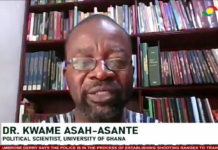
Titled “Is Ghana a Two-Party State? A Historical Account and Statistical Analysis of the Contemporary Multiparty System in Ghana,” the study was conducted by Kwame Asah-Asante of the University of Ghana’s Department of Political Science and Ezekiel Nii Noye Nortey of the Department of Statistics and Actuarial Science.
It was presented at the 2026 Ghana Statistical Association Statistics and Data Science Conference in Tamale.
The researchers found that although Ghana is constitutionally a multiparty democracy, election outcomes in the Fourth Republic increasingly resemble what they describe as a competitive two-party system.
Across the nine presidential elections examined between 1992 and 2024, the combined vote share of the NPP and NDC averaged more than 96 percent.
The most recent elections underline the scale of the challenge confronting any potential third force.
In 2020, despite 12 parties contesting the presidential election, the NPP and NDC together accounted for about 99 percent of the vote.
Four years later, with another 12 parties contesting in 2024, the two dominant parties still secured approximately 98 percent of the presidential vote.
The figures suggest that Ghana’s problem is not necessarily a shortage of political parties, but the difficulty smaller parties face in converting their presence on the ballot into meaningful electoral support.
That conclusion is reinforced by another of the study’s key indicators — the Effective Number of Parties, or ENP.
Although several parties have contested elections over the years, the researchers calculate Ghana’s average ENP at just 2.10047 between 1992 and 2024.
In practical terms, the study suggests that Ghana’s electoral competition behaves statistically as though only about two political parties are genuinely competitive, regardless of how many names appear on the presidential ballot.
The researchers further note that the number of parties contesting elections has increased in recent years without producing a corresponding diversification of the vote.
Their analysis concludes that more contesting parties do not necessarily translate into more effective electoral competition.
That finding could prove significant as political conversations begin to turn toward 2028 and the possibility of independent candidates, breakaway movements or alternative political formations challenging the two established parties.
Rather than predicting that such a movement cannot succeed, the study highlights the structural barriers it would have to overcome.
Among them are Ghana’s First-Past-the-Post parliamentary system, the winner-takes-all character of presidential competition, strategic voting, entrenched regional and historical party loyalties, campaign financing and disparities in media visibility.
The researchers argue that these factors reinforce established political parties and make it difficult for smaller parties to become electorally viable.
Under the principle commonly associated with Duverger’s Law, plurality electoral systems tend to encourage two-party competition.
The study explains that this happens partly because winner-take-all seat allocation disadvantages smaller parties and partly because voters may strategically support candidates they believe can actually win rather than risk backing a less viable contender.
The researchers also examined whether voter turnout and the number of parties contesting an election could explain changes in two-party concentration.
Their regression model produced an R² of approximately 0.453, suggesting moderate explanatory power.
However, neither turnout nor the number of contesting parties was statistically significant at conventional levels, and the authors caution that the analysis is based on only nine election observations.
The broader pattern, they argue, points instead to a deeply rooted structural equilibrium.
Parliamentary elections tell a similar story.
The NPP and NDC have overwhelmingly dominated representation under the Fourth Republic, with the 2020 election producing an exceptional 137–137 parliamentary split between the two parties.
The researchers interpret that near-perfect division not as evidence of one-party dominance, but of a competitive duopoly in which power alternates between two dominant political organisations.
The NDC emerged dominant in 1992, 1996, 2008, 2012 and 2024, while the NPP dominated in 2000, 2004 and 2016.
The alternation of power, the study argues, means Ghana differs from a one-party hegemonic system. The problem for smaller parties is that the competition remains overwhelmingly confined to the same two major political traditions.
The findings therefore raise a bigger question ahead of the next electoral cycle: what would a third force have to do differently to break through in 2028?
The study suggests that increasing the number of parties alone is unlikely to be enough.
The researchers propose consideration of reforms including Proportional Representation, a Mixed-Member or Mixed-Member Proportional electoral system, greater equity in political-party financing and media access, and stronger institutional support for smaller and more issue-based political movements.
They stress that the objective should not be to eliminate or weaken the NPP and NDC, but to reduce structural barriers to meaningful political representation.
For any emerging third force looking toward 2028, however, the historical numbers make the scale of the task clear.
Ghana may have many political parties on paper and several names on the ballot, but according to the study, the country remains “a multiparty constitutional framework with a strongly institutionalised two-party electoral reality.”
By Wisdom Sarfo