
In the south-western part of the Assin South District of the Central Region lies a village called Assin Amoabin, where my maternal great grandparents migrated from the Eastern Region to settle.
At the village, there is a river called Nana Adwoamoa, where we used to fetch water. It was a taboo to fish from that river or desecrate it in any form. Due to this, especially in the afternoons, display by the fishes in the river was a delight to watch. I never, during the period that I lived in that village, heard of anyone who dared to break that taboo.
Not long ago, I attended my mother’s eldest sister’s funeral and on the Saturday night, I saw a mentally deranged man dancing on the edge of the road at the village square. I asked one of my brothers who has been there for a while who that person was, and he told me it was one Kwabena Hunu. I remembered him immediately because he was noted for all the bad deeds while I lived in the village as a kid.
I was told he was struck, together with one other guy by name Kofi, by the river god for defecating into the river –Nana Adwoamoa, and also harvesting some fish from it. I’m told the duo also ate food offered to the gods at the village shrine and vandalised the place. Kofi is now in a psychiatric home at Ankaful, while Kwabena Hunu is wandering around in the village – mad. Their story is known to even a week-old stranger in the village. This tells the power of our gods in protecting the sanctity of their territories.
Impact of ‘galamsey‘ on Ghana’s environment
The illegal mining menace, also known as ‘galamsey’, has had a devastating impact on our environment, destroying forest reserves and polluting water bodies. A Parliamentary Hansard of Wednesday, February 19, 2025, captures the Minister of Lands and Natural Resources, Emmanuel Armah-Kofi Buah, who is also the Member of Parliament for Ellembelle in the Western Region, telling the House how Ghana’s forest landscape has been destroyed by galamsey.
“Ghana is currently faced with an unprecedented threat to our forest resources and water bodies due, largely, to illegal small-scale mining activities,” he stated.
After speaking about the damning impact of galamsey on Ghana’s forest reserves, the Minister further shed light on the water bodies that have also been polluted.
“According to the Ghana Water Company, the normal turbidity levels for water for treatment should not exceed 500 Nephelometric Turbidity Unit (NTU). However, the current turbidity levels of these water systems are between 5,000 and 12,000 NTU,” Minister Armah-Kofi Buah told the House.
Impact of ‘galamsey’ on living conditions of Ghanaians
The mercury and cyanide used by these illegal miners can stay in the soil for years, making it toxic and infertile. Aside from that, this huge number of deforested lands are prone to soil erosion and loss of biodiversity, where excavated lands also become unusable for agriculture and habitation.
Also, these chemicals contaminate water bodies, affecting aquatic life. According to research, when humans consume fish that contain mercury, a chemical called neurotoxin accumulates in them as a result of the mercury, posing risks to consumers.
Residents along river bodies depend on them as their source of water for domestic and agricultural purposes. But due to the contamination, access to clean water becomes difficult for them. At a point in time, some farmers had to purchase sachet water to irrigate their farms due to the toxic nature of our water bodies.
On Tuesday, April 23, 2024, the Head of the Anti-Illegal Mining Unit of Ghana Cocoa Board (COCOBOD), Prof. Michael Kwarteng, confirmed on Onua TV’s morning show, Maakye, how the situation has reached alarming levels.
“The challenge today is that farmers do not even get water to irrigate their farms so they purchase pure (sachet) water to the farms to irrigate their crops. They don’t get water because all the rivers in their area have been contaminated. Labour on cocoa production has become difficult because the youth have migrated to galamsey and if care is not taken, it will affect even our education,” he said in Twi.
The politician’s lip service to fighting galamsey
During Akufo-Addo’s eight years in office, nothing tangible was achieved in the fight against galamsey. What they were good at was forming one taskforce after the other. In the lead-up to the December 2024 elections, when Organised Labour threatened industrial action over the then government’s inaction on galamsey, they told Ghanaians they couldn’t risk their electoral fortunes to protect Ghana’s environment.
Then President Akufo-Addo defended his Ashanti Regional Chairman, Bernard Antwi Boasiako’s (a.k.a. Wontumi) Akonta Mining, saying the company, which had been cited by the Minerals Commission and Ministry of Lands for engaging in galamsey and was being tried in court, wasn’t involved in the act at the time they were having a conference on galamsey in the Ashanti Region. (Wontumi is in jail now by the way).
At the time, the likes of Ing. Kenneth Ashigbey, convenor of the Media Coalition Against Galamsey, were very vocal in calling out the then government to act on this issue, which many environmentalists have described as an existential threat. He received applause from the then opposition National Democratic Congress (NDC).
Thankfully, the New Patriotic Party (NPP) lost the election beautifully. The NDC had promised to use drones and other technology to fight galamsey, and as part of his first 120 days in office, President John Dramani Mahama promised to ameliorate galamsey.
But after 20 months in office, the canker has become worse. Some senior government appointees are now calling the likes of Ing. Ashigbey an NPP member, for calling on the government to stop the galamsey canker.
Men of God are also taking their share of the national abuse by being told to shut up or be taken to the cleaners. I am referring to the CEO of the Ghana Free Zones Authority, Dr. Mary Awusi, who threatened the Chairman of the Church of Pentecost not to meddle in galamsey affairs. What could be her reason?
President Mahama himself has admitted that some of his own party people and appointees are into the illegal activity. Today, just like the NPP, what the NDC government has become popular for is the creation of a National Anti-Illegal Mining Operations Secretariat (NAIMOS) and Blue Water Guards who have been arresting people engaged in illegal mining. Apart from that, the real big guns behind the practice are sitting in their homes.
If you are living in a mining area, check and see if the galamsey fight has seen any improvement. The NPP did zilch to improve the situation, except the GALAMSTOP and other bodies formed by the then administration, and now the problem is even worse under the NDC.
Politicians have paid lip service to the issue over the years because ‘party hia sika’, to wit, the party needs money, as we were told during the previous administration. Is it that both political parties are sponsored by galamsey funds, the reason we are not making any headway in the fight?
From the look of things, it is obvious the situation is going to get worse as the days and years go by. We have laws but they don’t bite, except when you’re in opposition. The reason Wontumi is in jail today despite glaringly engaging in galamsey when his government was in power.
It might take us another election cycle to get members of the current administration to also pay for their involvement in galamsey, because after President Mahama himself admitting that some of his party people are involved, we haven’t seen any action.
Are the gods sitting aloof?
Do you remember the story about Nana Adwoamoa and the gods of Assin Amoabin with the two young men at the beginning of this piece? It tells how the gods in our river bodies and forests are still potent.
Maybe, just maybe, ‘galamsey’ is not a big deal to the gods as we humans see it. Considering the devastating impact of the menace on our environment, I personally would have expected the gods to have acted by now, by defending themselves just as Kwabena Hunu and Kofi faced the consequences for defying them.
We can’t trust the politicians anymore, and the chiefs, who are custodians of the lands, become powerless once a mineral is discovered on a land. They sit in their villages and the Minerals Commission and Ministry of Lands and Natural Resources issue permits to people for small-scale mining but end up engaging in galamsey.
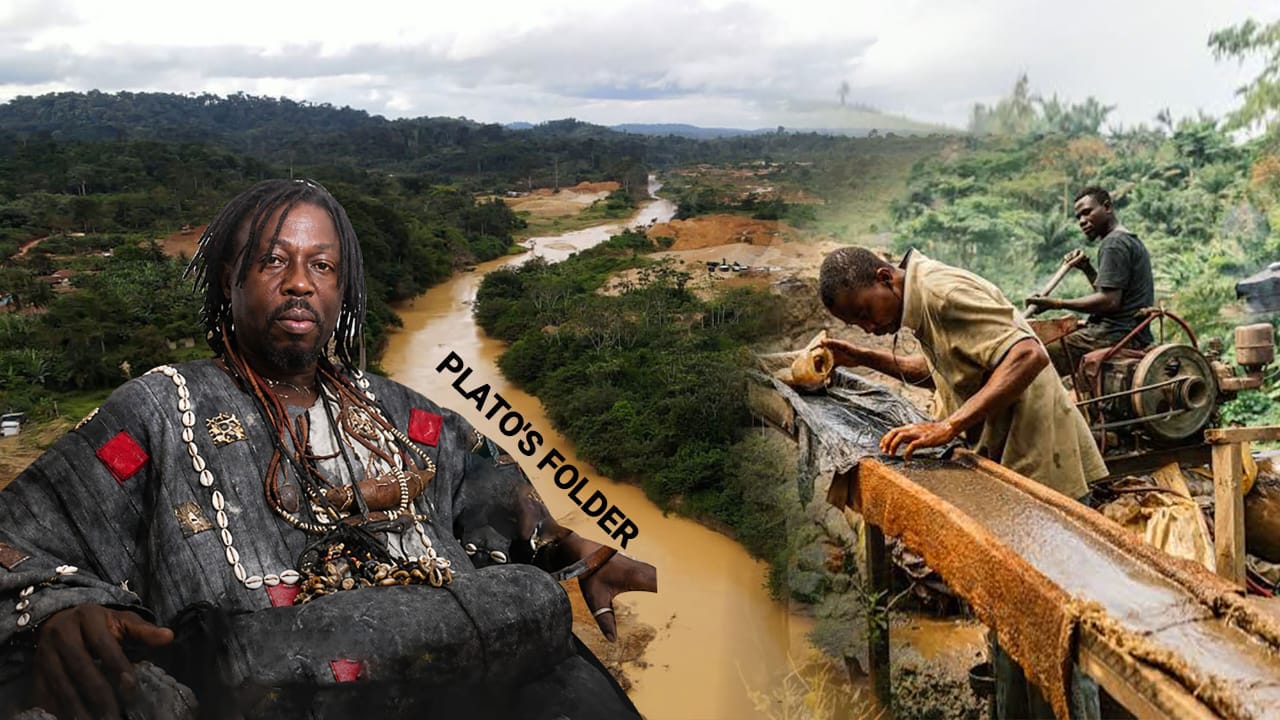
While wondering why the gods have been silent on fighting those who are destroying their habitats and that of their offspring, I called a notorious fetish priest in this country, Nana Kwaku Bonsam, and asked him why the gods, though known to be powerful, are not doing anything about galamsey which is putting their habitats in danger.
In his response, the ‘Kofi o Kofi’ servant told me it is because the gods have not been invited to intervene in the matter. According to him, these gods only act upon their invocation.
Quite ironic. Because, nobody invoked the powers of Nana Adwoamoa and the village god of Assin Amoabin to punish Kwabena Hunu and his counterpart. So why do we have to consult them before they act when their very homes are under attack?
For Kwaku Bonsam, it is the political leadership of the country that has relinquished the heritage of the nation for other religions, making those in authority forget to call on the gods for support. He reiterated that until the gods are called upon, they will not act and the situation will keep worsening.
“Every country has its religion and in Ghana, we say we are a Christian country. That was introduced to us by the white man and that’s what has brought us here,” he stated, and blamed politicians for dishonoring the gods.
“Some of the government officials do not give honour to the gods. Because if they do that, they’ll see what they don’t like by their deeds. So, we should revert to the old ways so that we can pour libation to the gods to kill anyone that comes to their place to engage in galamsey,” he stated firmly.
I then proceeded to ask him if the gods were asleep, for which reason they are waiting on humans to wake them up before protecting their own habitat. In his response, he said “they’re not asleep. They’re not dead. But the reality is that, “sɛ asɛm ɛmmaa wo akye a, wontumi mma no deɛneaa” to wit you can’t intervene in a matter you’ve not been invited into.”
“If you don’t invoke a god –’Nana, this is our schnapps, eggs, sheep. We offer them to you to protect Ghana…’ –so that we do it such that if one person goes, a snake will bite him, the second, third and others will die. That will serve as a deterrent to others that, entry into this forest will come with death and nobody will step foot there anymore. Other than that, we should forget,” Nana Kwaku Bonsam explained.
The way forward
The politicians have kept lying. Chiefs have said their own. Community and government watchdogs have been formed. At a point in time, men of God went to galamsey sites to pray, but all to no avail. The laws are only dealing with a few kingpins in opposition. Some have suggested the ‘shoot-to-kill’ approach. But human rights advocates, like Martin Luther Kpebu, a renowned legal practitioner, and others have vehemently kicked against it.
Our environment is being destroyed and Ghana faces an existential threat. If the gods are our last resort, why don’t we engage them to intervene to save our environment from these unscrupulous individuals who are enriching themselves at the expense of the nation’s future?
There is no solution I will suggest in this piece which has not already been suggested by politicians, anti-galamsey crusaders and environmentalists. What is left is consulting the gods to intervene. Maybe, this might work because, in Ghana, it is said that if you leave an amount of money in an open space with a Bible and another with eggs, charms and amulets, you will come back to meet the latter intact, with the former stolen.
Conclusion
Ghana is not a Christian or an Islamic state. Although about 70% of Ghana’s population are Christians, it is officially a secular state with the constitution guaranteeing religious freedom. When we go for state functions such as independence parades and others, we offer Christian, Islamic and traditional prayers.
If pastors have been to the galamsey sites and the situation hasn’t improved, politicians have failed on their promises and the laws are merely playing out George Orwell’s Animal Farm, what stops us from invoking the powers of the gods?
The writer, Felix Anim-Appau, works with the online unit at Media General. The views expressed in this piece are his personal opinions and do not reflect, in any form or shape, those of the Media General Group, where he works. His email address is [email protected], and he can be found on X as @platofintegrity.