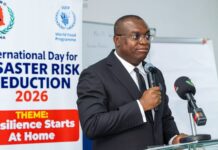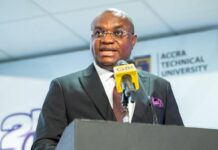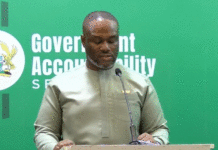

Outgoing Deputy Minister for Defence, Ernest Brogya Genfi, has expressed appreciation to President John Dramani Mahama, the leadership of the Ministry of Defence and the Ghana Armed Forces for the opportunity to serve the country, as he transitions to a new role as Presidential Adviser on National Resilience and Emergency Preparedness.
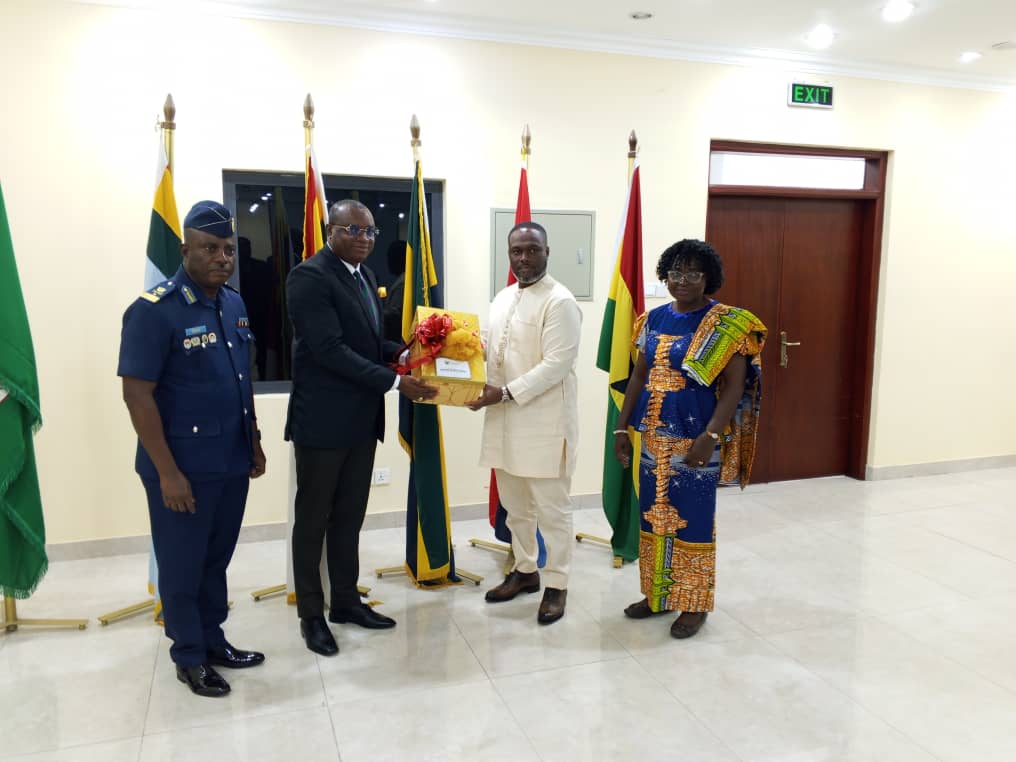
Mr Genfi made the remarks on Friday, September 4, 2026, at the Ministry of Defence in Accra during a send-off ceremony held in his honour.
Reflecting on his tenure, the former Deputy Defence Minister said his time at the Ministry had provided him with valuable lessons about leadership, national security, public administration and the importance of teamwork in safeguarding the country.
“This is a moment of deep gratitude and reflection. It is said that in public service, every arrival carries the quiet promise of an eventual departure.”
He said his appointment to the new role was another opportunity to serve Ghana and contribute to the country’s ability to prepare for and respond effectively to emergencies and national crises.
According to him, his new responsibilities remain closely connected to the work of the Ministry of Defence and the Ghana Armed Forces, particularly in the areas of national resilience, crisis management and emergency preparedness.
“My new role is not completely detached from the Ministry of Defence or the Armed Forces. It is closely aligned with the mandate safeguarding our nation in times of crisis and ensuring preparedness for emergencies.”
Mr Genfi highlighted military modernisation as one of the major areas of progress during his tenure, noting that significant attention had been given to improving the operational capacity of the three services of the Ghana Armed Forces.
He also pointed to the Government’s investments in military equipment, infrastructure and logistics, describing the ongoing retooling programme as one of the most significant efforts to strengthen the Armed Forces in recent years.
He stressed, however, that strengthening the military goes beyond the procurement of equipment and must include improving the welfare and living conditions of personnel.
“A modern military must also be a military whose personnel are adequately housed, properly trained, professionally developed and treated with dignity.”
One of the initiatives he highlighted was the development of a Ghana Armed Forces Home Ownership Policy and Scheme, aimed at providing a sustainable pathway for military personnel to own homes.
The initiative formed part of broader efforts to address accommodation challenges within the Armed Forces and improve the welfare of personnel and their families.
His tenure also saw increased attention to military infrastructure, including major redevelopment projects intended to improve accommodation and other facilities for personnel.
Mr Genfi also identified the advancement of defence education and professional development as another important area of work during his tenure.
He played a role in engagements surrounding the proposed National Defence University of Ghana, an initiative intended to strengthen strategic defence education, research and professional development.
The initiative, he said, was particularly important at a time when Ghana and the wider West African region face increasingly complex security challenges.
“Our Armed Forces must therefore be equipped not only with modern hardware, but also with the knowledge, strategic thinking and leadership capabilities required to confront emerging threats.”
The proposed university is expected to provide a platform for advanced studies in defence, security and strategic affairs while strengthening Ghana’s capacity to develop indigenous expertise in national security.
Another area of focus during his tenure was the development of Ghana’s defence industry and the strengthening of local capacity.
Mr Genfi, who also contributed to the work of the Defence Industries Holding Company Limited (DIHOC), supported efforts to position the institution as an important component of Ghana’s defence industrialisation agenda.
He noted that greater indigenous capacity would not only support the operational requirements of the Armed Forces but could also contribute to technology development, skills creation and economic growth.
“The future of Ghana’s defence architecture must include a greater degree of local capability, innovation and strategic partnerships.”
His tenure also included engagements with international partners on opportunities to strengthen Ghana’s defence industrial base and develop strategic partnerships in defence production and technology.
Mr Genfi further underscored Ghana’s longstanding contribution to international peace and security.
Ghana remains one of Africa’s prominent contributors to United Nations peacekeeping operations, and he said the country’s role in international peace operations must continue to evolve in response to emerging threats, including terrorism and violent extremism.
During his tenure, he participated in high-level engagements on regional security and the future of peacekeeping, advocating greater collaboration among African countries in responding to complex security threats.
He stressed the need for African countries to adopt a more coordinated approach to emerging threats.
“Complex security challenges require a multilateral approach to resolve.”
one of the most challenging periods of Hon. Genfi’s tenure came following the tragic helicopter crash that claimed the lives of several senior public officials, including the then Defence Minister, Dr Edward Kofi Omane Boamah.
Mr Genfi paid tribute to his former boss and colleague, describing his death as a profound loss to the Ministry, the Armed Forces and the country.
“I want to remember our late Minister, Hon. Dr Edward Kofi Omane Boamah, whom I had the honour of serving under. His loss was deeply felt, but his legacy endures in the work we continue to do.”
He said the experience reinforced the importance of preparedness, effective crisis management and institutional resilience issues that will now form part of his responsibilities in his new assignment.
Mr Genfi expressed particular appreciation to the Chief of the Defence Staff, Lieutenant General William Agyapong, for what he described as his professionalism, patience and support throughout his tenure.
He also thanked the Service Chiefs, Chief of Staff at General Headquarters, directors, management and civilian staff of the Ministry for their cooperation.
“None of it was the work of one person. Every milestone, every reform, every challenge we overcame was the result of collective effort and teamwork, driven by your expertise, dedication and love for this country.”
As he takes up his new assignment, Hon. Genfi said he was leaving the Ministry with confidence in its to extend the same cooperation to his successor, Defence Minister Hon. Kenneth Gilbert Adjei, as he leads the sector.
“I leave with confidence”
As he takes up his new assignment, Hon. Genfi said he was leaving the Ministry with confidence in its leadership and the future of the Ghana Armed Forces.
“I leave with full confidence that this Ministry will continue to rise to the challenges before it under the leadership of the Honourable Minister, the Chief Director and the Military High Command.”
He said although his new role would take him formally away from the Ministry, his commitment to Ghana’s national security would remain unchanged.
He expressed his readiness to continue collaborating with the Ministry of Defence, the Ghana Armed Forces and other relevant institutions in strengthening Ghana’s capacity to anticipate, withstand and recover from national emergencies.
“I leave with gratitude. I leave with humility. I leave with fond memories. And, above all, I leave with deep respect for the men and women who serve Ghana through the Ghana Armed Forces and the Ministry of Defence.”
The send-off ceremony brought together the Defence Minister, senior officials of the Ministry, the Military High Command led by the chief of the defence staff, Service Chiefs, Generals, senior officers and civilian staff to honour Hon. Genfi’s service and wish him well in his new assignment.
He concluded by calling for continued unity and commitment to national service.
“Together, we will continue to build a resilient Ghana.”
By Joseph Armstrong Gold-Alorgbey