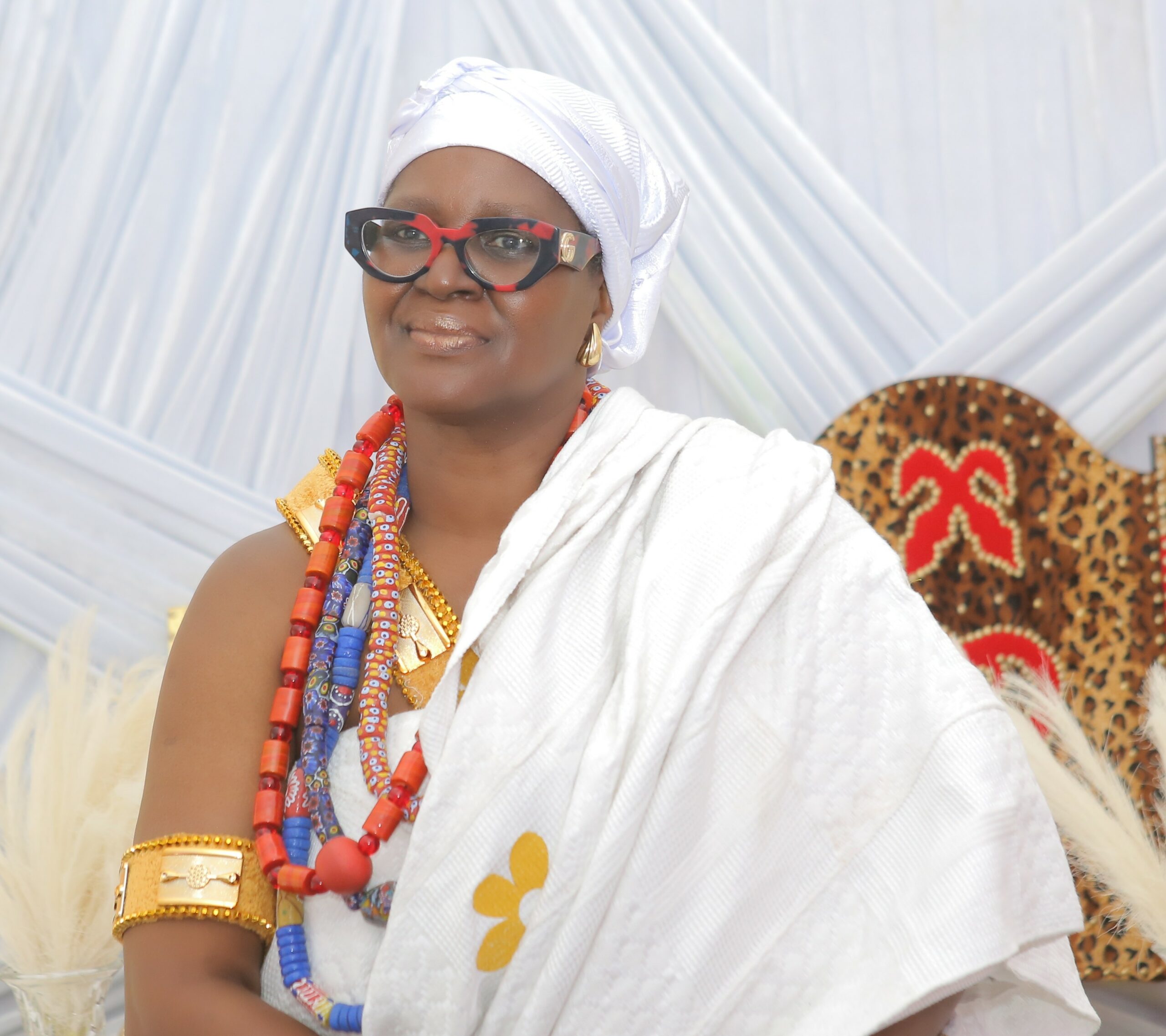

Former University of Professional Studies, Accra (UPSA) Registrar, Prof. Koryoe Anim-Wright, has been enstooled as Naa Ashong Ababio I, Dzaasenye of the Abola Traditional Area, pledging to make education and the welfare of women and girls central to her service.
Abola is one of the traditional quarters of Old Accra within the Ga State, with historic links to Ga Mashie.
The new traditional leader is taking decades of experience in education, institutional leadership and public service back to her traditional roots, describing her enstoolment as an opportunity to reconnect with her community and give back.
A thanksgiving service at Christ Anglican Church on the University of Ghana campus brought together traditional leaders, relatives, friends and members of the Abola community to celebrate the beginning of her new role.
But for Naa Ashong Ababio I, the occasion is about more than tradition and ceremony. It has prompted a deeper reflection on her relationship with her roots and the responsibility that comes with it.
‘We have a responsibility to give back’ Reflecting on her first month in the role, Naa Ashong Ab abio I said the experience has made her recognise how easily people can lose touch with their origins.
“What has struck me the most is how unintentionally we drift apart from our roots.”
She said the experience has strengthened her resolve to contribute to the community that played a role in shaping her life.
“All of us have a responsibility to give back to our communities. I should have been doing this a long time ago.”
For her, the new position provides an opportunity to rebuild that connection.
“This role will allow me to reconnect with my roots and show how much I appreciate what the community did for me to become who I am today.”
A development role, not merely a title
Naa Ashong Ababio I says her responsibilities as Dzaasenye will include supporting the welfare of women and girls, assisting the traditional leadership and contributing to the development of Abola.
“The title of Dzaasenye means that I will be interested in and focused on the welfare of women and girls, and that is what I intend to do.”
She explained that the role also comes with administrative responsibilities, including supporting the Abola Mantse and members of his court.
“There is also an administrative part of the role, where I assist the king and others in his court and offer advice. But my primary interests will be women, girls and the development of Abola.”
She added:
“Anything I can do to support the community, I will be honoured to do.”
Her emphasis on women and girls places education and empowerment at the centre of her vision for the role.
Education emerges as an early priority
Education has already emerged as one of the areas receiving attention under the new traditional leadership arrangement.
The Abola Mantse, Nii Kofi Otuadan III, said the traditional area has more than 30 villages and indicated that education would be among the areas targeted for support.
He disclosed that the headmistress of Richard Akwei Memorial School, together with four pupils, attended the thanksgiving reception as part of an emerging relationship between the school and the new Dzaasenye.
Support for the school is expected to include books and other learning materials.
Nii Kofi Otuadan III stressed, however, that the educational intervention would not be limited to one institution.
“We have more than 30 villages under Abola, and there are many good things we want to do.”
He said: “One of the focal areas has been education. We will support the schools in terms of books and other materials. This will not be limited to Richard Akwei Memorial School.”
The Abola Mantse expressed optimism about what the new leadership could bring to the traditional area.
“I can tell the people of Abola that better days are yet to come.”
Bringing professional experience home
Naa Ashong Ababio I brings to her new traditional role extensive experience in higher education management, institutional advancement, partnerships, fundraising and grants.
She became the first woman to serve as Registrar of UPSA when she assumed office in August 2020, before retiring in April 2024.
Prior to becoming Registrar, she served as Dean of UPSA’s Centre for International Education and Collaboration, where she was involved in partnerships, exchange programmes and international grant initiatives.
She also previously served as the first female President of the African University College of Communications and held leadership positions at the Ghana Institute of Management and Public Administration and Western Connecticut State University in the United States.
She holds a PhD in Interdisciplinary Studies, with a concentration in Communication and Development, from Union Institute and University in Cincinnati, Ohio.
Her experience in institutional leadership and partnerships could provide useful tools as she seeks to mobilise support for community initiatives in Abola.
The challenge: turning a pledge into impact
For Naa Ashong Ababio I, the real test of her new role will ultimately be what it delivers for the people.
Support for basic education, mentorship for girls, scholarships, skills training and opportunities for women could translate her stated priorities into tangible community benefits.
But achieving those goals will require more than individual commitment. It will depend on partnerships between the traditional authority, schools, professionals, businesses, development organisations and members of the Abola community.
Her transition from higher education administration to traditional leadership therefore represents more than a change in title.
It brings professional experience into a traditional institution and a renewed connection to the community from which she traces her roots.
As Naa Ashong Ababio I begins her tenure as Dzaasenye, her message is clear: the honour of traditional office must be matched by service.
And for the women, girls and communities of Abola, the expectation will be to see that commitment translated into opportunity, education and lasting development.
By Enyonam Haligah