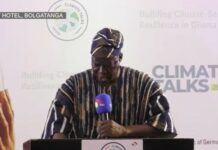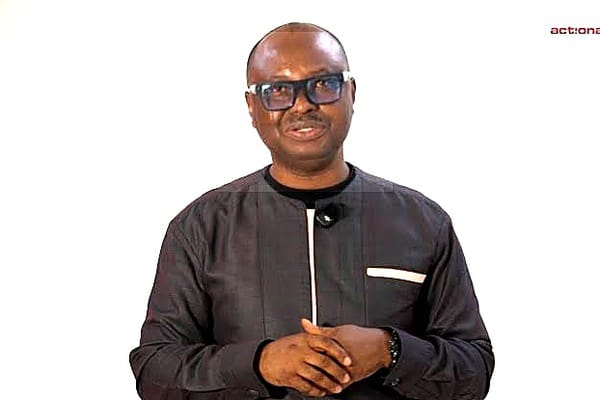

ActionAid Ghana Country Director, John Nkaw, is urging government to push for further debt cancellation and use the proceeds to finance climate resilience, renewable energy and sustainable agriculture.
His call comes at a time Ghana is seeking billions of dollars to implement its climate commitments while continuing to service substantial public debt obligations.
Ghana estimates it will require about US$53.3 billion between 2025 and 2035 to implement its updated climate action plan, covering areas including energy, transport, agriculture, forestry, water, health and other climate-sensitive sectors.
Spread across the 10-year period, the requirement translates into an average of about US$5.33 billion every year, although actual expenditure is not expected to be evenly distributed from year to year.
The financing challenge comes as Ghana continues to commit significant resources to debt servicing. The International Monetary Fund projects Ghana’s total public debt service at about US$13.19 billion in 2026, while the 2026 Budget projects about GH¢57.7 billion in interest payments alone.
For ActionAid, the concern is not simply the size of Ghana’s debt, but what continued debt repayments mean for the resources available to respond to climate change and provide essential public services.
Speaking to TV3, Nkaw said debt repayments were increasingly limiting the ability of developing countries to invest in areas that could improve livelihoods and strengthen resilience.
“More and more of government resources is not available to invest in the productive sectors of our economy,” he said.
He said the pressure extends beyond climate projects to health, education, water systems and social services, with vulnerable households often bearing the consequences when governments are forced to tighten spending.
Nkaw cited ActionAid figures indicating that Ghana’s external debt repayments were equivalent to about 9.2 percent of national revenue, compared with about 8.2 percent spent on health.
He argued that when large portions of government revenue are committed to debt repayments, less money remains available to strengthen health systems and support communities already exposed to climate shocks.
“Because of the debt servicing complications, little amount is available for government to invest in these sectors,” he said.
According to Nkaw, the fiscal pressure can also push governments towards austerity, with the impact eventually showing up in the cost of services and the burden carried by poorer households.
“Governments present austere budgets, and in that budget, there are a lot of cuts,” he said.
He said such cuts often hit the poorest hardest, including women, older persons and single-parent households, as families are forced to absorb higher costs in health, education and other essential services.
The concerns are reinforced by ActionAid’s latest report, Debt Fuels the Climate Crisis: How the Finance Flows, which examined public revenues, debt repayments, national budgets and climate plans across 65 of the world’s most climate-vulnerable countries.
The report finds that those countries are spending nearly 25 times more on debt repayments than on climate action, while debt servicing consumes about 65 percent of their combined government revenue.
ActionAid also says 93.5 percent of the countries examined are either already in debt distress or at significant risk of it.
Nkaw said that imbalance is delaying climate action across developing countries.
“Because debt is a crippling financial problem for developing countries, you realise that either their actions against climate change are delayed, reduced, or even dependent on governments going in to take additional loans,” he said.
ActionAid says the problem is compounded by the structure of international climate finance. Its report finds that about two-thirds of climate finance provided by wealthy countries comes in the form of loans rather than grants, meaning countries already under debt pressure may have to take on additional liabilities to finance adaptation and recovery.
The organisation argues that this creates a cycle in which climate disasters force countries to borrow, debt repayments then reduce money available for resilience, and countries become more exposed when the next climate shock occurs.
For Nkaw, Ghana should respond by pushing more strongly for debt relief.
“We are calling on government to focus on demanding debt cancellation,” he said.
He said creditor countries and institutions should consider deeper cancellation for vulnerable developing economies, arguing that this would give governments greater room to invest in climate action and productive sectors.
“It is only just that these creditor institutions engage in debt cancellation, or grant debt cancellation, for poor countries that are facing climate change vulnerabilities,” he said.
Nkaw also called for stronger international rules governing sovereign debt, including a framework that would compel a broader range of creditors to participate in restructuring arrangements.
He said such reforms could give countries more breathing room to redirect resources towards climate action.
In Ghana’s case, he wants some of that fiscal space channelled into renewable energy. Nkaw said the country already has a renewable energy strategy but needs to intensify implementation, particularly in solar energy and other parts of the energy transition.
“We are now calling on government to escalate or to intensify renewable energy deployment,” he said.
Agriculture is another sector he wants prioritised. Nkaw said Ghana should invest much more in climate-sustainable agriculture and agroecology, particularly because of the number of Ghanaians whose livelihoods depend on farming and agricultural value chains.
“There’s need for us to invest in climate sustainable agriculture. And in many organisations like civil society, we call that agroecology,” he said.
He argued that investment in agriculture could simultaneously strengthen food security, create employment for young people and women, and make farming communities more resilient to climate shocks.
“The more and more we invest in the agriculture ecosystem, it will create value chain employment for a lot more young people and especially women,” he said.
Nkaw acknowledged that Ghana has already made progress with debt restructuring and said those efforts should continue.
“We are happy that the government is working prudently in restructuring its sovereign debt, and that is going to help in rechanneling resources into more productive sectors,” he said.
Ghana’s overall debt indicators have improved following the domestic and external debt restructuring exercises, but large annual repayment obligations remain.
That leaves government balancing two competing pressures: maintaining debt sustainability while finding the billions of dollars required to protect communities, infrastructure and livelihoods from climate risks.
For ActionAid, the question is therefore not only how much climate finance Ghana can mobilise, but also the terms on which that financing comes.
If climate finance continues to arrive mainly as loans, Nkaw’s argument is that countries such as Ghana risk borrowing today to fight climate change, only to face an even heavier repayment burden tomorrow.
By Wisdom Sarfo