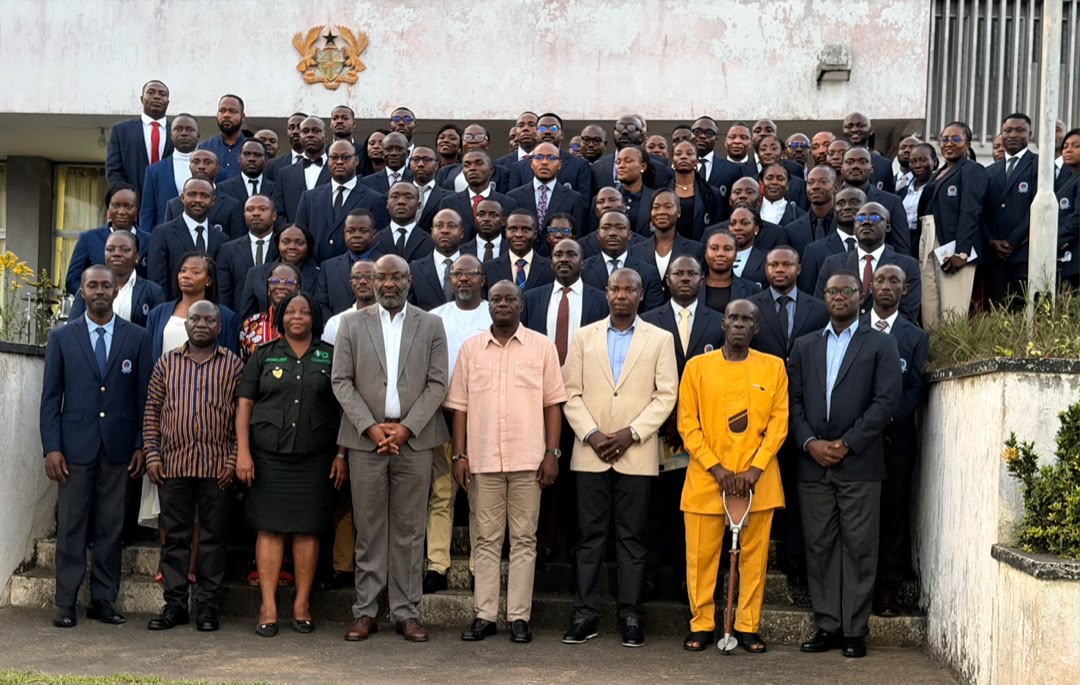

A 70-member delegation from the Ghana Armed Forces Command and Staff College (GAFCSC), Junior Division, has called for stronger coordination among state institutions, traditional authorities and local communities to tackle illegal mining and its growing impact on the environment and human security in the Western Region.
The delegation, comprising 61 Ghanaians and nine foreign nationals, made the call after conducting an environmental study tour of the region.
Lieutenant Commander Sheba Fiadzomor, who led the team’s debriefing, presented the findings and recommendations to the Western Regional Minister, Joseph Nelson.
The study tour was undertaken by students of Junior Staff Course 86 of the Ghana Armed Forces Command and Staff College under the theme: “Safeguarding the Environment for National Development: Challenges and Prospects in the Western Region.”
The exercise focused on three key areas: illegal mining and human security, illegal mining and cash-crop production, and sustainable mining and land reclamation.
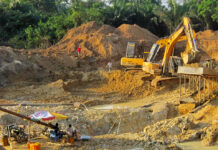
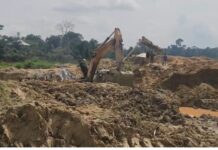
“As of August 2026, illegal mining activities have still managed to destroy 270 hectares of forest land and 219 mature trees within this region,” she said.
The team said the environmental damage was not limited to the loss of forest cover, but also included soil degradation, water pollution and disrupted drainage systems.
The study further highlighted health and social concerns associated with illegal mining.
According to the delegation, tuberculosis and HIV cases in the Ellembelle District increased by two per cent between 2025 and 2026, the highest increase recorded in the region.
The team partly attributed the increase to the influx of foreign nationals linked to illegal mining activities.
It also identified the absence of a dedicated health surveillance system to track illnesses and birth defects associated with illegal mining.
Lieutenant Commander Fiadzomor also raised concerns about the social consequences in mining communities.
“There is also a sharp increase in school dropouts, prostitution and child trafficking in Teleku Bokazo, Essiama and Eikwe because of illegal mining activities,” she added.
The study found that mining activities were increasingly encroaching on cocoa, rubber, coconut, oil-palm and other agricultural lands, reducing the acreage available for sustained cash-crop production.
It also reported significant losses of cocoa and rubber farmlands in parts of the region.
According to the delegation, the destruction and degradation of farmlands were affecting crop productivity and farmers’ incomes.
“Illegal mining has reduced crop productivity and farmers’ income. Soil degradation, polluted water and disrupted drainage are affecting the performance of crops located close to mining areas,” Lieutenant Commander Fiadzomor said.
The study tour also gave the Western Regional Coordinating Council and other stakeholders an opportunity to assess existing interventions and identify areas requiring stronger coordination.
The delegation called for greater collaboration among state institutions, traditional authorities and local communities to address the environmental, agricultural and human-security challenges associated with illegal mining.
Responding to the findings, Western Regional Minister Joseph Nelson assured the delegation that the Regional Coordinating Council would give due attention to the observations and recommendations from the exercise.
“Let me therefore assure you that the Western Regional Coordinating Council will pay due attention to the issues and recommendations arising from this exercise within the mandate and resources available to the Council,” he said.
The findings are expected to contribute to ongoing efforts to protect the Western Region’s forests and agricultural lands while strengthening measures to promote responsible and sustainable mining.
By Ebenezer Atiemo