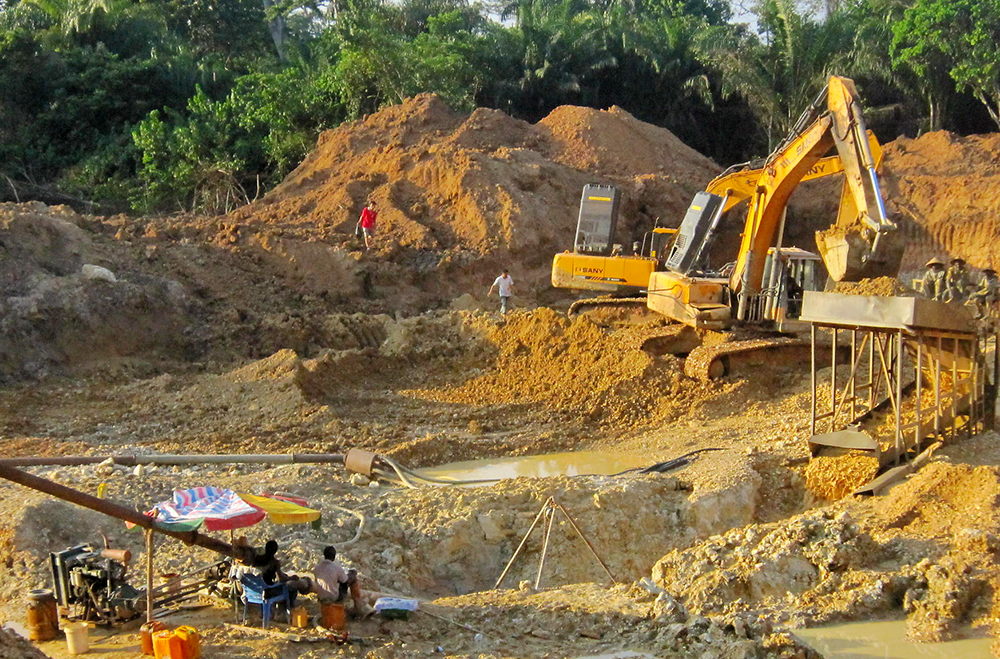

The Forestry Commission is calling for a permanent 24-hour security presence in forest reserves as part of efforts to prevent illegal miners from returning to areas cleared during enforcement operations.
The Commission says repeated raids and the destruction of mining equipment have not been enough to permanently stop illegal mining because miners often return to the same locations after enforcement teams withdraw.
Speaking on the situation in the Kakum Forest area, the Western Regional Manager of the Forestry Commission, Nana Poku Bosompem, said recent operations had led to the arrest of 41 illegal miners and the destruction of hundreds of machines and makeshift structures.
According to him, the operation resulted in the immobilisation of 125 “Changfa” machines and more than 200 industrial pumps used for illegal mining activities.
He said several makeshift structures and wooden processing plants had also been destroyed during the operation.
“41 of them have been arrested, including four females who were arrested in the night, after 2 a.m., inside the forest,” he said on August 8.
Mr. Bosompem added that 27 of those arrested had, as of the time of the interview, been arraigned before the circuit court.
He, however, said the major challenge remains the ability of illegal miners to return to cleared areas once enforcement teams leave.
He explained that the Forestry Commission has to rotate its teams among several forest reserves, making it difficult to maintain a permanent presence at every location.
“There are 195 forest reserves in the Western Region, so the effort cannot be concentrated on just one,” he said.
According to him, enforcement teams may spend several days in one forest clearing out illegal miners, but once they move to another location, the miners return with new equipment.
Mr. Bosompem said this cycle has made it necessary for the Commission to rethink its approach to the fight against illegal mining.
“We need to change the strategy. It means you should have permanent structures on the ground inside the forest and make sure your officers are there 24/7,” he said.
He believes a permanent security presence would prevent illegal miners from returning to areas already cleared by enforcement teams.
He also called for permanent camps and support facilities in strategic locations to enable enforcement officers to respond quickly whenever illegal mining activity is detected.
Mr. Bosompem argued that the fight against illegal mining cannot be treated as a temporary or occasional intervention.
He said the Forestry Commission conducts operations regularly, but miners continue to adapt by returning with new equipment.
“We fight them daily, but every day we keep arresting, we keep banishing,” he said.
He therefore proposed an approach similar to the government’s 24-hour economy concept, with personnel permanently stationed in forest reserves to maintain continuous surveillance.
“Fighting illegal mining needs something similar to the 24-hour economy,” he said.
The Forestry Commission says sustained presence on the ground, rather than periodic operations alone, will be critical to preventing illegal miners from re-establishing their activities in Ghana’s forest reserves.
By Christabel Success Treve