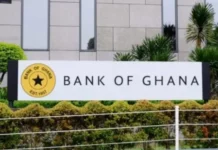

Governor of the Bank of Ghana, Dr. Johnson Pandit Kwasi Asiama, has disclosed that all 23 banks operating in Ghana have now met the regulatory capital requirements.
Dr. Asiama says the development marks the completion of a recovery process that began after the Domestic Debt Exchange Programme (DDEP).
Speaking at the 43rd Annual General Meeting of the Ghana Association of Banks and the launch of the 6th edition of the GH Bankers’ Voice Magazine in Accra on Thursday, October 8, 2026, he said the 2022 audited financial statements showed that 13 banks had breached regulatory capital requirements due to the economic crisis and financial asset impairments.
According to him, the feat was achieved through collective efforts.
“Through the collective efforts of banks, shareholders, investors, the Association, Government and the Bank of Ghana, all 23 banks have now met the regulatory capital requirements. This is a significant achievement,” he said.
Dr Asiama said restoring regulatory capital is only the beginning, noting that focus must now shift to ensuring that banks maintain capital commensurate with their risk profiles and build sufficient buffers to withstand future shocks.
He said the risks confronting banks are becoming increasingly complex and that boards and senior management are expected to have a clear understanding of the risks embedded in their institutions’ business models.
He said the Bank undertook a comprehensive thematic review of the viability and long-term sustainability of banks’ business models in 2025, disclosing that the vulnerabilities identified have been shared with the respective institutions and engagements with boards and senior management have commenced.
The Bank, he said, intends to conduct a second round of Business Model Analysis next year.
On sector performance, Dr Asiama said the banking sector has recorded significant improvement since 2025, reflecting improved macroeconomic conditions and continued regulatory and supervisory reforms.
He said as at the end of August 2026, total banking sector assets had increased by 20.47 per cent to GH¢500.20 billion, compared with GH¢415.20 billion a year earlier.
He said the sector remains well capitalised, with the Capital Adequacy Ratio improving from 18.28 per cent to 19.10 per cent, significantly above the regulatory minimum of 13 per cent.
Asset quality, he noted, has also improved, with the Non-Performing Loans ratio declining from 20.77 per cent in August 2025 to 15.66 per cent in August 2026.
Dr Asiama has, however, cautioned against interpreting the improvement as the end of the reform journey, saying the task now is to ensure that stronger balance sheets translate into sustainable business models.
He reminded banks of the requirement to reduce their NPL ratios to the prudential limit of 10 per cent by the end of December 2026.
He said the Bank of Ghana issued the Notice on Non-Performing Loans in August 2025 to strengthen governance arrangements for credit risk management and to provide remedial measures in respect of wilful defaulters.
On liquidity, the Governor said the Bank is in the process of publishing the Liquidity Coverage Ratio Directive, which will establish the prudential liquidity requirement for banks.
He said the Bank has also strengthened its macroprudential stress-testing framework and has been engaging banks on the results of stress tests conducted under severe but plausible scenarios.
On digitalisation, Dr Asiama said cybersecurity, digital fraud, data protection and operational resilience are receiving increasing supervisory attention.
He said following the publication of the revised Cyber and Information Security Directive, the Bank has continued to work closely with the Association and the industry to facilitate implementation.
He said the Bank is developing a Directive on the Use of Artificial Intelligence in the Financial Sector, which will seek to promote responsible experimentation while ensuring appropriate governance throughout the AI lifecycle.
Strengthen risk management frameworks – BoG Governor tells banks