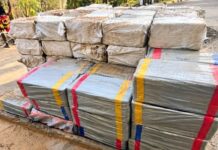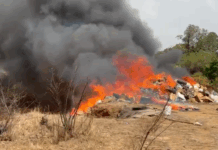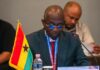

Legal practitioner Martin Kpebu has criticised the Narcotics Control Commission (NACOC) for the way and manner it is handling incidents of smuggling of cocaine out of the country.
Mr wondered how the claim by NACOC that the arrest was effected through controlled delivery was backed by a video footage.
“If you say it is a controlled delivery, how come a bribe had to be paid to let it through,” he asked.
“The way NACOC is going, it is not helpful and not the best. Who took the bribe? We should have a video of it, if it was indeed a controlled delivery. Have you arrested the one who took the bribe? We expected the controlled delivery to be on video. You can’t tell Ghanaians that you are doing a controlled delivery and there was no video,” Kpebu said on the Key Points on TV3 Saturday, November 7.
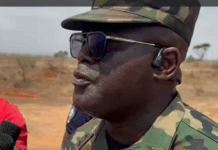
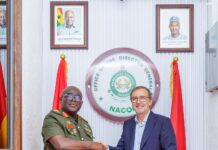
Alexander Twum-Barimah, Deputy Director-General, Narcotics Control Commission, who also joined the discussion via phone, said the Commission is going to investigate the alleged bribery claim.
“I have no knowledge of the alleged $3,000 payment. Investigations are ongoing, and anyone found culpable will face the law,” he said.
In relation to the arrest of cocaine in foreign lands from Ghana, a member of the New Patriotic Party (NPP), Kwasi Kwaryeng, also said the incidents appear like organised crime.
He makes the point that the government is expected to tell Ghanaians what it intends to do about these drug seizures linked to Ghana, but it has not done so.
In his view, the positioning of the government is problematic.
“What we are seeing looks like organised crime. We expect the government to tell us what it intends doing about these drug seizures linked to Ghana.
“The scanners are able to identify cans but cannot identify the cocaine; it is surprising. The government may not be complicit, but the posturing of the government is problematic,” he said on the Key Points on TV3 Saturday, November 7.
The NPP had called for the immediate dismissal of the heads of the Narcotics Control Commission (NACOC), Ghana Airports Company Limited (GACL), Ghana Ports and Harbours Authority (GPHA) and National Security over what it describes as Ghana’s growing involvement in international cocaine trafficking.
The party says the repeated interception of cocaine consignments traced to Ghana at various international destinations raises serious questions about the effectiveness of the country’s security and anti-narcotics institutions.
Addressing a press conference at the NPP Headquarters in Accra on Wednesday, 4 November, the party’s Second National Vice Chairman, Henry Nana Boakye, popularly known as Nana B, accused the government of failing to address what he described as an emerging cocaine trafficking corridor.
“We have invited you here a second time on the same subject because the subject has refused to go away. Six weeks ago, we warned that Ghana was fast becoming a corridor for cocaine. Last Saturday, the world received fresh proof, this time not from a seaport in Europe, but from the Accra International Airport,” he said.
14 major drug busts recorded
Mr Boakye said Ghana had recorded at least 14 major cocaine and drug seizures between March 2025 and October 2026.
According to him, seven of the interceptions occurred on Ghanaian soil, involving approximately 3.6 tonnes of drugs, while more than 12 tonnes of cocaine traced to Ghana had been seized abroad.
He estimated the street value of the cocaine intercepted outside Ghana at between US$1.3 billion and US$1.7 billion.
Among the incidents he cited were the seizure of nearly 4,500kg of cocaine concealed in a timber shipment from Ghana at Amsterdam in June 2025, and 2,829kg hidden in cassava flour shipped from Tema and intercepted at Antwerp in November 2025.
Another 1,158kg was reportedly seized at the same Belgian port in December 2025.
In September 2026, French authorities also intercepted approximately 3.9 tonnes of cocaine concealed in a container declared as plastic waste at Dunkirk.
The NPP further cited an April 2026 operation in Australia, where police seized 320kg of illicit drugs concealed in charcoal from Ghana, with an estimated value of US$210 million.
“This is not a run of bad luck. It is a pattern. And a trade of this scale… does not survive without protection from those who are supposed to stop it,” Nana B said.
NPP questions NACOC’s account of Beirut seizure
The party also challenged NACOC’s explanation that the recent cocaine interception at the Rafic Hariri International Airport in Beirut, Lebanon, was part of a controlled delivery operation.
Lebanese Customs, working with the country’s General Security, arrested a Syrian national who had arrived from Accra on Middle East Airlines flight MEA 576 with 40 packages of cocaine weighing 46.7kg.
The NPP questioned why Lebanese authorities’ account of the operation did not mention NACOC’s involvement.
It also demanded clarification on the identity of persons arrested in Ghana in connection with the operation, as well as allegations that the courier paid bribes to airport officials to facilitate the movement of the cocaine.
“An arrest without a name is not an arrest. It is a press release,” Nana B said.
The party further questioned the difference between the 46.7kg reported by Lebanese authorities on October 31 and the approximately 40kg cited by NACOC in its account of the operation.
It also recalled a December 2025 incident in which Lebanese Customs reportedly seized about 70kg of cocaine from Ghana concealed in air freight declared as coconut oil.
The opposition also demanded answers from the government over Musah Attah, popularly known as “Kromo”, who has been charged in connection with the cocaine shipment intercepted at Dunkirk, France.
The party questioned how Mr Attah allegedly gained access to the close security cordon around President John Dramani Mahama and Vice President Professor Jane Naana Opoku-Agyemang.
It cited photographs purportedly showing him within the presidential security circle and called for an explanation of the circumstances under which he had access to the two leaders.
The NPP also demanded the publication of all diplomatic and service passports issued since January 2025.
Additionally, it called for the suspension of the direct shipping arrangement between Tema and Cartagena in Colombia, agreed in March 2026, pending a comprehensive security review.
“Colombia… is the world’s largest source of cocaine, and Cartagena is a known trafficking port,” Nana B said.
Government criticised
The party further criticised the government for failing to make public a security roadmap following an emergency meeting chaired by President Mahama on September 17.
It said the President had given an inter-agency task force two weeks to develop measures to address the growing concerns over drug trafficking.
However, the NPP said the October 1 deadline had passed without the roadmap being made public.
The NPP is demanding a bipartisan parliamentary inquiry with public hearings into all Ghana-linked cocaine seizures since January 2025.
It has also called on the government to publish the task force’s roadmap within seven days and produce a joint statement with Lebanese authorities confirming NACOC’s claim that the Beirut operation was a controlled delivery.
Other demands include the publication of the names of persons NACOC says it has arrested in connection with the Beirut seizure, the arrest and prosecution of officials allegedly involved in bribery at the Accra International Airport, and the immediate dismissal of the heads of NACOC, GACL, GPHA and National Security.
The party is also seeking an update on the prosecution of Musah Attah, an explanation of his alleged access to presidential security, the publication of all diplomatic and service passports issued since January 2025, and the suspension of the Tema-Cartagena shipping arrangement.
Nana B accused President Mahama of failing to demonstrate sufficient commitment to tackling the drug trafficking concerns.
“President Mahama is pampering activities related to cocaine and other illicit drugs. Inaction on this scale is not incompetence. It is complicity,” he said.
“The President promised Ghanaians a 24-hour economy. He did not promise a 24-hour cocaine corridor.”